
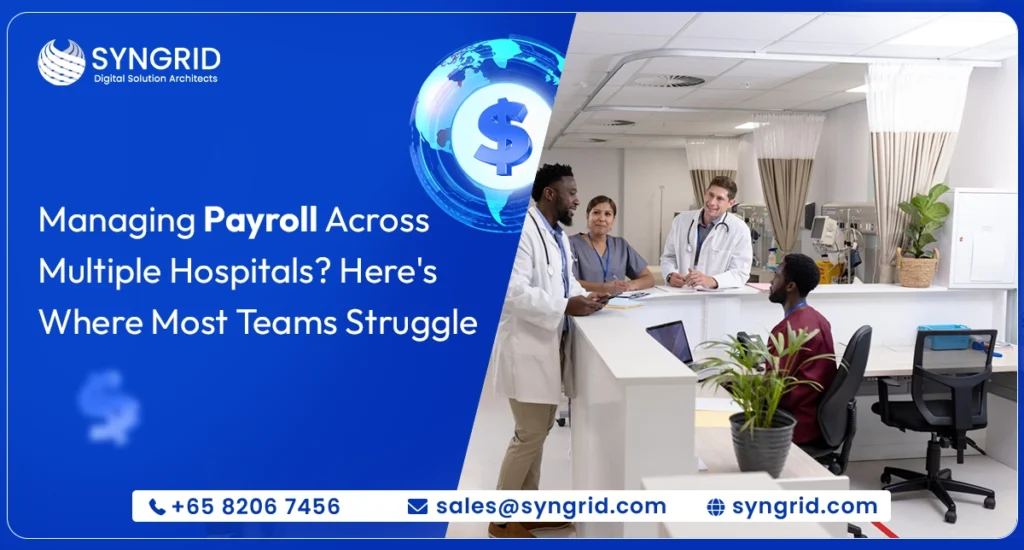
Running payroll for a single hospital is already complex. Managing payroll across multiple hospitals introduces an entirely different level of operational pressure.
Healthcare organizations operate across departments, shifts, countries, contract types, and compliance frameworks. HR and payroll teams often deal with overtime calculations, different employee classifications, leave synchronization, reimbursement tracking, and country-specific regulations—all while ensuring employees receive accurate salaries on time.
As healthcare networks continue expanding, traditional payroll processes become difficult to sustain.
This is where modern Hospital payroll management systems create measurable improvements.
Why Multi-Hospital Payroll Operations Become Difficult to Scale
Hospitals do not operate like conventional businesses.
A healthcare workforce includes permanent staff, temporary employees, contract nurses, consultants, remote teams, and rotating shift workers—all generating different payroll conditions.
According to the World Health Organization, healthcare workforce optimization remains a major operational priority globally
When payroll systems remain disconnected, hospitals often experience the following:
Delayed salary processing
Payroll discrepancies
Attendance mismatch
Manual compliance tracking
Complex leave reconciliation
Limited payroll visibility
Without centralized processes, administrative overhead increases rapidly.
1. Managing Multiple Payroll Structures Across Hospital Locations
One hospital network may operate multiple compensation models.
Examples include:
Monthly payroll
Hourly wages
Shift-based compensation
Country-specific tax structures
Department-specific incentives
Finance teams frequently manage payroll manually through spreadsheets and disconnected systems.
The result:
Increased payroll processing time
Calculation errors
Reporting inconsistencies
Modern global payroll software centralizes payroll administration across all locations through a unified workflow.
2. Compliance Requirements Change Across Regions
Compliance is one of the biggest challenges in healthcare payroll.
Hospitals operating internationally or even across different regulatory environments must comply with changing labor rules, tax regulations, overtime policies, and employee benefit requirements.
Common compliance risks:
Statutory deduction errors
Incorrect tax and contribution calculations.
Audit challenges
Missing payroll history and approvals.
Reporting inconsistencies
Difficulty generating region-based reports.
A centralized payroll environment significantly reduces compliance exposure.
3. Attendance, Leave, and Payroll Often Operate Separately
One of the most common operational bottlenecks is disconnected employee management.
Employees may:
Request leave on one platform
Mark attendance elsewhere
Receive payroll through another system
This separation increases reconciliation work.
Integrated HRMS payroll platforms automatically connect:
Check-In / Check-Out Tracking
Real-time work-hour visibility.
Leave Management
Auto-sync approved leave into payroll.
Holiday Management
Country and region-specific holiday mapping.
Employee Dashboard
Self-service access to payslips and records.
The result is faster payroll processing with fewer manual interventions.
4. Payroll Teams Spend Too Much Time on Manual Calculations
Healthcare payroll contains variables that standard payroll tools rarely handle efficiently.
Examples include:
Shift differentials
Overtime
Reimbursements
Project allocations
Benefit deductions
Contract renewals
Manual calculations increase operational costs.
According to healthcare workforce and HR operational recommendations published through healthcare HR organizations, automation significantly improves payroll consistency and administrative efficiency.
Payroll automation capabilities should include the following:
Employee earnings and deductions
Bulk payslip generation
Dynamic payroll forms
Automated approval workflows
Integrated accounting
5. Limited Visibility Across Hospital Groups
Hospital leadership requires real-time visibility.
Without centralized reporting:
Payroll forecasting becomes difficult.
Budget planning slows down
Department allocation becomes unclear
Advanced payroll systems solve this through:
Payroll Analytics & Reporting
Track salary expenses and workforce trends.
Project Management Integration
Connect labor costs with operations.
Timesheet Compliance
Maintain complete employee work records.
Role-Based Access Control
Secure payroll visibility by user role.
How Modern Global Payroll Software Solves These Challenges
Organizations moving toward centralized payroll management typically look for five priorities:
1. Automated Salary Processing
Reduce repetitive payroll activities.
2. Global Compliance Monitoring
Support country-level payroll requirements.
3. Employee Self-Service
Improve employee experience.
4. Multi-Currency Payroll
Enable accurate international payouts.
5. Enterprise Data Security
Protect sensitive employee information.
Solutions such as Syngroo Global Payroll Software are designed to simplify payroll administration across healthcare environments by combining payroll, HRMS, attendance, leave, project management, and compliance workflows into one connected ecosystem.
Features include:
Applicant Tracking System
Dynamic Employee & Payroll Forms
Employee Earnings & Deductions
Payslip Automation
Leave & Holiday Management
Attendance Tracking
Reimbursement Management
Timesheet Management
Integrated Accounting
Country-Wise Compensation Management
Global Payments & Currencies
Final Thoughts
Healthcare organizations cannot scale payroll operations using disconnected systems forever.
As hospital groups expand, payroll complexity grows exponentially.
Centralized hospital payroll management supported by automation, compliance tracking, and integrated HRMS workflows allows healthcare organizations to reduce errors, improve employee experience, and maintain operational control.
If your hospital network is still dependent on manual payroll processing, now may be the right time to modernize your payroll infrastructure.
Frequently Asked Questions About This Blog
What is hospital payroll management?
Hospital payroll management is the process of calculating, processing, and managing employee compensation across healthcare organizations. It includes salaries, overtime, shift allowances, reimbursements, statutory deductions, attendance tracking, and compliance reporting for healthcare staff.
Why is payroll difficult to manage across multiple hospitals?
Managing payroll across multiple hospitals becomes challenging because healthcare organizations often operate with different employee categories, rotating shifts, multiple departments, varying compensation structures, and regional compliance requirements. Manual payroll processes can lead to delays, errors, and reporting inconsistencies.
How does global payroll software help healthcare organizations?
Global payroll software centralizes payroll operations into one platform and automates salary calculations, leave synchronization, attendance tracking, compliance monitoring, and employee payments across multiple locations and countries. This improves payroll accuracy and reduces administrative workload.
What features should hospitals look for in payroll software?
A faster recruitment process allows businesses to engage top candidates before competitors do. Quick communication, efficient screening, and timely decision-making improve candidate experience and increase the chances of securing high-quality talent.