Syngrid

Digital Marketing

Digital Marketing

How to Set Up a Chatbot for Lead Generation on Your Website

Your website gets visitors every day. But how many of them actually turn into leads? Most visitors leave without taking any action simply because no one was there to engage them at the right moment. A chatbot for lead generation changes that completely. It engages visitors instantly, asks the right questions, captures contact details, and qualifies prospects—all automatically and around the clock. In this blog, we explore what a lead generation chatbot is, why it matters, and how Syngrid Technologies helps businesses set one up for maximum results. What Is a Chatbot for Lead Generation? A chatbot for lead generation is an automated conversational tool embedded on your website that engages visitors, collects their information, and qualifies them as potential leads without any human involvement. It enables businesses to: Engage website visitors instantly, day or night Ask qualifying questions to identify serious prospects Capture contact details such as name, email, and phone number Route qualified leads to the right sales representative automatically Follow up with leads through automated messages Integrate with CRM and marketing platforms for seamless lead management By automating the first stage of the sales process, a chatbot for lead generation ensures no visitor leaves your website without being engaged, turning passive traffic into active opportunities. Why a Lead Generation Chatbot Matters for Your Business Most businesses invest heavily in driving traffic to their website. But without a system to engage and capture those visitors, that investment is largely wasted. Without a chatbot for lead generation, businesses commonly face the following: Visitors leaving without providing any contact information Delayed responses to inquiries that result in lost opportunities Sales teams spending time on unqualified leads Poor visibility into which website visitors are genuine prospects Missed leads outside of business hours Inconsistent follow-up processes that let warm leads go cold A lead generation chatbot solves all of these problems by engaging every visitor immediately, qualifying them automatically, and delivering only the most relevant leads to your sales team. Key Benefits of a Chatbot for Lead Generation 24/7 Lead Capture   A chatbot never sleeps. It engages visitors and captures leads around the clock, ensuring your business never misses an opportunity regardless of time zone or business hours. Instant Visitor Engagement   Speed matters in lead generation. A chatbot responds to every visitor instantly, creating a positive first impression and keeping prospects engaged before they consider leaving your site. Automated Lead Qualification   Not every visitor is a ready-to-buy prospect. A chatbot asks targeted qualifying questions and filters out unqualified visitors, delivering only serious, relevant leads to your sales team. Higher Conversion Rates   Engaged visitors convert at significantly higher rates than passive ones. By proactively starting conversations, a chatbot for lead generation turns more website traffic into measurable business opportunities. Seamless CRM Integration   Captured lead data flows directly into your CRM, ensuring every prospect is recorded accurately, assigned to the right sales rep, and followed up without any manual data entry. Reduced Sales Team Workload   By handling initial engagement and qualification automatically, chatbots free your sales team to focus on closing deals rather than chasing cold or unqualified inquiries. How to Set Up a Chatbot for Lead Generation on Your Website Step 1: Define Your Lead Generation Goals   Before building your chatbot, clearly define what you want it to achieve. Are you capturing email addresses, booking demo calls, qualifying prospects, or routing inquiries to specific departments? Clear goals shape every chatbot decision that follows. Step 2: Map Your Conversation Flow   Design the conversation your chatbot will have with visitors. Start with a friendly greeting, follow with qualifying questions, and end with a clear call to action, such as booking a call, submitting a form, or connecting with a sales rep. Step 3: Write Your Chatbot Script   Write natural, conversational responses for every possible path in your flow. Keep language simple, friendly, and on-brand. Avoid robotic or overly formal phrasing that makes visitors disengage. Step 4: Set Up Lead Capture Fields   Decide which information you need to capture: name, email, phone number, company size, or specific requirements. Only ask for what’s essential at this stage; shorter forms convert better than long ones. Step 5: Connect Your CRM and Tools   Integrate your chatbot with your CRM, email marketing platform, and sales tools. This ensures every captured lead flows automatically into the right system, ready for follow-up without manual effort. Step 6: Test Before You Launch   Run your chatbot through every possible conversation path before going live. Test on desktop and mobile devices; check that all integrations work correctly and that the conversation flow feels natural throughout. Step 7: Monitor; Optimize; and Improve   After launch, review chatbot performance regularly. Track metrics like engagement rate, lead capture rate, and conversion rate, and refine your conversation flow based on real visitor behavior data. Key Features to Look for in a Lead Generation Chatbot Conversational AI: Natural language understanding that makes interactions feel human and keeps visitors engaged longer. Custom conversation flows: Flexible flow builders that let you design chatbot conversations tailored to your specific audience and sales process. Lead qualification logic: Built-in rules that automatically score and filter leads based on their responses, ensuring only relevant prospects reach your team. CRM and tool integration: Seamless connections with your existing CRM, email platform, and marketing tools for automated lead management. Multi-channel deployment: The ability to deploy the same chatbot across your website, landing pages, and messaging platforms from one system. Real-time notifications: Instant alerts to your sales team when a high-quality lead is captured, enabling faster follow-up and higher conversion rates. Analytics and reporting: Detailed reports on chatbot performance, engagement rates, lead volumes, drop-off points, and conversion metrics for continuous optimization. How Syngrid Technologies Supports Businesses with Chatbots for Lead Generation? Syngrid Technologies provides advanced chatbot development and lead generation solutions designed to help businesses capture, qualify, and convert website visitors into real sales opportunities. The platform enables organizations to deploy intelligent, conversational chatbots that engage visitors instantly, collect lead information automatically, and integrate seamlessly with existing CRM and
Digital Marketing

How A/B Testing for Conversions Helps Your Business Grow

Most businesses spend heavily on driving traffic to their website. But getting visitors is only half the battle. The real challenge is turning those visitors into leads, customers, and revenue. That’s exactly where A/B testing for conversions becomes one of the most powerful tools in your marketing arsenal. Instead of guessing what works, A/B testing lets you test two versions of a page, headline, button, or email and lets real user behavior tell you which one performs better. In this blog, you’ll learn what A/B testing is, how it works, and how businesses use it to consistently improve conversion rates without increasing their marketing spend. What Is A/B Testing and How Does It Work? A/B testing, also called split testing, is a method of comparing two versions of a webpage, email, ad, or any digital asset to determine which one drives better results. It takes the guesswork out of marketing decisions and replaces opinion with data. Version A vs Version B: One group of users sees the original version (A) while another group sees the modified version (B). The version that generates more conversions wins. Single variable testing: Effective A/B tests change only one element at a time, a headline, button color, image, or call-to-action, so you know exactly what caused the difference in performance. Statistical significance matters: Results are only reliable once enough users have been exposed to both versions. Running tests too briefly leads to inaccurate conclusions. Applies across multiple assets: A/B testing works on landing pages, email subject lines, paid ads, product pages, CTAs, pop-ups, navigation menus, and more. Continuous improvement cycle: A/B testing isn’t a one-time exercise. The best marketing teams run ongoing tests, each one building on the insights of the last. Data drives every decision: Instead of relying on gut feeling or assumptions, A/B testing gives you concrete evidence about what your specific audience responds to best. A/B testing transforms marketing from a creative guessing game into a disciplined, data-driven process that consistently moves conversion rates in the right direction. Why A/B Testing for Conversions Matters More in 2026 Digital competition has never been more intense. Every business is fighting for the same attention, the same clicks, and the same customers. In 2026, A/B testing for conversions isn’t optional; it’s essential for any business serious about growth. Traffic costs keep rising: Paid advertising costs are increasing across every platform. A/B testing helps you extract more value from existing traffic, reducing your effective cost per conversion. User expectations are higher: Visitors make split-second decisions about whether to stay or leave. Small improvements in messaging, design, or layout can dramatically impact conversion rates. Data beats assumptions every time: What works for one audience may fail completely for another. A/B testing gives you audience-specific insights that generic best practices simply can’t provide. Small changes deliver big results: A single headline change or button color update, backed by testing data, can increase conversions by double digits without any additional spend. Reduces risk in marketing decisions: Before rolling out a major website redesign or campaign change, A/B testing lets you validate the approach with real users before committing fully. Compounds over time: Each successful A/B test raises your baseline conversion rate. Over months and years, the cumulative impact on revenue is significant and measurable. In a marketplace where every conversion counts, A/B testing for conversions gives your business the edge it needs to outperform the competition consistently. What You Can Test to Improve Conversions One of the most powerful aspects of A/B testing is how broadly it can be applied. Almost every element of your digital presence can be tested, and even small optimizations can produce meaningful conversion improvements. Headlines and subheadings: Your headline is the first thing visitors read. Testing different angles, benefit-focused vs. problem-focused, can reveal which framing resonates most with your audience. Call-to-action buttons: Button text, color, size, and placement all influence click-through rates. Testing “Get Started” against “Book a Free Demo” can produce surprisingly different results. Landing page layouts: The arrangement of your content, images, testimonials, and forms directly impacts how visitors engage and whether they convert. Email subject lines: A/B testing email subject lines is one of the fastest ways to improve open rates, which directly impacts downstream conversions from email campaigns. Form length and fields: Shorter forms often convert better but capture less data. Testing different form lengths helps you find the right balance for your specific audience. Images and visual content: Hero images, product photos, and illustration styles all affect how users feel about your brand. Testing visuals can significantly impact trust and conversion intent. Pricing page presentation: How you display pricing, monthly vs. annual, feature comparisons, and highlighted plans can be tested to find the layout that drives the most sign-ups or purchases. Every element you test and optimize brings your conversion rate closer to its true potential, and every improvement directly impacts your bottom line. How to Run an Effective A/B Test Step by Step Running an A/B test correctly is just as important as deciding what to test. A poorly structured test produces unreliable data and leads to wrong decisions. Here’s how to do it right. Start with a clear hypothesis: Define exactly what you’re testing and why. For example, “Changing the CTA from ‘Submit’ to ‘Get My Free Demo’ will increase form submissions because it communicates clear value.” Test one variable at a time: Changing multiple elements simultaneously makes it impossible to know which change caused the result. Keep each test focused on a single variable. Split your audience evenly: Divide your traffic randomly and equally between Version A and Version B to ensure neither group is inherently biased toward a particular result. Define your success metric upfront: Decide before the test what you’re measuring—form submissions, click-through rate, purchases, or time on page—and stick to that metric throughout. Run the test long enough: Don’t end a test after two days because one version looks like it’s winning. Run tests until you reach statistical significance, typically a minimum

Digital Marketing

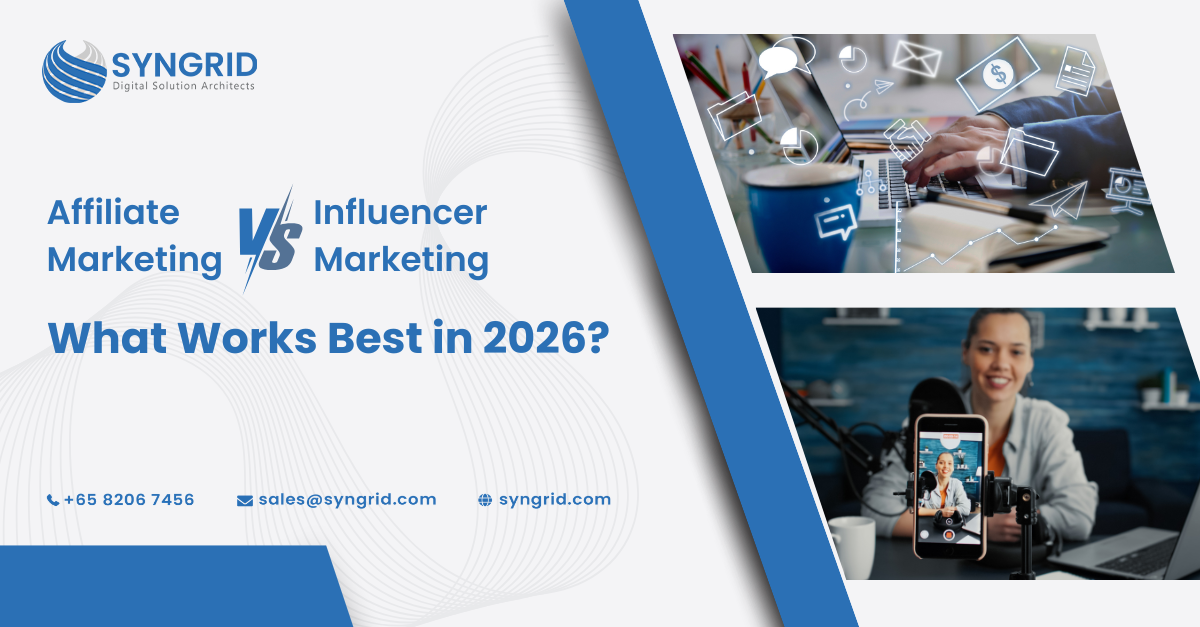
Affiliate Marketing vs Influencer Marketing: What Works Best in 2026?

Introduction Digital marketing has never been more competitive. Businesses are constantly looking for strategies that deliver real results without wasting budget. Two approaches dominate the conversation right now: affiliate marketing and influencer marketing. Both can drive traffic, generate leads, and boost sales. But they work very differently. And in 2026, the gap between using the right one and the wrong one is bigger than ever. This blog breaks down affiliate marketing vs. influencer marketing in plain terms: what each one is, how they work, where they shine, and which strategy is the right fit for your business goals. What Is Affiliate Marketing and How Does It Work? Affiliate marketing is a performance-based model. You pay only when a result happens: a sale, a sign-up, or a lead. That makes it one of the most cost-efficient digital marketing strategies available today. How it works: Businesses partner with affiliates, bloggers, content creators, or website owners who promote their products using unique tracking links. Pay-per-result model: You only pay a commission when the affiliate delivers a measurable outcome, such as a completed purchase or a verified sign-up. Low financial risk: Since payment is tied to results, there’s minimal upfront cost and virtually no wasted spend. Scalable by nature: The more affiliates you recruit, the wider your reach without proportionally increasing your marketing budget. Long-term content value: Affiliate content, blog reviews, comparison blogs, and YouTube videos continue driving traffic and conversions long after they’re published. Trackable and measurable: Every click, conversion, and commission is tracked in real time, giving you full visibility into ROI. Works across industries: Affiliate marketing performs well in e-commerce, SaaS, finance, health, travel, and almost every major industry vertical. Affiliate marketing rewards patience and system-building. It’s not an overnight strategy, but when it’s set up correctly, it becomes a reliable, self-sustaining revenue channel. What Is Affiliate Marketing and How Does It Work? Affiliate marketing is a performance-based model. You pay only when a result happens: a sale, a sign-up, or a lead. That makes it one of the most cost-efficient digital marketing strategies available today. How it works: Businesses partner with affiliates, bloggers, content creators, or website owners who promote their products using unique tracking links. Pay-per-result model: You only pay a commission when the affiliate delivers a measurable outcome, such as a completed purchase or a verified sign-up. Low financial risk: Since payment is tied to results, there’s minimal upfront cost and virtually no wasted spend. Scalable by nature: The more affiliates you recruit, the wider your reach without proportionally increasing your marketing budget. Long-term content value: Affiliate content, blog reviews, comparison blogs, and YouTube videos continue driving traffic and conversions long after they’re published. Trackable and measurable: Every click, conversion, and commission is tracked in real time, giving you full visibility into ROI. Works across industries: Affiliate marketing performs well in e-commerce, SaaS, finance, health, travel, and almost every major industry vertical. Affiliate marketing rewards patience and system-building. It’s not an overnight strategy, but when it’s set up correctly, it becomes a reliable, self-sustaining revenue channel. H2: What Is Influencer Marketing and How Does It Work? Influencer marketing takes a different approach. Instead of paying for results, you pay for reach, trust, and audience attention. It’s about borrowing credibility from someone your target audience already follows and believes in. How it works: Brands partner with social media creators on Instagram, YouTube, TikTok, or LinkedIn to promote their products or services to an engaged audience. Awareness-first strategy: Influencer marketing excels at building brand visibility and reaching new audiences quickly, especially for new product launches. Trust through association: When a creator their audience trusts recommends your brand, that endorsement carries far more weight than a traditional ad. Multiple formats: Influencer content includes sponsored blogs, unboxing videos, product reviews, stories, reels, and live streams, offering creative flexibility. Audience targeting: By choosing the right influencer, you reach a highly specific demographic by age, interest, location, or lifestyle. Faster results: Unlike affiliate marketing, a well-executed influencer campaign can generate immediate spikes in traffic, mentions, and brand searches. Macro-to-micro options: You can work with celebrity influencers for mass reach or micro-influencers for higher engagement rates and niche audiences. Influencer marketing is powerful for visibility and brand building. But it requires careful selection, clear briefs, and realistic expectations around direct conversions. Affiliate Marketing vs. Influencer Marketing: Key Differences Understanding the core differences between these two strategies helps you decide which one fits your business model, budget, and goals. Here’s a direct comparison. Payment structure: Affiliate marketing is performance-based; you pay for results. Influencer marketing is typically paid upfront; you pay for exposure, regardless of outcome. Primary goal: Affiliate marketing is built for conversions and direct sales. Influencer marketing is built for awareness, reach, and brand perception. Risk level: Affiliate marketing carries lower financial risk since spend is tied to results. Influencer marketing involves upfront investment with less guaranteed ROI. Content lifespan: Affiliate content lives online for months or years, compounding value over time. Influencer content, especially stories and reels, often has a short shelf life. Relationship type: Affiliates are long-term partners motivated by ongoing commissions. Influencers are typically engaged for specific campaigns or short-term contracts. Measurement: Affiliate marketing ROI is precise and trackable. Influencer marketing ROI often involves softer metrics like reach, impressions, and brand sentiment. Best for: Affiliate marketing suits businesses focused on sales volume and customer acquisition. Influencer marketing suits brands launching new products or entering new markets. Neither strategy is universally better; they serve different purposes and work best when you understand what you’re actually trying to achieve. When to Choose Affiliate Marketing for Your Business Influencer marketing earns its place in specific scenarios too. There are moments when paying for reach and trust is exactly the right move, and ignoring that opportunity is a missed advantage. You’re launching a new product: Influencer marketing generates immediate buzz and social proof at exactly the moment you need maximum visibility. You’re entering a new market: Partnering with local or niche influencers gives you

Digital Marketing

How to Optimize Product Feeds for ChatGPT Shopping & GEO Visibility

The way people find and buy products online has changed permanently. ChatGPT is no longer a novelty assistant; it is an active product discovery engine processing tens of millions of shopping queries every single day. And unlike Google, it does not crawl your website for clues. It reads your product feed directly, treating it as the authoritative source of truth about everything you sell. If your product feed is not optimized for this reality, your products are invisible to an enormous and rapidly growing audience of high-intent buyers. No amount of paid advertising can compensate for a poorly structured feed in an AI-first discovery environment. This guide gives you the complete strategy to fix that. Why This Moment Changes Everything for E-Commerce For over a decade, product visibility meant Google Shopping, social media ads, and SEO. Those channels still matter. But an entirely new, massively scaled layer of product discovery has emerged, and the rules that governed the old channels simply do not apply here. ChatGPT Shopping Processes 50 Million Queries Daily | Relevance: 96% OpenAI launched Shopping Research in November 2025, powered by a reinforcement-trained variant of GPT-5 mini that fundamentally changes how 700 million ChatGPT users discover products, processing 50 million shopping queries daily. Your product feed is now the primary dataset ChatGPT indexes and reasons over, making feed optimization a direct visibility strategy with measurable business impact. ChatGPT Shopping operates through conversational reasoning, not keyword matching. When a user asks, “What is the best waterproof hiking boot under $150?” ChatGPT does not scan websites in real time. It draws on structured product data it has already indexed, reasons over attributes like waterproofing rating, price, and brand trust signals, and generates a recommendation. If your product data is not in that structured feed or if it is incomplete, you simply do not appear. The Feed Quality Crisis—And Why It Costs You Sales Most e-commerce businesses built their product feeds for Google Shopping or Meta Catalog. Those environments tolerated imperfect data, missing attributes, generic titles, and occasional stale pricing. AI engines do not. A Sloppy Feed Means Zero AI Visibility | Relevance: 95% of AI agents like ChatGPT are reshaping search and discovery; your product feed is now the frontline for visibility in these new channels. A sloppy feed means zero visibility, and no amount of ad budget can fix that. Unlike Google, ChatGPT treats your feed not just as a signal but as a primary authority. Price, stock, and product attributes directly shape whether and how your products are recommended to buyers. This is a critical distinction. When ChatGPT reads your feed, it accepts what it finds as fact. Outdated prices create mismatch errors. Vague product titles miss the conversational queries that buyers actually use. Missing attributes like material, size, or use case mean your product fails to match specific search intent regardless of how relevant it actually is. 7 Steps to Optimize Your Product Feed for AI Visibility Step 1—Rewrite Titles in Natural, Conversational Language Replace internal SKU-style titles with how real buyers search. “Men’s Waterproof Hiking Boot Size 10, Black, Lightweight” outperforms “HKB-BLK-10” in every AI context. Match the language of buyer intent, and your products will match the queries that matter. Step 2—Enrich Descriptions With Use Cases and Benefits AI models reason over descriptions to match products to intent. Add who the product is for, what problem it solves, and when to use it. Context is the currency of AI-driven recommendation; the more your description answers real buyer questions, the more often ChatGPT surfaces your product. Step 3—Complete Every Attribute Field Without Exception. Color, size, material, GTIN, MPN, gender, age group, and condition—every empty field is a missed query match. Audit your entire catalog and treat missing attributes as direct revenue gaps that need to be closed immediately. Step 4—Synchronize Price and Stock Data in Real Time ChatGPT treats your feed as live truth. Stale pricing excludes your product from budget-filtered queries. Configure automated feed refresh at minimum every 24 hours, ideally every few hours for high-volume catalogs, to keep your data authoritative at all times. Step 5—Add GEO-Specific Data for Regional Visibility GEO visibility requires regional pricing, local currency, availability by location, and localized descriptions where relevant. Without geo-aware attributes, your feed is invisible to the location-filtered queries that dominate mobile purchase intent across global markets. Step 6—Use High-Resolution Images With Descriptive Alt Data: Clean, high-resolution product images increase click-through rates when ChatGPT surfaces your product. Pair every image with descriptive alt text that reinforces product attributes; this adds an additional indexable data layer that strengthens your overall feed quality signals. Step 7: Implement Schema on Product Pages Structured markup on your product pages reinforces and validates your feed data. When AI systems can cross-reference feed attributes against live page markup, it builds confidence in your data accuracy and directly increases how frequently your products are recommended. How Syngrid Technologies Optimizes Your Feed for AI Discovery At Syngrid Technologies, we help e-commerce businesses build product feeds that perform in the ChatGPT Shopping and GEO era. We combine technical feed engineering, content enrichment, and real-time data strategy to ensure your products reach high-intent buyers across every AI-powered discovery channel. We audit your existing feed structure, close attribute gaps across your full catalog, rewrite product content for conversational AI alignment, configure geo-targeting data layers, and implement automated refresh pipelines that keep your data authoritative and accurate. Every decision we make is driven by a single goal: getting your products recommended to the right buyer at the right moment. Our product feed optimization services include feed audit and gap analysis, full content enrichment with conversational title rewrites and benefit-led descriptions, GEO data layer configuration for regional pricing and availability, and real-time sync setup with automated pipelines to keep price and stock data live always. Conclusion—Your Feed Is Your Most Important AI Asset ChatGPT Shopping and GEO visibility are not future trends; they are active, high-volume channels driving product discovery for hundreds of millions of buyers right

Digital Marketing

How Landing Page Optimization Helps to Increase Quality of Website Page

Your website may attract thousands of visitors every month, but if those visitors are leaving without taking action, your digital presence is underperforming. The most common culprit is a poorly optimized landing page. Landing page optimization is the disciplined practice of refining every element of a page to maximize its quality, relevance, and ability to convert visitors into leads or customers. In 2026, landing page optimization is not just a conversion tactic; it is a foundational pillar of website quality. A well-optimized landing page improves user experience, strengthens SEO performance, builds audience trust, and delivers measurable business results. Here is how it works and why every business needs to take it seriously. What Is Landing Page Optimization? Landing page optimization is the process of improving the design, content, speed, structure, and user experience of a specific web page to increase the percentage of visitors who complete a desired action, whether that is filling out a form, making a purchase, booking a consultation, or downloading a resource. Unlike general website improvements, landing page optimization is laser-focused on a single goal: guiding the right visitor toward the right action at the right moment. Every headline, image, button, and line of copy is evaluated and refined with that goal in mind. The result is a page that not only performs better but also represents a higher standard of overall website quality. Why Landing Page Quality Directly Affects Business Performance? A landing page is often the first and sometimes only interaction a potential customer has with your brand. If that page fails to communicate value clearly, load quickly, or guide the visitor toward a next step, the opportunity is lost, often permanently. The business cost of a poorly performing landing page is significant and largely invisible, hiding in the gap between your traffic numbers and your actual revenue. Landing page quality also directly influences your Google Ads Quality Score, organic search rankings, and overall domain authority. Search engines assess page relevance, user experience signals, and engagement metrics to determine how much visibility your pages deserve. A high-quality, optimized landing page earns better placements, making optimization a dual investment in both paid and organic performance. The Numbers Behind Landing Page Optimization The impact of landing page optimization is not theoretical; it is proven by consistent data across industries and business models. Business sites with 10–15 landing pages generate 55% more customers than those with fewer than 10. Shorter landing pages with clear CTAs outperform longer ones by 13.5%, and the average landing page conversion rate across all industries sits at 6.6%, confirming that intentional optimization produces measurable, compounding business results. These figures highlight a critical insight: more optimized, purpose-built landing pages translate directly into more business opportunities. Each page that is deliberately designed and continuously refined becomes an active asset generating leads and conversions around the clock without additional advertising spend. Page Speed—The Silent Conversion Killer One of the most impactful and frequently overlooked aspects of landing page optimization is page load speed. In an era of shrinking attention spans and high user expectations, a slow-loading page is a conversion killer regardless of how compelling the content or design may be. A one-second delay in page load time reduces conversions by 7%, while pages loading in one second convert three times higher than five-second pages. Nearly half of all users expect pages to load in two seconds or less, making speed optimization a direct and measurable revenue driver for any business with an online presence. Speed optimization is therefore not a technical luxury; it is a business necessity. Compressing images, minimizing code, leveraging browser caching, and using fast hosting infrastructure are all components of a comprehensive landing page optimization strategy that directly impacts both user experience and bottom-line results. Key Elements of a High-Quality Optimized Landing Page 1. A Clear and Compelling Headline   The headline is the first thing every visitor reads. It must immediately communicate what the page offers and why it matters to the reader. A strong headline captures attention, establishes relevance, and gives visitors a reason to keep reading, all within the first three seconds of arrival. 2. Focused and Persuasive Copy   Landing page copy must speak directly to the visitor’s needs, pain points, and goals. It should be concise, benefit-driven, and structured to guide the reader naturally toward the call to action. Every sentence must earn its place on the page; anything that does not serve the conversion goal should be removed. 3. A Single, Strong Call to Action   Every high-performing landing page has one clear call to action. Multiple competing CTAs create confusion and dilute focus. Whether it is “Get a Free Quote,” “Start Your Free Trial,” or “Book a Consultation,” the CTA must be visually prominent, action-oriented, and repeated strategically throughout the page. 4. Trust Signals and Social Proof   Testimonials, client logos, case study results, star ratings, and industry certifications all serve as trust signals that reduce visitor hesitation. Placing these elements strategically near the CTA significantly increases the likelihood of conversion by addressing doubts at the exact moment of decision. 5. Mobile Responsiveness   With the majority of web traffic now coming from mobile devices, a landing page that does not perform flawlessly on smartphones is a landing page that is actively losing business. Mobile optimization is a non-negotiable component of page quality in 2026, affecting both user experience and search engine rankings simultaneously. 6. A/B Testing for Continuous Improvement   Landing page optimization is not a one-time task; it is an ongoing process. A/B testing different headlines, CTA placements, color schemes, and page layouts generates real-world data on what resonates with your specific audience. This iterative approach ensures that your landing pages continuously improve over time, compounding their impact on website quality and conversion performance. How Syngrid Technologies Optimizes Landing Pages That Perform At Syngrid Technologies, we approach landing page optimization as a strategic discipline, not a design exercise. Our team combines conversion-focused UI/UX design, persuasive copywriting, technical performance engineering, and data-driven A/B testing to build landing pages

Digital Marketing

Is Human Content Writing Service Still Valuable in the Age of AI?

The rise of artificial intelligence has fundamentally changed how businesses approach content creation. Tools that generate full blog posts, social media captions, and marketing copy in seconds are now widely accessible. In that context, it is natural to question whether investing in a professional human content writing service still makes sense in 2025. The answer, backed by performance data and real-world results, is a clear yes. Human content writing services are not just surviving the AI era; they are becoming more essential because of it. Here is why. What AI Content Tools Do Well To make an honest case for human writing, we must first acknowledge what AI does right. AI writing tools are fast, scalable, and cost-efficient. They can produce structured drafts, summarize information, and generate content variations at a volume no human team could match alone. For repetitive, templated tasks like product descriptions, basic FAQs, or standardized reports, AI delivers real efficiency gains. It becomes a problem only when businesses treat AI as a complete substitute for human writing rather than a supporting tool within a broader content strategy. Where AI Falls Short? AI generates content by predicting statistically likely word sequences based on patterns in existing data. It does not reason, research independently, or truly understand context. The result is content that can sound plausible on the surface but consistently lacks the depth, originality, and nuanced thinking that genuinely engages readers and builds brand authority. AI cannot interview subject matter experts, uncover a brand’s unique positioning, or craft a narrative that moves an audience emotionally. It cannot respond to cultural moments with the timing and sensitivity a skilled human writer brings. And it cannot be held accountable for factual accuracy, a significant concern in any industry where credibility is a core business asset. What the Data Says—Human Writing Still Leads in Search The performance data in 2025 tells a clear story about where human content writing services stand relative to AI-generated alternatives. A study analyzing 65,000 URLs found that 86% of articles ranking in Google Search were written by humans, with AI-generated content ranking notably lower. Human-written articles also dominated ChatGPT and Perplexity citations at 82%, confirming that search engines continue to reward authentic, expertly crafted content above AI output. This data has a direct business implication. A content strategy built primarily on AI-generated text is likely leaving substantial organic traffic and search visibility behind. Google’s algorithms are increasingly capable of distinguishing content that genuinely serves users from content assembled through pattern prediction, and human writers consistently produce content that meets that standard. Trust and Brand Resonance—Where Humans Win Content has a function that goes far beyond search rankings. Its deeper purpose is to build a relationship between your brand and your audience to earn attention, establish credibility, and inspire action. This is precisely the area where human content writing services deliver value that AI tools cannot replicate. A marketing study found that human-written content achieved 79% ratings in trust and brand resonance compared to just 12% for AI-generated content. Hybrid approaches combining AI drafting with human editing consistently outperformed both, delivering a 26% performance boost, confirming that human expertise remains the critical ingredient in high-performing content. Readers can sense when content has been written with genuine understanding versus assembled from patterns. Human writers bring empathy, lived experience, and authentic voice to every piece—qualities that build the audience’s trust, which translates into lasting brand loyalty and real business growth. What Professional Human Content Writers Deliver? 1. Original Research and Genuine Insights   Human writers conduct real research, draw on expert interviews, and develop perspectives that have never existed before. In a landscape flooded with recycled AI output, genuinely original insights attract both readers and search engines and cannot be manufactured by any algorithm. 2. Consistent and Authentic Brand Voice   Every brand has a distinct personality and a specific way of speaking to its audience. Skilled human writers invest time learning and consistently maintaining that voice across all content, creating a cohesive experience that strengthens brand recognition and deepens audience connection over time. 3. Strategic Thinking Behind Every Piece   Professional content writers understand business goals, audience personas, and buyer journeys. They do not simply produce words; they plan content with intent, crafting pieces that serve a specific purpose, whether that is generating organic traffic, nurturing leads, or supporting conversions at a particular stage of the funnel. 4. Emotional Storytelling That Moves People   The most effective content creates an emotional response: curiosity, inspiration, or motivation to act. Human writers apply genuine emotional intelligence to their work, connecting with audiences on a level that data-driven AI text cannot reach. Stories told by humans, for humans, will always carry more weight. 5. Accuracy, Accountability, and Editorial Judgment   Human writers verify facts, apply critical editorial judgment, and take ownership of quality. In industries where a single inaccuracy can damage credibility, this accountability is not a minor benefit; it is a fundamental requirement that AI tools cannot fulfill on their own. How Syngrid Technologies Supports Your Content Strategy? At Syngrid Technologies, we understand that content is the foundation of every successful digital presence. Our human content writing service brings together experienced writers, SEO strategists, and brand specialists who work collaboratively to produce content that ranks, resonates, and delivers real results. We do not treat content as a commodity. Every piece we produce is grounded in thorough research, aligned to your brand voice, and structured for both reader engagement and search engine performance. Whether you need long-form blog posts, website copy, case studies, or thought leadership articles, our team crafts content that genuinely represents the value your business offers and gives your audience a compelling reason to choose you. Conclusion Human Content Writing Is More Valuable Than Ever AI has made it easier to produce average content. That is precisely what makes skilled human content writing more valuable, not less. When every competitor can flood the internet with AI-generated text at zero cost, the businesses that invest in purposeful, expertly crafted human writing are

Digital Marketing

Top Social Media Mistakes That Kill Your Social Media Engagement

“Social media success is not about posting more  it’s about posting smarter, engaging better, and connecting deeper.” Social media has become one of the most powerful tools for brand building, customer engagement, and business growth. However, despite consistent posting and promotional efforts, many businesses struggle to achieve meaningful engagement. Likes, shares, comments, saves, and clicks are not random. They are driven by strategy, relevance, and audience understanding. When engagement drops, it is often due to avoidable mistakes that silently damage visibility and trust. In this blog, we explore the top social media mistakes that kill your social media engagement and how businesses can fix them to build stronger digital connections in 2026. Why Social Media Engagement Matters More Than Ever? Social media platforms prioritize content that sparks interaction. Higher engagement improves reach, brand credibility, and conversion potential. Strong engagement helps businesses: Build authentic audience relationships Increase brand visibility Boost website traffic Improve lead generation Strengthen customer loyalty Ignoring engagement metrics leads to weak digital performance and declining online relevance. Mistake 1: Posting Without a Clear Strategy Random posting is one of the biggest reasons engagement suffers. Without a defined content strategy, posts lack direction and purpose. A strong social media strategy includes: Clear audience targeting Content goals (brand awareness, leads, conversions) Posting schedules Content format planning When posts are aligned with audience intent and business objectives, engagement naturally improves. Mistake 2: Ignoring Your Target Audience Many brands focus more on what they want to say instead of what their audience wants to see. If your content does not match audience interests, pain points, or expectations, engagement will decline. Understanding your audience requires: Behavioral insights Engagement pattern analysis Feedback tracking Regular content testing Successful social media marketing is always audience-driven. Mistake 3: Over-Promotion and Sales-Heavy Content Excessive promotional posts push users away. Audiences come to social media for value, inspiration, entertainment, and education — not constant advertising. A healthy content mix includes: Educational posts Industry insights Tips and tutorials Stories and behind-the-scenes User-generated content Promotional content should complement, not dominate, your strategy. Mistake 4: Inconsistent Posting Schedule Posting irregularly confuses algorithms and audiences alike. Long gaps reduce brand recall, while sudden posting bursts overwhelm followers. Consistency builds momentum. A reliable posting schedule helps: Maintain visibility Build brand recall Improve algorithm ranking Increase long-term engagement Consistency always beats intensity. Mistake 5: Poor Visual Quality Social media is highly visual. Low-quality graphics, cluttered designs, and poor video resolution instantly reduce content appeal. High-performing content includes: Clear visuals Readable typography Balanced layouts Brand-consistent colors Strong visuals capture attention and encourage interaction. Mistake 6: Ignoring Comments, Messages, and Mentions Engagement is a two-way conversation. When brands fail to respond, audiences feel ignored. Quick replies to comments and messages: Build brand trust Improve relationships Encourage repeated engagement Strengthen customer loyalty Social media engagement grows through genuine interaction. Mistake 7: Not Using Analytics to Improve Content Many businesses post content but never analyze performance. Without analytics, there is no improvement. Tracking metrics such as: Reach Click-through rate Engagement rate Follower growth helps identify what works and what doesn’t. Data-driven strategies consistently outperform guesswork. Mistake 8: Using the Same Content Across All Platforms Each platform has its own audience behavior and content style. What works on LinkedIn may fail on Instagram. What works on X (Twitter) may not perform on Facebook. Optimizing content per platform boosts: Relevance Engagement Shareability Visibility Customization leads to stronger results. Mistake 9: Weak Call-to-Action (CTA) Even the best content needs direction. Without a clear CTA, users may consume your content but never interact. Strong CTAs guide users to: Comment Share Save Visit website Start conversations Every post should have a purpose. Mistake 10: Not Adapting to New Formats and Trends Social media trends evolve quickly. Brands that ignore new formats risk becoming invisible. High-performing formats in 2026 include: Short-form video Carousels Interactive polls Story-based content Live sessions Early adopters consistently gain algorithm advantage. How to Fix These Social Media Engagement Mistakes? Businesses can significantly improve engagement by: Building a structured content strategy Creating value-first content Designing visually appealing creatives Posting consistently Tracking performance data Engaging with followers When done right, social media becomes a powerful growth engine. How Syngrid Technologies Helps Improve Social Media Engagement? Building high-performing social media strategies requires expertise, creativity, and performance tracking. Syngrid Technologies helps businesses craft data-driven content strategies, create high-impact creatives, and optimize engagement through performance marketing and analytics-driven insights. By combining content planning, design, automation, and audience behavior analysis, Syngrid Technologies enables brands to increase reach, engagement, and digital authority across platforms. Conclusion The top social media mistakes that kill your social media engagement are often small, silent, and avoidable. From poor content planning to ignoring analytics and audience interaction, each mistake slowly erodes brand visibility and trust. By eliminating these mistakes and adopting a strategic, data-driven approach, businesses can dramatically improve engagement, build stronger communities, and drive sustainable digital growth. Social media success is not about posting more — it’s about posting smarter, connecting deeper, and engaging better.

Digital Marketing

How to Audit Your AEO/GEO Online Presence in 2026

“ “In the age of AI-driven search, visibility is no longer about ranking first—it’s about being understood, trusted, and selected. Search is evolving rapidly. Traditional SEO is no longer enough to maintain digital visibility. With the rise of AI search engines, voice assistants, and generative answer platforms, businesses must now optimize for AEO (Answer Engine Optimization) and GEO (Generative Engine Optimization). In 2026, your brand’s online presence depends not only on keyword rankings but also on how AI systems interpret, validate, and present your content. If your business is not visible in AI-generated responses, conversational search, or zero-click answers, you are already falling behind. This guide explains how to audit your AEO/GEO online presence in 2026, step by step, and how to strengthen your authority, accuracy, and discoverability across AI-powered platforms. Understanding AEO and GEO in 2026 AEO (Answer Engine Optimization) focuses on optimizing content so it can be easily understood and selected by AI-powered answer engines such as voice assistants, smart search tools, and conversational bots. GEO (Generative Engine Optimization) ensures that your content is recognized, trusted, and cited by generative AI systems that summarize, recommend, and generate answers. Together, AEO and GEO define how your brand appears in modern search ecosystems where AI chooses the answer instead of users clicking links. Why Auditing Your AEO/GEO Presence Matters? In 2026, users increasingly rely on: AI chat interfaces Voice search Smart assistants Zero-click search results This means fewer people are scrolling through traditional search listings. If your content is not structured, authoritative, and contextually optimized, AI systems may ignore it completely. Regular AEO/GEO audits help ensure: Strong AI visibility Higher brand trust Improved lead quality Better conversion potential Auditing is no longer optional. It is a competitive necessity. Step 1: Analyze How AI Systems Currently See Your Brand Start by testing your visibility in AI-driven platforms. Search your brand, services, and core topics using: AI chat engines Voice search assistants Generative search tools Check whether your business is: Mentioned Recommended Cited as a source Used in answer summaries If your brand rarely appears, it indicates a weak AEO/GEO footprint. Also analyze whether AI responses accurately describe your offerings. Misinformation or vague mentions suggest content gaps and authority issues. Step 2: Review Your Content Structure for AI Readability AI systems prioritize content that is easy to scan, interpret, and extract answers from. Audit your website content for: Clear headings and subheadings Short, structured paragraphs Simple language Direct answers to questions Logical flow of information Content buried inside long blocks of text, poor formatting, or excessive jargon becomes difficult for AI to interpret. Well-structured content increases the probability of being selected as a trusted answer source. Step 3: Evaluate Entity Recognition and Brand Authority AI systems rely heavily on entity recognition, which means they identify brands, services, locations, and expertise as trusted digital entities. Check if your business: Has consistent branding across platforms Appears in knowledge panels Is referenced across authoritative websites Has structured business data Your brand should be clearly connected with your services, industry, and expertise. Weak digital entity signals lead to lower AI trust and visibility. Step 4: Audit Your Structured Data and Schema Markup Schema markup helps AI systems understand your content contextually. Audit your website for: Organization schema Product and service schema FAQ schema Article and blog schema Review and rating schema Correct schema implementation improves: AI comprehension Answer extraction Knowledge graph inclusion Rich result eligibility Without structured data, even high-quality content may remain invisible to AI platforms. Step 5: Check Your Presence in Knowledge Graphs and Data Sources Generative AI systems often pull information from: Knowledge graphs High-authority websites Trusted business directories Public databases Audit your listings on: Google Business Profile LinkedIn company pages Industry directories Review platforms Ensure consistency in: Business name Service descriptions Location details Contact information Inconsistent data weakens AI trust and affects your brand credibility. Step 6: Analyze Your Topical Authority Depth AI prioritizes websites that demonstrate deep topical coverage rather than scattered content. Audit your blog and resource sections for: Topic clusters Supporting content Internal linking Content freshness If your website has only surface-level articles, AI may not recognize your expertise. Deep, structured knowledge signals increase your authority across AI search ecosystems. Step 6: Analyze Your Topical Authority Depth AI prioritizes websites that demonstrate deep topical coverage rather than scattered content. Audit your blog and resource sections for: Topic clusters Supporting content Internal linking Content freshness If your website has only surface-level articles, AI may not recognize your expertise. Deep, structured knowledge signals increase your authority across AI search ecosystems. Step 7: Evaluate Brand Mentions and Citations AI systems learn from online references. Audit your brand mentions across: Blogs News articles Partner websites Industry publications High-quality backlinks and brand citations strengthen: Domain authority Entity trust Generative visibility The more credible sources mention your brand, the more likely AI will trust and recommend you. Step 8: Assess User Experience and Technical Performance AEO/GEO audits also include technical health. Check for: Page load speed Mobile responsiveness Core web vitals Accessibility compliance Secure HTTPS infrastructure AI systems favor technically optimized websites because they deliver better user experiences. Slow or broken sites lose trust signals. Step 9: Track AI Visibility and Engagement Metrics Traditional analytics alone are no longer enough. Track: AI-generated traffic Zero-click impressions Brand mentions in AI outputs Voice search visibility Conversational engagement metrics These indicators reveal whether your AEO/GEO strategies are working effectively. Building a Strong AEO/GEO Strategy for 2026 After auditing, your strategy should focus on: Creating intent-driven content Strengthening structured data Building topical authority Enhancing brand entity signals Improving technical performance AEO and GEO success comes from system-level optimization, not isolated tactics. This is where businesses increasingly rely on expert digital partners. At Syngrid Technologies, organizations receive structured AEO/GEO audit frameworks and AI-driven content strategies designed to improve generative visibility, search authority, and AI trust signals across platforms. The Future of Search Belongs to Context and Trust As AI becomes the primary gateway to information, businesses must shift from

Digital Marketing

What Is Email Marketing and How Businesses Can Do It Right?

What Is Email Marketing? Email marketing is a form of direct digital marketing that involves sending targeted emails to a list of subscribers. These emails may include: Promotional offers Newsletters Product updates Event invitations Educational content Personalized recommendations The goal is to nurture leads, engage customers, and encourage actions such as purchases, sign-ups, or website visits. Unlike social media platforms where algorithms control visibility, email marketing gives businesses direct access to their audience’s inbox, making it a highly reliable marketing channel. Why Email Marketing Matters for Businesses? Email marketing continues to deliver strong results because it combines personalization, automation, and measurable performance. 1. Direct Communication with Customers Email allows businesses to speak directly to customers without relying on third-party platforms. Your message reaches people in a space they check daily. 2. Cost-Effective Marketing Channel Compared to paid advertising, email marketing has a low cost while offering high returns. Businesses can reach thousands of subscribers with minimal expense. 3. High ROI (Return on Investment) Email marketing is known for generating one of the highest ROIs among digital marketing methods because it targets people who already have interest in your brand. 4. Personalized Customer Experience With segmentation and personalization, businesses can send tailored messages based on customer preferences, purchase history, or behavior. 5. Builds Long-Term Relationships Consistent and valuable email communication helps create trust, loyalty, and repeat customers over time. How to Build an Email List the Right Way? A successful email marketing campaign starts with a high-quality subscriber list. The key is to grow your list ethically and organically. Use Sign-Up Forms Place email opt-in forms on: Website homepage Blog pages Landing pages Checkout pages Make it easy for visitors to subscribe. Offer Incentives (Lead Magnets) People are more likely to share their email if they receive value in return, such as Free eBooks Discount coupons Webinar access Exclusive content Collect Subscribers Through Social Media Promote your newsletter on platforms like Instagram, LinkedIn, or Facebook and direct users to a sign-up page. Never Buy Email Lists Purchased lists often lead to low engagement, spam complaints, and damage to your sender reputation. Always focus on genuine subscribers. Best Practices for Successful Email Marketing To achieve strong engagement and conversions, businesses must follow proven strategies. Segment Your Audience Email segmentation means dividing subscribers into smaller groups based on: Interests Location Purchase history Engagement level This improves relevance and increases open rates. Craft Compelling Subject Lines Your subject line is the first thing people see. Keep it: Short Clear Curiosity-driven Relevant Example: “Exclusive Offer Inside—Don’t Miss Out!” Provide Valuable Content Avoid sending only promotional emails. Mix in educational and helpful content, such as: Tips and guides Industry insights Customer success stories This builds trust and authority. Optimize Send Times Timing matters. Test different days and hours to find when your audience is most active. Use Email Automation Automation helps businesses send emails based on customer actions, such as Welcome emails Abandoned cart reminders Birthday offers Follow-up sequences Automation improves efficiency and personalization. Monitor and Analyze Performance Track key email marketing metrics like Open rate Click-through rate (CTR) Conversion rate Bounce rate Unsubscribe rate Analyzing data helps you continuously improve campaigns. Common Email Marketing Mistakes to Avoid Even experienced marketers can make errors. Avoid these common mistakes: Avoid the common mistakes of sending too many emails, which can lead to unsubscribes. Ignoring mobile-friendly design Not personalizing content Using misleading subject lines Forgetting a clear call-to-action (CTA) A well-balanced strategy ensures long-term success. Email Marketing Tools Businesses Can Use Modern email marketing platforms make it easier to manage campaigns professionally. Popular tools include Mailchimp HubSpot Zoho Campaigns ActiveCampaign ConvertKit These tools support automation, segmentation, analytics, and template design. Doing Email Marketing the Right Way Email marketing remains one of the most powerful ways for businesses to connect with customers, drive conversions, and build brand loyalty. When done correctly, it helps you build trust, stay connected with your audience, and generate consistent results over time. To do email marketing the right way, focus on: Building a genuine and high-quality email list Delivering valuable and personalized content Using segmentation and automation for better targeting Tracking performance and optimizing campaigns regularly When approached strategically, email marketing becomes more than just sending messages; it becomes a long-term relationship-building tool that supports sustainable business growth. At Syngrid Technologies, we help businesses run email marketing the right way by creating professional email campaigns, building automation workflows, improving audience segmentation, and tracking performance to ensure better engagement and conversions.

Digital Marketing

What is E-E-A-T, and Why is it Dominating SEO Today?

If your website traffic has fluctuated or newly published content is struggling to gain visibility, the reason may lie in how Google evaluates content quality today. E-E-A-T has become a defining framework in modern SEO, influencing how search engines assess credibility and relevance. At Syngrid Technologies, we work closely with businesses to strengthen these signals and improve long-term search performance. This article explains what E-E-A-T means, why it matters more than ever, and how organizations can build it authentically. E-E-A-T Explained: Google’s Content Quality Lens E-E-A-T stands for Experience, Expertise, Authoritativeness, and Trustworthiness. Rather than being a standalone ranking factor, it is the evaluation framework used by Google’s human quality raters to assess the credibility and reliability of content. These evaluators help train Google’s systems by reviewing real websites and determining whether content genuinely serves users. According to Google’s Search Quality Rater Guidelines, trustworthiness carries the greatest weight, as even experienced or knowledgeable content is considered low quality if it cannot be trusted Breaking Down the Four E-E-A-T Components Experience: Google progressively  prioritizes content that reflects real-world interaction. This means showing you have actually worked with the topic you’re writing about, not just researched it. Expertise: Expertise measures whether the content creator has sufficient knowledge or skill in the subject area. In fields such as finance, healthcare, or law, formal credentials are essential. In digital marketing and technology, demonstrated professional experience plays an equally important role. Authoritativeness: Authority is earned externally, not claimed internally. It grows when other credible websites reference your work, link to your insights, or cite your research. Trustworthiness: Trust extends beyond content accuracy. It includes technical security, transparency, and business legitimacy. Secure websites, clear contact details, authentic reviews, and honest messaging all contribute to trust signals. Why E-E-A-T Became Essential in 2026 and Beyond? Search ecosystems have changed significantly. With the rise of automated content generation, Google has updated its quality guidance to emphasize genuine human insight. Content that lacks originality, lived experience, or practical depth now faces increased scrutiny. Mass-produced content may appear polished, but it often fails to offer meaningful value. As a result, Google increasingly elevates content that reflects first-hand knowledge, original thinking, and practical expertise. For businesses with real experience, this shift creates an advantage. Authentic brands can now outperform competitors relying on templated or surface-level content. Practical Ways to Strengthen Your E-E-A-T Signals Highlight Real Experience Focus on content drawn from actual projects, testing, or research. Use specific examples, original data, and real scenarios. When possible, include visuals or documentation that reinforce authenticity. At Syngrid Technologies, we moved away from generic SEO articles and toward detailed case-based content, resulting in stronger engagement and improved rankings. Make Expertise Visible Ensure content is written or reviewed by qualified professionals. Each article should clearly identify the author, their role, experience, and relevant credentials. Linking to professional profiles adds another layer of credibility. Earn Authority Through Value Authority grows when content contributes something new. This can include proprietary research, in-depth guides, or practical frameworks others find useful enough to reference. Authority is a long-term outcome of consistent quality, not quick tactics. Reinforce Trust at Every Touchpoint Maintain secure infrastructure, accurate business information, and transparent communication. Display customer feedback responsibly and respond professionally to all reviews. Trust is cumulative and fragile; every interaction matters. How Syngrid Technologies Applies E-E-A-T in Practice? We apply E-E-A-T principles across our own platforms and client engagements. Each piece of content is attributed to a real author. We prioritize firsthand insights over recycled information and update content regularly to maintain relevance. Rather than pursuing backlinks artificially, we focus on meaningful industry relationships, professional collaboration, and contribution to credible platforms. This approach has consistently delivered sustainable improvements in visibility and engagement. Looking Ahead: E-E-A-T as a Long-Term Strategy E-E-A-T reflects a broader evolution in how search engines assess value. Ranking success now depends less on keyword placement and more on credibility, experience, and usefulness. The real question businesses must ask is not how to rank faster, but how to become the most reliable source in their space. Syngrid Technologies supports organizations through E-E-A-T-focused content audits, authority development, author credibility enhancement, and trust optimization. This is not short-term SEO; it is the foundation of sustainable digital growth. The brands that will succeed in 2026 are those that demonstrate real experience, proven expertise, earned authority, and consistent trustworthiness. Ready to strengthen your content credibility? Contact Syngrid Technologies to build a digital presence that earns both user confidence and search engine trust.

Scroll to Top