Syngrid

AI Chatbot

AI Chatbot

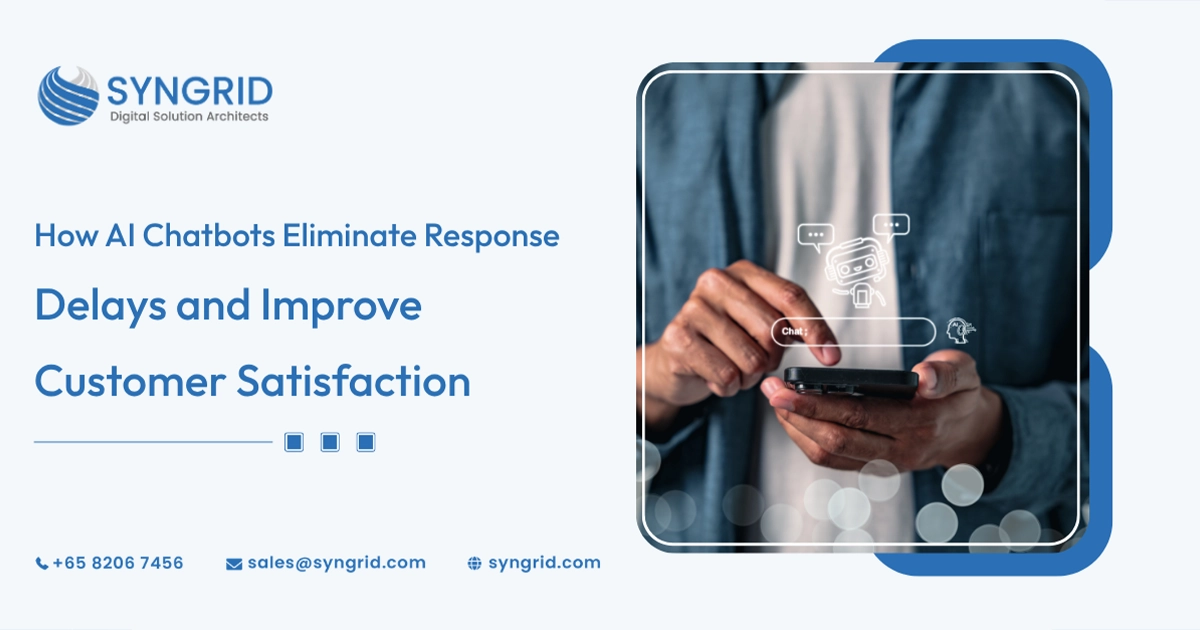
How AI Chatbots Eliminate Response Delays and Improve Customer Satisfaction

A customer sends a support message at 9 PM. They wait. And wait. By morning, they had already left a negative review and switched to a competitor. This happens every day in businesses without proper customer support systems. Slow responses cost real money. They damage trust. And they push customers away permanently. AI chatbots for customer service solve this problem directly. They respond instantly, any time of day, without making customers wait. They handle common queries automatically. And they free your human agents to focus on complex issues that actually need personal attention. In this blog, we explore how AI chatbots eliminate response delays and improve customer satisfaction and why Syngrid Technologies helps businesses deploy them effectively. What Are AI Chatbots for Customer Service? AI chatbots for customer service are intelligent automated tools that engage customers through real-time conversations. They use artificial intelligence to understand questions and deliver accurate responses instantly. Unlike basic rule-based bots, AI chatbots learn from every interaction. They get smarter over time. They understand context, intent, and even sentiment. They can handle: Frequently asked questions and product queries Order tracking and status updates Complaint logging and ticket creation Appointment booking and scheduling Payment queries and billing support Lead capture and qualification Escalation to human agents when needed By automating routine customer interactions, AI chatbots deliver fast, consistent, and reliable support around the clock. Why Response Delays Are Killing Customer Satisfaction Speed is everything in customer service. Customers today expect instant responses. They will not wait hours for a reply The Real Cost of Slow Responses Lost customers: Studies show that 82% of customers expect an immediate response to sales questions. Delays push them to competitors. Damaged reputation: Slow support leads to negative reviews. One bad experience gets shared quickly on social media. Frustrated support teams: Without automation, agents handle repetitive queries all day. This leads to burnout and poor service quality. Missed revenue opportunities: Slow responses to sales inquiries mean lost deals. Speed directly impacts conversion rates. Why Manual Support Cannot Keep Up Businesses grow. Customer queries grow with them. However, support teams cannot scale at the same pace. Hiring more agents is expensive. Training takes time. And human agents cannot work 24 hours a day. AI chatbots for customer service fill this gap perfectly. They scale instantly. They never sleep. And they deliver consistent quality every single time. How AI Chatbots Eliminate Response Delays Instant 24/7 Availability AI chatbots respond in milliseconds. It does not matter if it is midnight or a public holiday. Every customer gets an immediate response. This eliminates wait times completely. Customers feel heard and valued from the very first interaction. Handling Multiple Conversations Simultaneously A human agent can handle one conversation at a time. An AI chatbot handles thousands simultaneously. As a result, no customer ever waits in a queue. Every query gets attention instantly, regardless of how many customers contact you at the same time. Instant Answers to Common Questions Most customer queries are repetitive. Product information; pricing; delivery timelines; and refund policies come up constantly. AI chatbots answer these questions instantly. They pull accurate information from your knowledge base and deliver it within seconds. This frees human agents to focus on genuinely complex issues. Smart Escalation to Human Agents Not every issue can be resolved by a chatbot. However, smart AI chatbots recognize when a human touch is needed. They escalate complex issues to the right agent automatically. They pass the full conversation history along. This means the customer never has to repeat themselves. The result is a smooth, frustration-free handoff every time. How AI Chatbots Improve Customer Satisfaction Consistent and Accurate Responses Human agents have good days and bad days. AI chatbots do not. They deliver the same quality response every single time. Customers receive accurate, consistent information regardless of when they reach out. This builds trust and confidence in your brand. Personalized Customer Interactions Modern AI chatbots go beyond generic responses. They remember previous interactions. They recognize returning customers. They personalize responses based on purchase history and preferences. For example, a returning customer asking about their order gets a response tailored to their specific order details. This feels personal. It feels human. And customers notice the difference. Proactive Customer Engagement AI chatbots do not just wait for customers to ask questions. They proactively engage visitors based on their behavior. For instance, if a customer spends three minutes on a pricing page, the chatbot initiates a conversation. It offers help. It answers questions before the customer even thinks to ask them. This proactive approach significantly improves conversion and satisfaction rates. Multilingual Support Businesses operating across regions face language barriers. AI chatbots handle multiple languages effortlessly. Every customer gets support in their preferred language. This removes friction; improves understanding; and creates a more inclusive customer experience. Key Benefits of AI Chatbots for Customer Service Zero wait times: Customers get instant responses at any hour, on any day of the week. Reduced support costs: Automating routine queries significantly reduces the cost of running a customer support team. Higher first contact resolution: AI chatbots resolve most queries in the first interaction without escalation. Scalable support: Handle growing query volumes without hiring additional agents or increasing costs. Valuable customer insights: Every chatbot interaction generates data. This data reveals common pain points, frequently asked questions, and customer behavior patterns. Improved agent productivity: Human agents focus on high-value, complex interactions. Routine queries are handled automatically. Better customer retention: Fast, consistent, and personalized support keeps customers coming back. How Syngrid Technologies Helps Businesses Deploy AI Chatbots Syngrid Technologies builds advanced AI chatbot solutions designed to transform customer service operations. Every chatbot is custom-built to match your brand, your workflows, and your customer needs. Custom AI Chatbot Development Syngrid does not use generic chatbot templates. Every solution is built from scratch. It reflects your brand voice; your product knowledge; and your specific customer service requirements. Natural Language Processing Integration Syngrid integrates advanced NLP capabilities into every chatbot. This allows the chatbot to understand customer
AI Chatbot

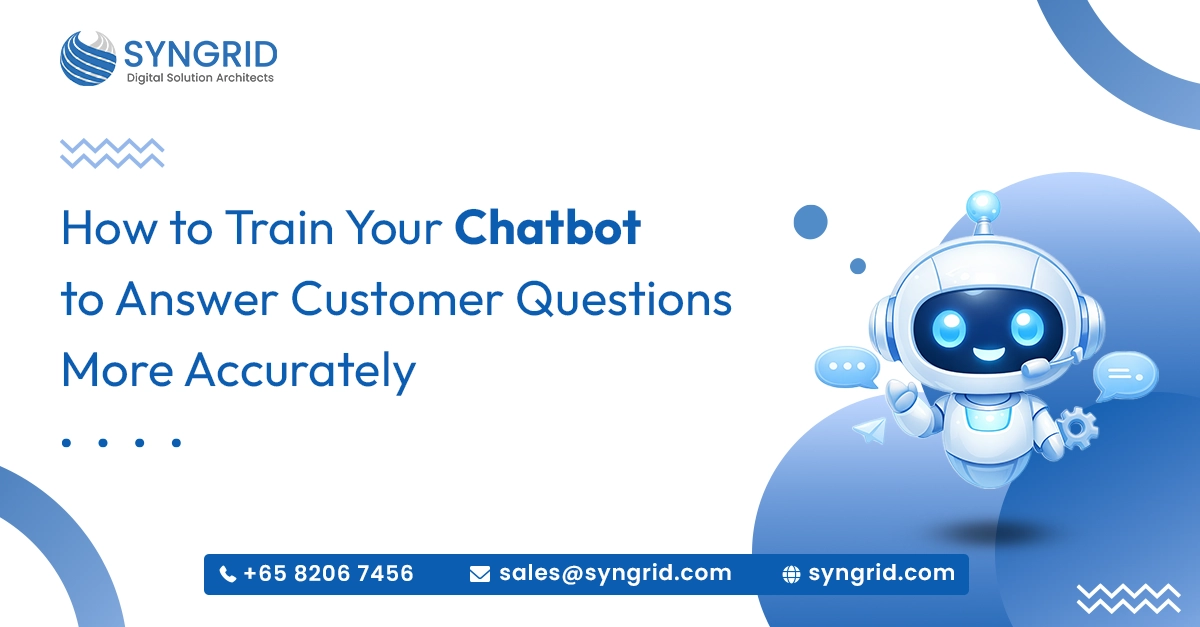
How to Train Your Chatbot to Answer Customer Questions More Accurately?

Is your chatbot giving generic replies instead of solving real customer problems? A chatbot is only as smart as the data and training behind it. Many businesses deploy chatbots expecting instant automation benefits, but without proper training, the bot delivers inconsistent answers, misunderstands intent, or frustrates users. If you want to train your chatbot to answer customer questions accurately, you need a structured approach not just automation.  Here’s how to do it properly. Why Chatbot Accuracy Matters? Customers expect fast and precise responses. If a chatbot fails to understand queries, it can: Increase bounce rates Reduce trust Escalate support tickets Damage brand perception According to Gartner, AI-driven customer service solutions are becoming a major support channel, but effectiveness depends heavily on proper implementation and continuous training. Accuracy directly impacts customer satisfaction. 1.Start With Clear Use Cases Before training begins, define: What types of questions will the chatbot handle? Is it for sales, support, booking, or FAQs? What queries should be escalated to humans? Avoid trying to automate everything at once. Start with high-frequency, repetitive questions such as: Pricing inquiries Product details Order status Appointment booking Refund policies Focused training improves precision. 2. Build a Structured Knowledge Base Your chatbot needs a well-organized knowledge source. Create: FAQ documents Product descriptions Service explanations Troubleshooting guides Policy documentation According to IBM, structured and high-quality training data significantly improves AI model performance. The cleaner your content, the better your chatbot responses. 3. Define Intents and Variations Customers ask the same question in different ways. Example: “What is the price?” “How much does it cost?” “Can you share pricing details?” All of these represent one intent: pricing inquiry. Training your chatbot requires mapping multiple variations to a single intent. This reduces confusion and improves response accuracy. 4. Use Real Customer Conversations for Training One of the most effective methods is analyzing: Past support tickets Live chat transcripts Email inquiries Sales call summaries Real conversations reveal how customers naturally phrase their questions. According to McKinsey & Company, organizations that leverage customer interaction data effectively see measurable improvements in service efficiency. Your chatbot should reflect real-world language, not internal terminology. 5. Implement Continuous Testing Training is not a one-time task. After deployment: Monitor unanswered queries Identify incorrect responses Review fallback triggers Track escalation rates Use analytics dashboards to measure: Resolution rate Response accuracy Customer satisfaction score (CSAT) Average handling time Improvement requires iteration. 6. Integrate With CRM and Backend Systems A chatbot becomes significantly more accurate when connected to: CRM systems Order management systems Inventory databases Appointment scheduling tools Instead of generic answers, the chatbot can provide personalized responses such as: “Your order #4567 is out for delivery.” Data integration increases contextual accuracy. 7. Apply Natural Language Processing (NLP) Optimization Modern chatbots rely on NLP to understand user intent. To enhance NLP performance: Train with diverse phrasing Add synonyms Improve entity recognition (names, dates, order IDs) Reduce ambiguous wording The more linguistic variations you include, the smarter your chatbot becomes. 8. Establish a Human Escalation Path Even the best-trained chatbot cannot solve everything. Ensure: Complex queries are transferred to live agents Escalation is seamless Chat history is shared with support staff A hybrid AI + human model increases overall customer satisfaction. How Syngrid Technologies Helps Businesses Improve Chatbot Accuracy? Deploying a chatbot is easy. Training it for precision requires strategy. Syngrid Technologies helps businesses: Define chatbot use cases Structure knowledge bases Implement AI-powered chatbot solutions Integrate CRM and backend systems Optimize chatbot performance through analytics By combining AI implementation with business strategy, Syngrid ensures chatbots don’t just automate responses; they deliver meaningful customer interactions. Common Mistakes That Reduce Chatbot Accuracy Avoid these errors: Uploading unstructured data Ignoring testing phase Overloading the bot with too many use cases Failing to update information Not tracking performance metrics Accuracy requires ongoing refinement. Final Thoughts A chatbot is not a “set it and forget it” tool. To train your chatbot to answer customer questions accurately, you need: Clear use cases Structured knowledge Intent mapping Continuous learning System integrations Performance monitoring When trained correctly, chatbots improve response time, reduce support costs, and enhance customer satisfaction. The real competitive advantage lies not in having a chatbot but in having a well-trained one.

AI chatbot integration with CRM and ERP img
AI Chatbot

How to Connect AI chatbots with your CRM and ERP for unified workflows?

Introduction Modern businesses deal with increasing customer interactions, complex processes, and continuous operational demands. AI chatbots are helping organizations manage this smarter, but their true power is unlocked when connected to internal systems such as CRM (Customer Relationship Management) and ERP (Enterprise Resource Planning).   When chatbots work independently, they provide automated responses. When chatbots are integrated with CRM & ERP, they provide data-aware, contextual, and business-driven automation. This leads to: Faster customer query resolution Data-backed responses instead of assumptions Automated tasks across sales, support, and operations Why Should Businesses Integrate Chatbots with CRM & ERP? Businesses integrate chatbots with CRM and ERP to create a single connected ecosystem where communication, customer management, and backend operations function together seamlessly.   🔹 Instant access to customer and transaction data🔹 Consistent responses across departments🔹 Automated workflows without human intervention🔹 Reduced errors and faster decision-making   In simple words: Chatbot + CRM + ERP = Smart communication + Reduced manual work + Improved business productivity CRM Integration Benefits for Sales & Support AI chatbots integrated with CRM systems significantly elevate customer-facing operations, especially in sales and support.   ✔ Personalized responses based on customer history✔ Automated lead qualification and routing✔ Ticket creation and status updates directly from chat✔ Lead reminders and follow-ups without manual entry   Result: More conversions, higher customer satisfaction, and reduced workload for sales & support teams. ERP Integration Benefits for Operations & Efficiency An ERP-connected AI chatbot retrieves and updates operational information in real time, eliminating long wait times and back-and-forth communication.   ✔ Product and stock availability details✔ Order status, invoices, and delivery tracking✔ Automated procurement and inventory alerts✔ Faster internal coordination across departments   Result: Smoother operations, fewer dependencies on humans, and higher organizational efficiency. Top Business Use Cases of AI Chatbot Integration Use Case Chatbot Function E-commerce Order tracking, product search, returns SaaS Onboarding, subscription upgrades, support Banking Loan status, transaction summaries, KYC Healthcare Appointment management, patient queries Manufacturing Inventory visibility, supplier communication Logistics Live shipment alerts, route and delivery updates   AI chatbots become a digital gateway to CRM and ERP data, improving responses, decision-making, and engagement. How to Connect AI Chatbots with CRM & ERP Method Description APIs & Webhooks Real-time data sync between systems iPaaS / Middleware Zapier, Make, Workato, etc. for no-code integration Native Integrations Ready connectors provided by Zoho, HubSpot, SAP, Salesforce Custom Development Tailored integrations for enterprise systems Before implementation, businesses should define:🔹 Data flow rules🔹 Access permissions🔹 Workflow triggers based on events Challenges Businesses Face & How to Fix Them Challenge Solution Data mismatch Standardize field structure across systems Security concerns Enable encryption & role-based access Legacy ERP compatibility Use middleware or custom connectors User adoption Well-structured onboarding & intuitive UX With the right architecture, chatbot-driven automation becomes future-proof and scalable. Syngrid Technologies’ Role in System Integration Syngrid Technologies specializes in developing AI chatbots fully integrated with CRM, ERP, and business applications. The company delivers:   ✔ Custom AI chatbot development for sales, support & operations✔ Seamless CRM/ERP integration with platforms like Zoho, SAP, HubSpot, Salesforce, Microsoft               Dynamics & Oracle✔ Secure and scalable API-driven architecture✔ Workflow automation tailored to business processes✔ Performance analytics and continuous optimization   Syngrid ensures that companies don’t just use chatbots; they leverage chatbot-powered automation for measurable business growth and ROI. Final Verdict Integrating AI chatbots with CRM and ERP systems is a transformational move, not just a technology trend. When done right, it elevates customer engagement, eliminates repetitive manual tasks, speeds up operations, and builds a connected digital infrastructure across every business function. With unified, real-time data flowing between departments, organizations can make faster decisions and deliver seamless customer experiences at scale.   If your organization is ready to automate workflows and unlock unified customer journeys, Syngrid Technologies can help you deploy secure, scalable, and ROI-driven AI chatbot integrations tailored to your business goals. Need help integrating AI chatbots with CRM and ERP? Contact Syngrid Technologies today for expert assistance.

AI Chatbot

How to Build an AI Chatbot for Your Website: Step-by-Step Guide

Introduction In today’s digital-first world, businesses need to engage with customers instantly, provide 24/7 support, and capture actionable insights. AI-powered chatbots make this possible by delivering automated, intelligent, and human-like conversations. A well-implemented chatbot can improve customer satisfaction, reduce support costs, and drive business growth. Companies like Syngrid Technologies specialize in designing AI chatbots that are scalable, efficient, and tailored to business objectives. By leveraging advanced AI technologies, Syngrid helps organizations create smarter, more interactive user experiences from the start. This guide walks you through why chatbots are important, the types of AI chatbots, strategy planning, development steps, no-code tools, costs, practical tips, and future trends. Why Your Business Needs an AI Chatbot AI chatbots are essential for businesses that want to stay competitive. Key benefits include: 24/7 Customer Support—Chatbots provide instant answers around the clock. Lead Generation & Qualification – Automatically collect and filter potential customers. Cost Efficiency – Reduce manual support while handling high volumes of queries. Enhanced Engagement – Personalized interactions keep users returning.   Types of AI Chatbots AI chatbots can vary in complexity and application: Rule-Based Chatbots – Follow predefined scripts, ideal for FAQs and simple queries. AI-Powered Chatbots – Use machine learning and NLP to understand intent and provide smart responses. Hybrid Chatbots – Combine rules and AI for both structured guidance and intelligent interactions. Voice-Enabled Chatbots – Enable hands-free interaction using voice recognition technology. Choosing the right type depends on your audience, industry, and business objectives. Planning an AI Chatbot Strategy A successful chatbot starts with a solid strategy: Define Objectives—Determine if the chatbot will handle customer support, sales, or lead generation. Know Your Audience—Understand users’ needs, pain points, and preferred communication channels. Feature Selection—Decide on live agent handover, analytics, multi-language support, or CRM integration. Set KPIs—Measure chatbot success through engagement, conversion rates, and user satisfaction. A clear strategy ensures the chatbot meets both business and user needs effectively. Step-by-Step Guide to Building an AI Chatbot Follow these steps for successful chatbot implementation: Requirement Analysis – Identify your goals, target audience, and the queries your chatbot will handle. Conversation Design – Map user journeys and create engaging dialogue flows. Technology Selection – Choose AI platforms, NLP engines, and integration tools. Development & Training – Build the chatbot and train it using relevant datasets. Testing & Optimization – Conduct beta testing and refine responses based on feedback. Deployment—Add the chatbot to your website, mobile app, or social media. Monitoring & Maintenance – Continuously optimize with analytics and user insights.   No-Code AI Chatbot Tools No-code platforms allow faster chatbot deployment without extensive coding: Dialogflow—Google’s platform for creating conversational interfaces. Microsoft Power Virtual Agents – Build chatbots using a drag-and-drop interface. Tidio, LandBot, ManyChat—Popular solutions for web and social media chatbot implementation. These tools are ideal for startups and small businesses aiming to launch quickly without deep technical resources. AI Chatbot Development Costs The cost of developing an AI chatbot depends on factors such as complexity, features, integrations, and the level of customization your business requires. Simple chatbots with basic functionality may require less investment, while advanced chatbots with NLP capabilities, CRM integration, analytics, and multi-channel support require a more strategic approach.   For an accurate estimate tailored to your business needs, it’s best to connect with the Syngrid Technologies sales team. They can help determine a solution that fits your goals, ensures scalability, and delivers a strong ROI. Practical Tips for Successful Chatbot Implementation Keep Conversations Simple – Avoid overly complicated scripts. Prioritize Mobile Experience – Ensure chatbots work flawlessly on smartphones and tablets. Continuous Testing—Regularly collect feedback and optimize performance. Integrate Analytics—Monitor interactions to improve user experience. Ensure Security & Privacy – Protect user data and comply with regulations. Even small improvements in these areas can significantly enhance user engagement and satisfaction. Future of Web-Based AI Chatbots The future of AI chatbots is bright and continuously evolving. Key trends include: Voice & Multimodal Interfaces—Handle text, voice, and images for richer interactions. Predictive Personalization – AI anticipates user needs and delivers tailored suggestions. Omnichannel Experiences—Unified interactions across websites, apps, and social platforms. AI-Driven Analytics – Real-time insights for smarter business decisions. AI chatbots are no longer just a tech trend; they are essential tools for business growth. Companies that leverage AI chatbots gain a competitive advantage through better customer support, higher conversions, and measurable efficiency. With strategic planning and expert implementation, your AI chatbot can transform the way your business interacts with users, providing scalable, intelligent, and impactful results. By partnering with Syngrid Technologies, businesses can implement future-ready AI chatbots that drive engagement, enhance customer experience, and improve operational efficiency.

Scroll to Top