“Doing the right thing is more important than doing things right.” — Peter Drucker
The Conversation Every Business Has Wrong
It happens in marketing meetings every week.
Someone says, “Should we invest in SEO or run paid ads?”
The room divides itself. One side argues for organic. The other pushes for pay. A decision gets made. Budget gets allocated. And six months later, the results are disappointing.
Why? Because the question itself is wrong.
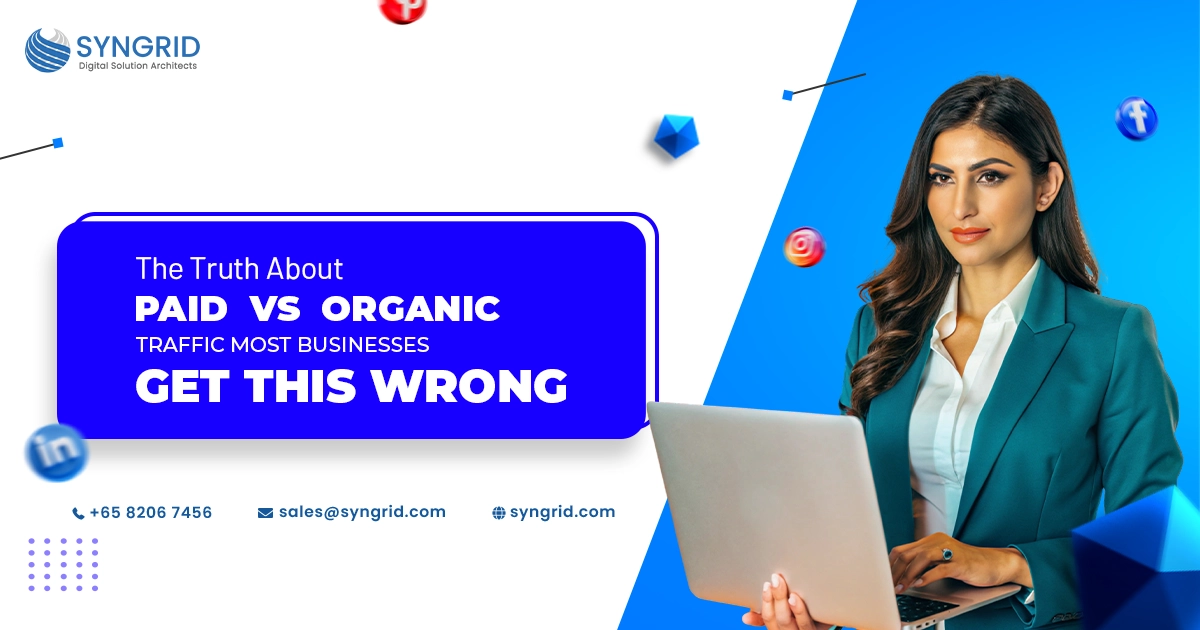
Organic traffic vs. paid traffic is not a competition. It is not an either-or decision. And treating it like one is one of the most expensive mistakes a growing business can make.
In this blog, we cut through the noise, expose the real truth about both traffic strategies, and show you exactly how smart businesses use them together to build sustainable, scalable growth.
First, let’s get crystal clear on what each one actually is.
Organic traffic is every visitor who finds your website without you paying for that specific click.
They searched something on Google. Your website appeared. They clicked. You paid nothing.
Organic traffic comes from:
SEO: Optimizing your website to rank higher in search results
Content marketing: Blog posts, guides, and articles that answer real questions
Backlinks: Other websites linking to your content
Google Business Profile: Local search visibility
Social media: Posts that drive clicks without paid promotion
The magic of organic traffic is what happens over time. A blog published today can drive visitors for years. Each piece of content compounds the last. And your traffic grows without your costs growing with it.
The honest downside? It takes time. Real results often take 3 to 6 months minimum. Sometimes longer.
Paid Traffic: The Fast Lane With a Meter Running
Paid traffic is every visitor who arrives because you paid for an ad. You pay per click, per impression, or per conversion depending on your campaign type.
Paid traffic comes from:
Google Ads: Appear at the top of search results instantly
Facebook and Instagram Ads: Reach specific audiences by interest, age, and behavior
LinkedIn Ads: Target professionals by job title, industry, and company
YouTube Ads: Reach users while they watch video content
Display Networks: Banner ads across millions of websites
The magic of paid traffic is speed. Launch a campaign today. Get visitors today. Target exactly the right audience. Test messages rapidly.
The honest downside? The moment you stop paying, the traffic stops completely. You own nothing.
The Real Cost of Choosing Only One
Here is where most businesses make their critical mistake.
They pick a side. And they stick to it.
The All-Paid Trap
A startup launches. They have a budget. They run ads. Traffic flows. Leads come in.
Then one of three things happens:
The budget runs out.
Ad costs increase
The platform changes its algorithm.
And overnight, the traffic disappears. Because they built nothing lasting. No organic foundation. No content library. No search visibility.
Furthermore, they have no idea which customers came from which keywords. No SEO data. No long-term asset. Just an empty pipeline and a depleted budget.
Another business decides SEO is the answer. They invest in content. They optimize their website. They wait.
Six months pass. Rankings improve slowly. Traffic trickles in. Meanwhile, competitors using paid ads capture every lead that is available right now.
They missed an entire market window because they refused to use the fastest tool available while their long-term strategy developed.
The Smart Approach
The smartest businesses use both. Strategically. Simultaneously. With each one informing and strengthening the other.
Organic Traffic, Paid Traffic, Cost Per Click, Zero Variable Speed to Results, 3 to 6 months Immediate Longevity Compounds forever stop with a budget. Trust Level: High/Lower Data Generation Slow, Fast, Best Use, Long-term Growth Immediate results Scalability Content and SEO Budget Neither wins. Both serve different purposes at different stages of your growth.
The 4 Truths Most Businesses Never Hear
Truth 1: Paid Traffic Makes Your Organic Strategy Smarter most businesses treat paid and organic as separate strategies. They shouldn’t.
Paid campaigns generate keyword data fast. You learn which search terms convert, which audiences respond, and which messages resonate within weeks.
This data is gold for your SEO strategy. Furthermore, you can build organic content around your highest-converting paid keywords. As a result, your organic strategy becomes data-driven from day one rather than based on guesswork.
Truth 2: Organic Traffic Makes Your Paid Campaigns Cheaper
When your website ranks organically for a keyword, you can reduce paid spend on that same keyword. Your organic ranking captures the free clicks. Your paid budget moves to new opportunities.
Consequently, as your organic traffic grows, your cost per customer acquisition decreases. The two strategies literally make each other more efficient over time.
Truth 3: Relying on Paid Traffic Alone Is Dangerous
Advertising platforms change constantly. Ad costs rise. Algorithms shift. Privacy regulations tighten targeting options. And competitors drive up bid prices in your industry.
Businesses with no organic foundation are completely exposed to these changes. One platform update can destroy their entire traffic source overnight.
In contrast, organic traffic is resilient. Algorithm updates can affect rankings. However, a strong content foundation recovers and adapts far better than a pure paid strategy ever can.
Truth 4: Organic Traffic Converts Differently Users who find you organically are often further along in their decision-making process. They searched for something specific. They found your content. They trust what they read.
Furthermore, organic visitors tend to spend more time on your website. They read more pages. And they convert with higher intent than many paid visitors who clicked an ad impulsively.
Therefore, organic traffic often delivers higher-quality leads even when it delivers fewer of them.
The Smart Business Playbook: How to Use Both Together
High-performing businesses don’t debate paid vs. organic. They build a system where both work together. Here is exactly how:
Phase 1: Launch With Paid; Learn Fast
When you enter a market or launch a product, use paid ads immediately. Generate traffic now. Capture leads now. Gather data now.
Don’t wait six months for organic to build while your competitors move on.
Phase 2: Use Paid Data to Build Organic
After 60 to 90 days of paid campaigns, you have valuable data. High-converting keywords. Best-performing audiences. Most effective messages.
Use all of it to build your organic content strategy. Write blogs around your best keywords. Optimize your website for your highest-converting search terms. Create content that answers the questions your paid audience asked.
Phase 3: Scale Organic; Optimize Paid
As your organic rankings grow, reduce paid spend on keywords where you now rank organically. Reallocate that budget to new markets, new products, or brand awareness campaigns.
Consequently, your marketing becomes more efficient over time. You spend less to achieve the same results.
Phase 4: Let Both Compounds Be Together
Over time, organic traffic generates consistent leads without ongoing spend. Paid campaigns focus on high-value opportunities and new growth areas. And both channels feed each other with data, audience insights, and content ideas.
As a result, your marketing engine becomes more powerful and more cost-efficient with every passing month.
The Self-Assessment: Where Does Your Business Stand?
Take 60 seconds. Answer honestly:
Do you know which traffic source generates your highest-quality leads?
Do you have a content strategy that builds organic visibility over time?
Are your paid campaigns generating data that improves your organic strategy?
Is your organic traffic reducing your dependence on paid ad spend?
Do you have a plan that uses both channels strategically together?
If you answered no to three or more, your traffic strategy has significant room for improvement. Furthermore, every month without a balanced strategy is a month of compounding missed opportunity.
How Syngrid Technologies Helps Businesses Get This Right.
Syngrid Technologies builds integrated digital marketing strategies that leverage both organic and paid traffic effectively. The team helps businesses stop choosing between the two and start using both strategically.
SEO and Content Strategy
Syngrid develops comprehensive SEO strategies built on real keyword data, audience research, and competitive analysis. From technical SEO and on-page optimization to long-form content creation, the team builds organic visibility that compounds over time.
Furthermore, every piece of content is strategically designed to rank, convert, and support your broader business goals.
Paid Campaign Management
Syngrid designs, launches, and continuously optimizes paid campaigns across Google, Facebook, Instagram, and LinkedIn.
Every campaign starts with clear objectives, precise audience targeting, and measurable KPIs. As a result, every rupee of ad spend works as hard as possible from day one.
Integrated Strategy That Connects Both
The real Syngrid advantage is integration. The team builds strategies where paid and organic inform each other continuously.
Paid data improves organic targeting. Organic rankings reduce paid spend. And both channels work together to build a traffic engine that grows more powerful and more cost-efficient over time.
Transparent Analytics and Reporting
You always know exactly what is working. Syngrid provides clear, jargon-free reporting on both organic and paid performance.
Traffic sources, conversion rates, cost per lead, keyword rankings, and campaign ROI are all visible and understandable. Consequently, decisions are always based on real data rather than assumptions.
The Bottom Line
The debate of organic traffic vs. paid traffic misses the entire point. It is not about choosing one. It is about understanding what each does best, when to use each one, and how to build a system where both work together to drive consistent, scalable, sustainable growth.
Paid traffic gives you speed, data, and immediate results. Organic traffic gives you long-term value, trust, and compounding growth. Together, they create a marketing engine that nothing can easily replicate or shut down.
Most businesses get this wrong because they never see the full picture.
Syngrid Technologies helps you see it clearly, build it strategically, and execute it consistently.
Ready to stop choosing between paid and organic and start using both the right way? Connect with Syngrid Technologies today and book a free consultation.