

“Every successful app begins with a simple idea, but turning that idea into a working product requires a clear process, the right strategy, and careful execution.”
Apps have become a core part of how modern businesses operate. Whether it’s ordering food, booking appointments, managing finances, or connecting with customers, applications are shaping everyday experiences.
But building an app is not something that happens overnight. A successful product requires more than coding skills. It involves research, planning, design thinking, development, and long-term improvements.
If you’ve ever wondered how an app goes from an idea in someone’s mind to a real product on the App Store or Google Play, this guide will walk you through the full journey.
Step 1: Begin with a Purpose-Driven Idea
Every app starts with a question: What problem am I solving?
The best app ideas come from real needs. Before jumping into development, it’s important to understand:
Who your users are
What challenge do they face?
How your app can make their life easier?
A clear purpose gives direction to the entire project. When the idea is strong, the rest of the development process becomes much smoother.
Testing your idea early through user discussions or simple surveys can help confirm whether it’s worth building.
Step 2: Research the Market Before You Build
Once you have an idea, the next step is to explore what already exists.
Market research helps you understand user expectations, while competitor research shows what similar apps are offering.
Look closely at:
Top apps in your category
user-friendly features
Common complaints in reviews
Pricing and subscription models
This stage is essential because it prevents you from building blindly. Instead, you build with awareness and strategy.
Step 3: Plan Features and Start with an MVP
A common mistake in app development is trying to include everything in the first version.
Instead, focus on an MVP—a Minimum Viable Product.
An MVP is a basic version of your app that includes only the most important features needed to deliver value.
This approach helps you:
Launch faster.
Reduce initial costs.
Gather feedback early.
Improve step by step.
A strong feature plan keeps development focused and avoids unnecessary complexity.
Step 4: Design the User Experience with Care
Design is where your app begins to feel real.
Two major design elements matter here:
UI (User Interface): how the app looks
UX (User Experience): how the app works
Designers often create:
Wireframes to map screen layouts
Prototypes to test user flow
Final visual designs for development
A well-designed app is easy to navigate, visually appealing, and enjoyable to use.
Good UX is one of the biggest reasons users stay or uninstall.
Step 5: Select the Right Development Approach
Now it’s time to decide how the app will be built.
Common options include
Native development for iOS or Android
Cross-platform development for both systems
Web-based applications for browser access
The right choice depends on your budget, target users, and scalability goals.
This stage also involves choosing technologies such as
Frameworks
Backend systems
Databases
API integrations
Making the right technical decisions early saves major rework later.
Step 6: Development Turns the Idea Into Reality
This is the stage where developers start building the actual application.
App development usually includes:
Frontend development (what users interact with)
Backend development (data, logic, servers)
Key tasks during this phase include
Building features one by one
Setting up secure authentication
Connecting databases
- Integrating payment or third-party tools
Most teams follow agile development, meaning work is completed in small cycles with regular improvements.
Step 7: Testing to Ensure Quality and Trust
No app should launch without proper testing.
Testing helps confirm the app is reliable, secure, and smooth across devices.
Quality assurance typically includes:
Feature testing to remove bugs
Performance testing for speed
Security testing for safety
Usability testing for user comfort
Even small errors can damage user trust, so this step is critical for long-term success.
Step 8: Launching the App on the Right Platforms
After testing, the app is ready for release.
Launch preparation includes:
Publishing on the App Store and Google Play
Writing clear descriptions with keywords
Uploading screenshots and previews
Meeting platform guidelines
A launch also needs promotion. Marketing through social media, email campaigns, and digital ads can help drive downloads from day one.
A strong launch strategy builds early momentum.
Working with the Right Development Partner
Building an app requires expertise across multiple areas—design, development, testing, and deployment.
That’s why many businesses choose to work with experienced teams.
Syngrid Technologies supports organizations in developing secure, scalable, and user-focused applications that align with business goals and deliver long-term value.
With the right partner, the journey from concept to launch becomes faster, smoother, and more successful.
Conclusion
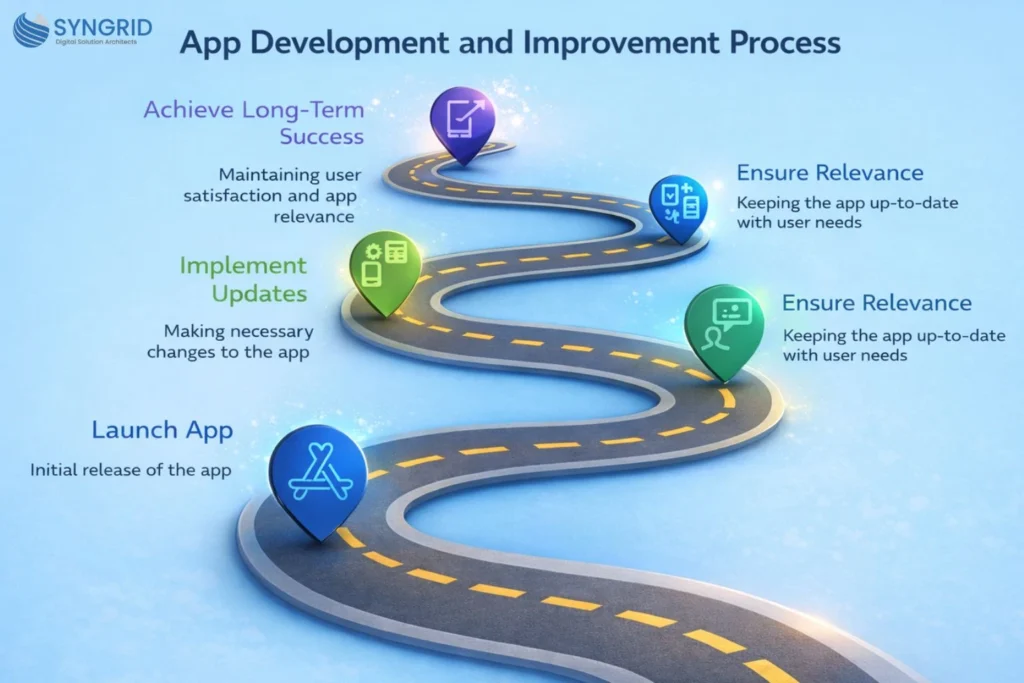
The app development process from idea to launch is a structured path that involves planning, creativity, execution, and continuous improvement.
By following the right steps—validating your idea, researching the market, designing thoughtfully, developing carefully, testing thoroughly, and supporting the app after launch, you can build a product that users trust and enjoy.
With the right approach, your app can grow from a simple idea into a powerful digital solution.