


Web development is constantly evolving. As businesses demand faster, scalable, and more interactive websites, frameworks play a critical role in shaping developer productivity and application performance.
With 2026 around the corner, it’s important to understand which frameworks offer the best features, community support, and future-proof capabilities. Choosing the right framework can reduce development time, improve code quality, and deliver exceptional user experiences.
Whether you are a startup, enterprise, or freelance developer, staying updated with the latest frameworks ensures your projects remain competitive and efficient.
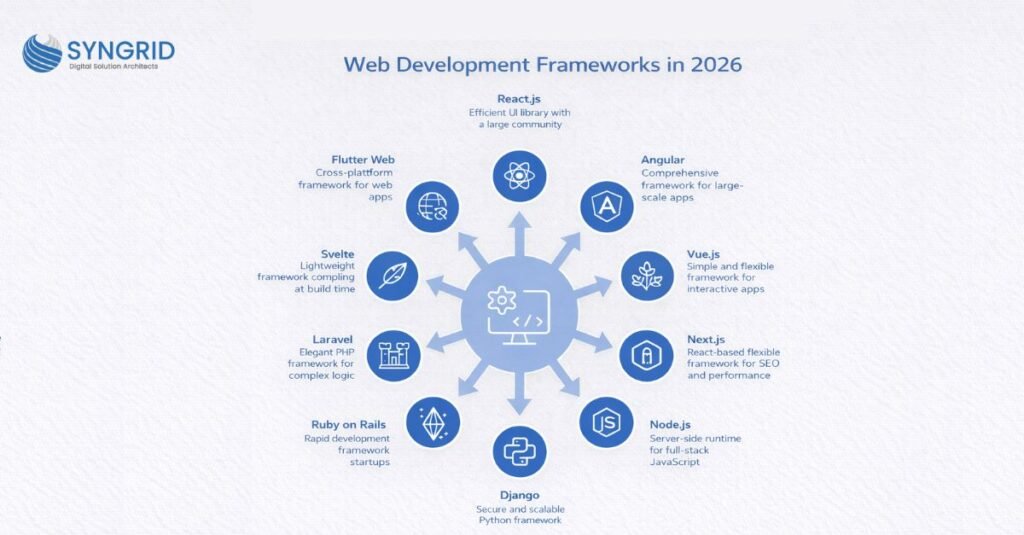
1. React.js
Overview: Developed by Facebook, React.js is a front-end JavaScript library for building dynamic user interfaces.
Why Use It in 2026:
Highly efficient virtual DOM for fast rendering
Component-based architecture for reusability
Large community and ecosystem
Use Cases: Single-page applications (SPAs), e-commerce sites, dashboards
Pros: Fast, reusable components, strong ecosystem
Cons: Only handles UI; requires other libraries for full-stack features
2. Angular
Overview: Angular, maintained by Google, is a TypeScript-based front-end framework for building large-scale web applications.
Why Use It in 2026:
Two-way data binding ensures real-time updates
Built-in dependency injection and modular architecture
Enterprise-level support
Use Cases: Enterprise apps, CRM systems, dynamic web portals
Pros: Full-featured, scalable, backed by Google
Cons: Steep learning curve, complex setup
3. Vue.js
Overview: Vue.js is a progressive JavaScript framework known for simplicity and flexibility.
Why Use It in 2026:
Lightweight and easy to integrate
Reactive data binding and component system
Growing adoption in small and medium businesses
Use Cases: Interactive web apps, small to medium SPAs, prototypes
Pros: Simple syntax, easy learning curve, flexible
Cons: Smaller ecosystem than React or Angular
4. Next.js
Overview: Next.js is a React-based framework for server-side rendering (SSR) and static site generation (SSG).
Why Use It in 2026:
Optimized for SEO with SSR and SSG
Built-in routing and API routes
Excellent performance and scalability
Use Cases: Blogs, e-commerce, SaaS apps
Pros: SEO-friendly, scalable, improved performance
Cons: Slightly heavier than plain React
5. Node.js
Overview: Node.js is a server-side JavaScript runtime that enables full-stack development using JavaScript.
Why Use It in 2026:
Handles high concurrency efficiently
Supports microservices and serverless architectures
Large library ecosystem via npm
Use Cases: Real-time apps, APIs, microservices
Pros: Fast, scalable, unified language across front-end and back-end
Cons: Single-threaded nature can affect CPU-intensive tasks.
6. Django
Overview: Django is a Python-based back-end framework for building secure, scalable web applications.
Why Use It in 2026:
Follows “batteries-included” philosophy with built-in admin, auth, and ORM
Emphasizes security and best practices
Rapid development and scalability
Use Cases: Web apps, e-commerce platforms, SaaS applications
Pros: Secure, feature-rich, fast development
Cons: Monolithic architecture, less flexible than micro-frameworks
7. Ruby on Rails
Overview: Ruby on Rails is a full-stack web framework that emphasizes convention over configuration.
Why Use It in 2026:
Rapid development for MVPs
Large developer community and gems library
Ideal for startups and agile projects
Use Cases: Startups, marketplaces, content platforms
Pros: Fast prototyping, readable code, strong community
Cons: Performance can be lower for large-scale apps.
8. Laravel
Overview: Laravel is a PHP-based back-end framework known for its elegant syntax and MVC architecture.
Why Use It in 2026:
Simplifies complex backend logic
Built-in features for authentication, caching, and queues
Active community and frequent updates
Use Cases: E-commerce sites, SaaS apps, APIs
Pros: Easy to learn, robust, secure
Cons: PHP-based, which may limit full-stack flexibility
9. Svelte
Overview: Svelte is a modern JavaScript framework that compiles code at build time instead of runtime.
Why Use It in 2026:
Extremely lightweight and fast
No virtual DOM, leading to smaller bundles
Developer-friendly reactive syntax
Use Cases: SPAs, performance-critical apps, small projects
Pros: Fast, lightweight, simple
Cons: Smaller ecosystem, less enterprise adoption
10. Flutter Web
Overview: Flutter Web is an extension of Google’s Flutter framework for building cross-platform applications.
Why Use It in 2026:
Single codebase for web, mobile, and desktop
Rich UI components and high performance
Growing popularity for progressive web apps (PWAs)
Use Cases: Multi-platform apps, PWAs, interactive web apps
Pros: Cross-platform, rich UI, unified development
Cons: Larger bundle sizes, still maturing for web
Choosing the Right Framework for 2026
As web development continues to evolve, businesses must not only adopt modern frameworks but also integrate them with strong development practices, secure infrastructure, and scalable architectures.
At Syngrid Technologies, we help organizations select and implement the best web development frameworks to future-proof projects. From enterprise-grade solutions to agile startup apps, our team ensures your digital ecosystem is fast, reliable, and ready for 2026 and beyond.