

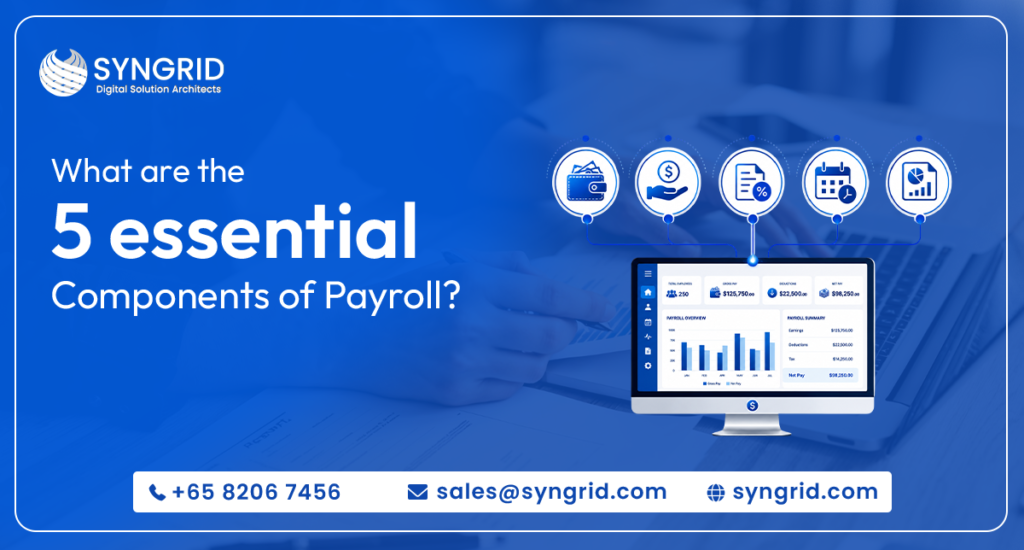
Payroll is one of the most critical business functions in any organization. It goes beyond simply paying employees on time; it ensures compliance with tax regulations, improves employee satisfaction, and supports accurate financial reporting.
Whether you’re managing payroll for a small business or a global workforce, understanding the essential components of payroll is key to building an efficient and compliant payroll process.
In this guide, we’ll explore the five essential components of payroll, why they matter, and how modern payroll software like Syngroo Global Payroll & HRMS helps businesses automate payroll while reducing manual work.
Why Payroll Management Is Important
Payroll directly impacts both employees and the business.
Employees expect accurate and timely salary payments, while employers must ensure compliance with labor laws, tax regulations, and statutory requirements.
An inefficient payroll process can lead to:
Payroll errors
Delayed salary payments
Tax penalties
Compliance issues
Reduced employee trust
Increased administrative workload
A well-structured payroll system eliminates these challenges and helps organizations operate more efficiently.
The 5 Essential Components of Payroll
1. Employee Information Management
Every payroll process starts with accurate employee data.
Businesses need to maintain complete employee records, including:
Employee ID
Personal information
Job role and department
Employment type
Salary structure
Bank account details
Tax identification information
Keeping employee records up to date ensures payroll calculations remain accurate and compliant.
2. Time, Attendance, and Leave Management
Payroll calculations depend on accurate attendance records.
Organizations should track:
Working hours
Overtime
Shift schedules
Paid leave
Sick leave
Public holidays
Absences
Integrating attendance and leave management with payroll reduces manual calculations and improves payroll accuracy.
3. Salary Calculation and Payroll Processing
Salary processing is the core of every payroll system.
This includes calculating:
Basic salary
Overtime pay
Bonuses and incentives
Allowances
Reimbursements
Tax deductions
Social security contributions
Other statutory deductions
Automating payroll calculations helps businesses minimize errors and ensures employees receive the correct net salary every pay cycle.
4. Payroll Compliance and Tax Management
Every country has different payroll regulations.
Businesses must ensure compliance with:
Income tax rules
Statutory deductions
Labor laws
Minimum wage regulations
Government reporting requirements
Social security contributions
For organizations operating internationally, maintaining global payroll compliance becomes even more important as each country has unique tax laws and reporting standards.
5. Payslip Generation and Payroll Reporting
After payroll processing, businesses should generate detailed reports and employee payslips.
Common payroll reports include:
Payroll summaries
Salary registers
Tax reports
Leave reports
Department-wise payroll reports
Compliance reports
Digital payslips improve transparency, while payroll reports help HR and finance teams monitor payroll costs and maintain audit-ready records.
Benefits of Payroll Software
Modern payroll software simplifies payroll management by automating repetitive tasks and improving overall efficiency.
Key benefits include:
Faster payroll processing
Improved payroll accuracy
Automated tax calculations
Better compliance management
Reduced manual work
Secure employee records
Easy payslip generation
Real-time payroll reporting
By replacing spreadsheets with payroll software, businesses can save time, reduce errors, and focus on strategic HR activities.
How Syngroo Global Payroll & HRMS Helps Businesses
Managing payroll manually becomes increasingly challenging as businesses grow.
That’s why Syngrid Technologies developed Syngroo Global Payroll & HRMS, a cloud-based payroll solution designed to simplify payroll processing for businesses of all sizes.
With Syngroo Global Payroll & HRMS, businesses can:
✅ Automate payroll processing
✅ Manage employee records from a centralized platform
✅ Track attendance and leave
✅ Generate accurate payslips
✅ Calculate salaries and statutory deductions automatically
✅ Maintain payroll compliance
✅ Access real-time payroll reports
✅ Support global payroll operations across multiple countries
Whether you’re managing a local workforce or international teams, Syngroo helps streamline payroll while improving accuracy and compliance.
Final Thoughts
Managing payroll across multiple countries requires more than basic payroll software. HR teams need automation, compliance support, multi-currency processing, and real-time reporting to stay efficient and compliant.
Choosing the right Global Payroll Software helps businesses reduce payroll complexity, improve accuracy, and support global growth.
With Syngroo Global Payroll & HRMS by Syngrid Technologies, organisations can confidently manage international payroll while ensuring compliance and delivering a better employee experience.
Ready to simplify global payroll? Contact Syngrid Technologies today to discover how Syngroo Global Payroll & HRMS can transform your payroll operations.
Frequently Asked Questions About This Blog
1. What are the five essential components of payroll?
The five essential components of payroll are employee information management, time and attendance tracking, salary calculation, payroll compliance, and payslip generation with payroll reporting.
2. Why is payroll compliance important?
Payroll compliance ensures businesses follow tax laws, labor regulations, and statutory requirements, helping avoid penalties and legal issues.
3. What is payroll software?
Payroll software automates salary calculations, tax deductions, attendance tracking, payslip generation, and compliance reporting, making payroll processing faster and more accurate.
4. How does payroll software improve employee experience?
Payroll software ensures employees receive accurate salaries on time, provides easy access to digital payslips, and reduces payroll errors, leading to greater employee satisfaction.