


Artificial intelligence is getting faster, cheaper, and more accessible. Businesses now use AI for search, automation, analytics, personalization, and customer support. Yet many teams feel something is off. The tools work, but the outcomes feel shallow.
- AI answers questions but misses intent.
- It automates tasks but lacks judgment.
- It processes data but fails to act meaningfully.
“The issue is not the model.
The issue is context.”
Context is what turns intelligence into understanding. Without it, AI workflows remain fragmented and reactive. With it, AI becomes strategic, adaptive, and outcome-driven.
What Does “Context” Really Mean in AI Workflows?
Context is the surrounding information that gives data meaning. In AI systems, context goes far beyond prompts or inputs.
It includes:
Who the user is and what they want
When and where the interaction happens
What has already happened before
What business rules, constraints, or goals exist
An AI workflow understands context when it can connect data, intent, and timing in one continuous loop.
Most AI failures happen not because the system lacks data, but because it lacks the right data at the right moment.
Why Traditional AI Workflows Breakdown?
Many organizations build AI in silos. One system handles search. Another handles CRM. Another manages inventory or operations. Each tool may work well independently, but they rarely communicate effectively.
This creates common problems:
AI recommendations that ignore real-time availability
Chatbots that repeat questions already answered
Automation that triggers actions at the wrong moment
Insights that arrive too late to influence decisions
Without shared context, AI becomes reactive instead of proactive.
Context Changes AI: From Automation to Decision Support
When AI workflows are context-aware, something important changes. The system stops executing rules and starts supporting decisions.
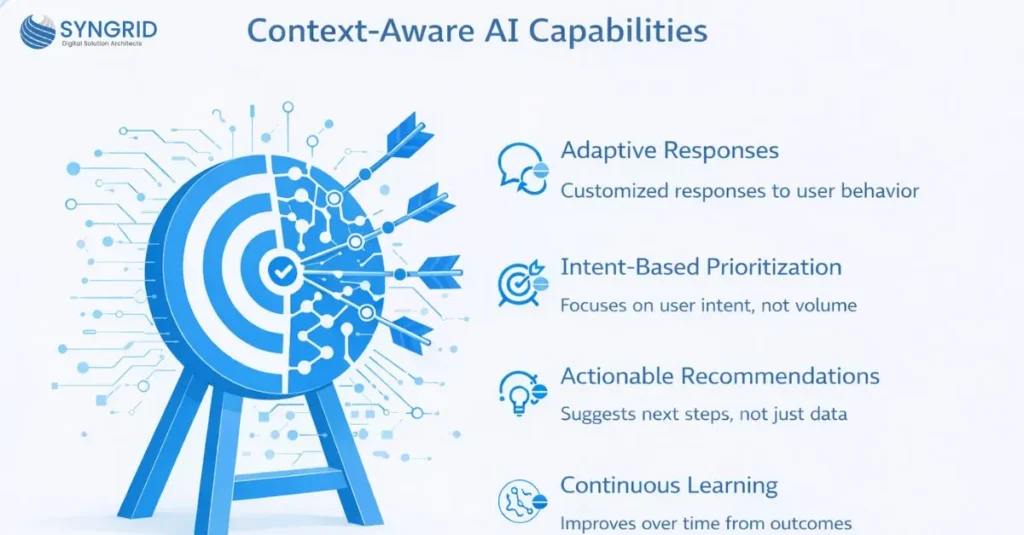
Context-aware AI can:
Adapt responses based on user behavior
Prioritize actions based on intent, not volume.
Recommend next steps, not just surface data
Learn continuously from outcomes
This is why modern AI systems are moving closer to decision-making layers rather than remaining simple tools.
The Rise of Real-Time, Context-Driven AI Experiences
Across industries, AI is shifting from background automation to frontline interaction.
“Search is becoming conversational.
Commerce is becoming predictive.
Customer support is becoming personalized.”
These experiences only work when AI understands:
What the user is trying to achieve
What options are realistically available?
What trade-offs matter most in that moment
This is where context becomes a competitive advantage.
Context Lives in Systems, Not in Models
A common misconception is that context is something you “add” to AI through better prompts. In reality, most context lives inside business systems.
Key sources of context include:
CRM platforms (customer history and intent)
ERP systems (operations and constraints)
Commerce platforms (pricing, inventory, fulfillment)
Analytics tools (behavior and performance data)
If these systems are disconnected, AI will always operate with blind spots.
Strong AI workflows depend on integration, not just intelligence.
Why Backend Architecture Matters More Than Ever?
As AI becomes more involved in decisions, backend systems can no longer be passive databases.
They must be:
API-first
Real-time
Consistent across platforms
Secure and scalable
Context-aware AI requires instant access to trusted data. Delays, inconsistencies, or gaps directly reduce AI effectiveness.
This is why many AI initiatives stall after initial success. The model improves, but the infrastructure cannot keep up.
Measuring the Impact of Contextual AI
Context-aware AI does not just feel better. It performs better.
Businesses typically see:
Higher conversion rates
Shorter decision cycles
Improved customer satisfaction
Lower operational friction
Most importantly, AI outputs become actionable, not just informative.
Instead of asking, “What happened?”
Teams start asking, “What should we do next?”
Preparing Your AI Workflows for Context Awareness
To build context-rich AI workflows, organizations should focus on fundamentals before advanced experimentation.
Key steps include:
Centralizing customer and business data
Breaking down silos between systems
Designing workflows around intent, not tasks
Ensuring real-time data availability
Aligning AI goals with business outcomes
Context is not a feature. It is a foundation.
The Future: AI That Understands Before It Acts
As AI systems become more autonomous, context will determine trust.
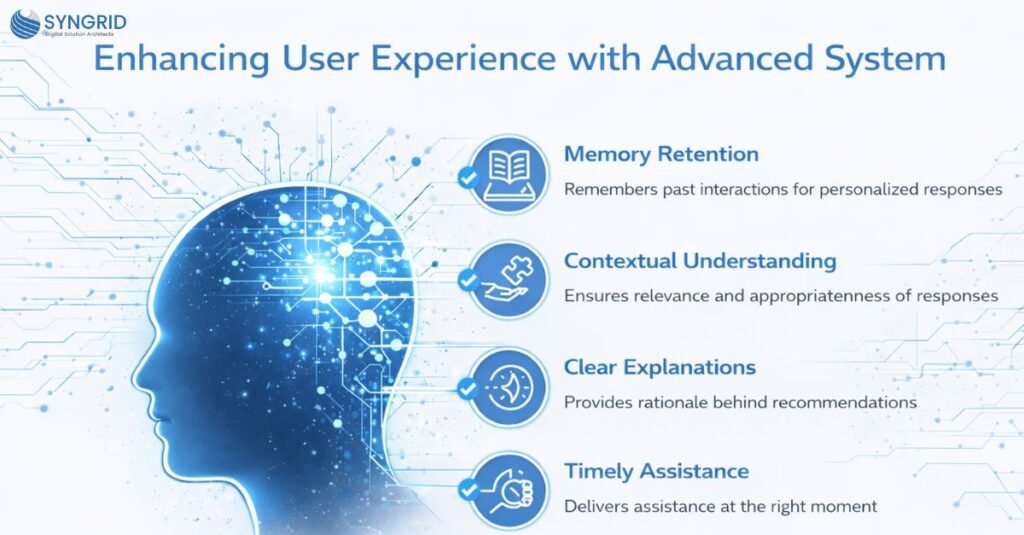
Users will trust AI that:
Remembers past interactions
Understands constraints
Explains recommendations clearly
Acts at the right time
Organizations that invest in context-aware architectures today will be better prepared for AI-led decision systems tomorrow.
Conclusion: Context Is the Multiplier, Not the Model
AI does not deliver value on its own. Context is what turns potential into performance.
The next generation of AI workflows will not be defined by smarter algorithms alone, but by how well systems understand people, processes, and timing.
At Syngrid Technologies, we help businesses design and integrate context-aware digital ecosystems. By connecting AI with CRM, ERP, commerce, and analytics platforms, we ensure intelligence flows across the organization, not just within tools.
If your AI workflows feel fragmented or underperforming, the question is no longer which model to use.
It’s whether your systems provide the context AI needs to succeed.