



Digital transformation initiatives often succeed or fail at the finance layer. While Zoho is widely recognized for its flexibility and scalability, the success of a Zoho implementation depends heavily on how well finance leaders plan, govern, and execute the rollout across systems, teams, and data flows.
For CFOs, finance directors, and controllers, Zoho implementation is not just a technology project; it is an operational, compliance, and performance initiative that directly impacts financial visibility and control.
This guide outlines how finance leaders can manage a Zoho implementation successfully while ensuring accuracy, governance, and long-term value.
Start With Financial Objectives
A common implementation mistake is starting with application selection instead of financial outcomes. Finance leaders must clearly define what success looks like before configuration begins.
Key objectives often include:
Real-time financial reporting
Improved cash flow visibility
Automated billing and reconciliation
Stronger compliance and audit readiness
Reduced manual accounting effort
When financial priorities are clearly documented, Zoho applications such as Zoho Books, Zoho Expense, Zoho Inventory, and Zoho Analytics can be configured to support measurable outcomes rather than generic workflows.
Expert Insight: Successful Zoho implementations align charts of accounts, approval hierarchies, and reporting structures with existing financial governance models.
Establish Strong Data Governance From Day One
Finance systems are only as reliable as the data flowing into them. During Zoho implementation, finance leaders must take ownership of data accuracy, structure, and validation.
This includes:
Standardizing master data (customers, vendors, tax rules)
Defining data ownership across departments
Setting validation rules for transactions
Ensuring audit trails and approval logs are enabled
Zoho’s finance ecosystem provides built-in controls, but governance decisions must come from leadership, not IT alone.
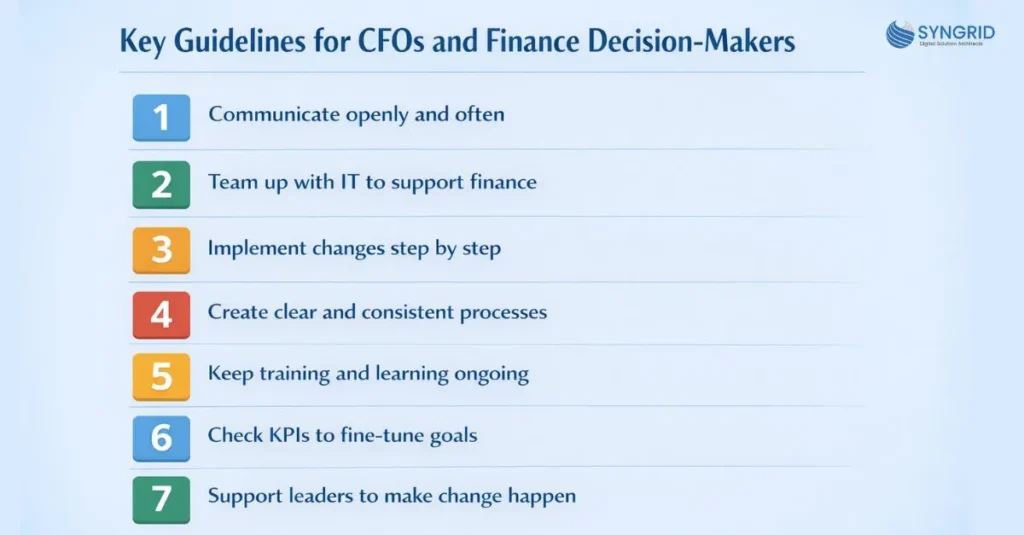
Key Guidelines for CFOs and Finance Decision-Makers
For a Zoho implementation to deliver measurable financial and operational value, finance leadership must take an active, structured approach. Clear communication between stakeholders, close collaboration with IT teams, and a phased rollout strategy help reduce risk and improve adoption. Standardized processes ensure data consistency across departments, while continuous training enables teams to adapt as workflows evolve. Regular monitoring of financial and operational KPIs allows leaders to refine objectives and improve outcomes over time. Most importantly, empowering internal leaders to champion change ensures alignment, accountability, and long-term success across the organization.
Integrate Zoho Finance With Business-Critical Systems
Finance teams rarely operate in isolation. CRM, payroll, inventory, and procurement systems all influence financial data.
A successful Zoho implementation requires:
Seamless integration between Zoho CRM and finance modules
Accurate payroll and expense data synchronization
Automated invoice, tax, and revenue recognition workflows
Centralized reporting across departments
Zoho’s native integrations and APIs make this possible, but architecture planning is critical to avoid fragmented reporting or reconciliation gaps.
Prioritize Compliance, Taxation, and Audit Readiness
For finance leaders, compliance is non-negotiable. Zoho supports multiple tax regimes, statutory reporting, and audit requirements, but these must be configured correctly based on geography and industry.
Key considerations include:
Local tax compliance and GST/VAT handling
Role-based access for financial data
Secure approval workflows
Audit logs and transaction traceability
Finance leaders should actively participate in compliance configuration rather than treating it as a post-implementation task.
Drive Adoption Through Structured Change Management
Even the best-configured system fails if teams do not adopt it correctly. Finance leaders play a critical role in driving behavioral change.
Best practices include:
Clear communication on why processes are changing
Role-specific training for finance, sales, and operations
Gradual rollout of automation to avoid disruption
Defined escalation paths for system issues
Zoho’s usability supports faster adoption, but leadership involvement ensures consistency and accountability.
Use Analytics to Measure Financial Impact Early
Zoho Analytics allows finance leaders to track ROI from implementation by measuring performance improvements in real time.
Metrics to monitor include:
Month-end close timelines
Billing and collection efficiency
Expense control and budget variance
Forecast accuracy
Early visibility into these KPIs helps finance leaders fine-tune workflows and demonstrate business value to stakeholders.
Work With a Zoho Authorized Partner With Proven Experience
Zoho implementations involve financial structuring, system integration, compliance configuration, and change management. Partner expertise significantly reduces risk.
Syngrid Technologies is a Zoho Authorized Partner with hands-on experience implementing Zoho Finance, CRM, and Analytics solutions for growing businesses. The focus is not just on deployment but on aligning Zoho with financial controls, reporting needs, and long-term scalability.
This partner-led approach ensures:
Faster implementation timelines
Reduced rework and configuration errors
Strong compliance alignment
Scalable architecture for future growth
Final Thoughts
For finance leaders, managing a Zoho implementation is about governance, accuracy, and strategic enablement, not just system rollout. When implemented with clear objectives, strong data controls, and expert guidance, Zoho becomes a powerful financial operating platform rather than just an accounting tool.
With the right leadership involvement and an experienced finance teams can unlock real-time visibility, operational efficiency, and confident decision-making across the organization