

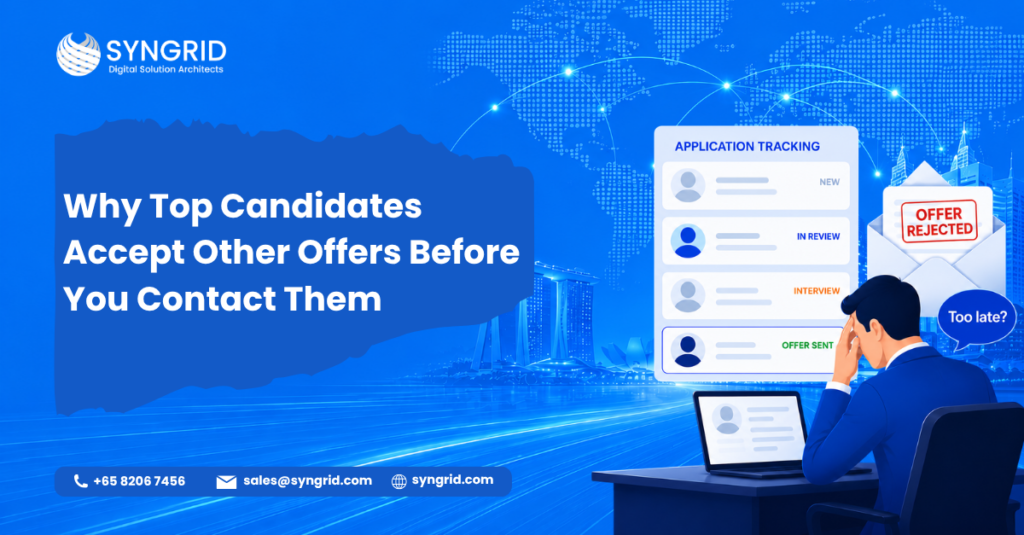
“The best candidates don’t stay available for long. The companies that move faster usually win.”
Recruitment today isn’t suffering from a lack of talent.
It’s suffering from a lack of speed.
Many businesses spend weeks reviewing resumes, coordinating interviews, and manually shortlisting applicants only to discover their strongest candidates have already accepted another opportunity.
By the time recruiters reach out, the decision has already been made.
And the cost is higher than most companies realize.
The Hiring Delay Most Businesses Don’t Notice
Hiring teams often assume candidates remain available throughout the recruitment process.
Reality is different.
Top candidates actively apply across multiple companies and typically receive several opportunities simultaneously.
Even a few days of delay can impact outcomes.
Common causes include:
Manual resume screening
Slow candidate shortlisting
Delayed internal approvals
Poor recruiter visibility
Too many applications to review
The result?
High-quality candidates disappear before meaningful engagement begins.
Why Speed Has Become a Competitive Hiring Advantage
Candidates evaluate employers the same way businesses evaluate talent.
A slow process often signals the following:
Poor internal coordination
Lack of decision-making speed
Weak candidate experience
Fast hiring creates momentum.
Candidates feel valued.
Recruiters stay productive.
Teams fill roles faster.
Modern recruitment is no longer about reviewing more resumes.
It’s about identifying the right people faster.
The Problem With Traditional Recruitment Processes
Manual hiring workflows create unnecessary friction.
Recruiters spend hours reading resumes, comparing candidates, updating spreadsheets, and tracking applications across disconnected systems.
As hiring volume grows, delays multiply.
Businesses struggle with:
Resume overload
Missed top candidates
Inconsistent evaluations
Limited recruitment visibility
Longer time-to-hire
This situation creates hiring bottlenecks that directly impact business growth.
How AI-Powered ATS Is Changing Recruitment
AI is helping recruitment teams reduce repetitive work and focus on decision-making.
Instead of manually reviewing every application, recruiters can instantly identify stronger matches using structured evaluation.
Modern ATS platforms help businesses:
Screen resumes faster
Match candidates against job descriptions
Generate candidate insights
Centralize hiring workflows
Improve recruiter productivity
The outcome is simple:
Better hiring decisions in less time.
How Syngrid Helps Businesses Hire Faster
Syngrid Technologies offers an AI-Powered Applicant Tracking System (ATS) designed to simplify and accelerate recruitment.
The platform combines intelligent screening with centralized hiring workflows to help businesses identify stronger candidates faster.
Key capabilities include:
✔ AI-powered resume screening
✔ JD-based Resume Analyzer
✔ AI Score Summary
✔ Keyword Match Evaluation
✔ Candidate tracking dashboard
✔ Faster shortlisting and hiring decisions
By reducing manual recruitment effort, Syngrid helps businesses engage top candidates before competitors do.
Final Thoughts
Top candidates are rarely unavailable.
They’re simply hired faster.
Companies that continue relying on manual recruitment processes risk losing strong talent before conversations even begin.
The businesses winning talent today are not reviewing more resumes.
They’re making smarter and faster hiring decisions.
Because in modern recruitment, speed creates opportunity.
Frequently Asked Questions About This Blog
Why do top candidates accept other job offers before recruiters contact them?
Top candidates often apply to multiple companies at the same time and receive several offers quickly. When recruitment processes are slow due to manual screening and lengthy approvals, qualified candidates may accept other opportunities before recruiters can engage with them.
How can an Applicant Tracking System (ATS) speed up hiring?
An ATS automates tasks such as resume screening, candidate tracking, and shortlisting. This reduces manual effort, improves recruiter efficiency, and helps businesses identify and contact qualified candidates faster, reducing overall time-to-hire.
What are the benefits of using an AI-powered ATS for recruitment?
An AI-powered ATS can analyze resumes, match candidates to job descriptions, generate candidate scores, and provide hiring insights. This helps recruiters make faster, more accurate hiring decisions while improving the candidate experience.
How does faster recruitment help businesses attract better talent?
A faster recruitment process allows businesses to engage top candidates before competitors do. Quick communication, efficient screening, and timely decision-making improve candidate experience and increase the chances of securing high-quality talent.