
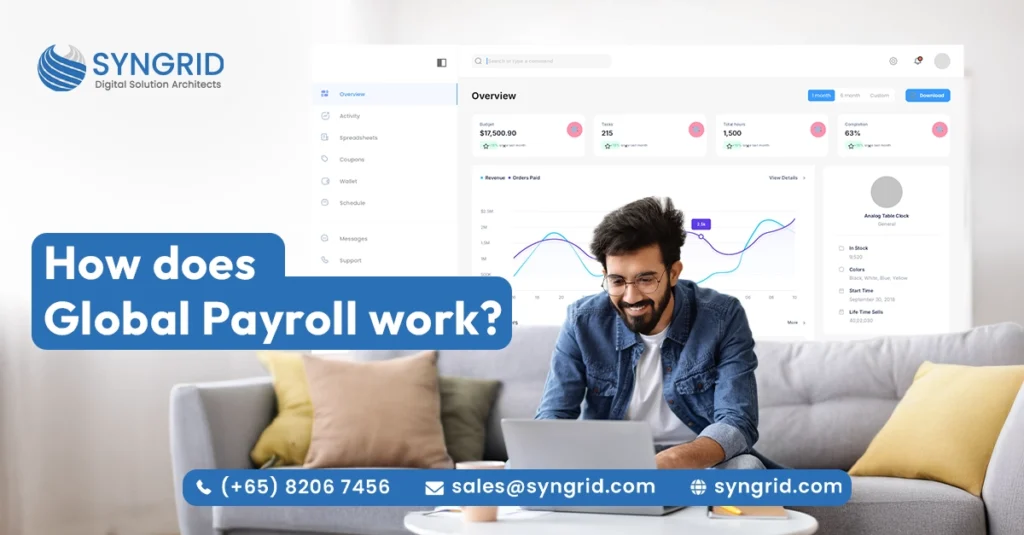
Global payroll is the process of managing employee compensation across multiple countries while ensuring compliance with local labor laws, tax regulations, currency conversions, and statutory reporting requirements. As businesses expand internationally and embrace remote hiring, global payroll has evolved into a strategic function that directly impacts compliance, employee satisfaction, and business continuity.
Unlike domestic payroll, global payroll involves handling complex regulations, multiple currencies, and diverse employment structures. Understanding how global payroll works helps organizations build efficient systems that ensure accurate, timely, and compliant salary processing across borders.
Why Global Payroll Is Important for Businesses?
With the rise of international operations, cross-border hiring, and remote work models, businesses must manage payroll across multiple jurisdictions. Any payroll error can result in penalties, legal issues, employee dissatisfaction, and reputational damage.
Global payroll ensures:
Legal compliance across regions
Accurate employee compensation
Transparent financial reporting
Strong workforce trust
Operational efficiency
When payroll processes function smoothly, companies can focus on growth without compliance concerns.
How Global Payroll Works: Step-by-Step Process
1. Employee Data Collection and Management
Global payroll begins with gathering accurate employee data, including personal information, employment terms, salary details, tax identification numbers, and benefits eligibility. This data must comply with regional data protection regulations and be securely stored.
2. Salary Calculation Based on Local Rules
Each country has unique wage structures, tax slabs, overtime rules, and benefit policies. Payroll systems calculate salaries based on these region-specific rules, ensuring accurate deductions and statutory contributions.
3. Tax and Statutory Compliance Processing
Global payroll systems calculate and deduct applicable income taxes, social security contributions, pension payments, insurance premiums, and other statutory deductions based on local laws.
Compliance teams must ensure all filings and contributions meet government deadlines to avoid fines or legal risks.
4. Multi-Currency Payment Processing
Once payroll calculations are complete, salaries are disbursed in local currencies. Exchange rate fluctuations, banking regulations, and international transfer fees must be carefully managed to ensure accurate payments.
5. Payslip Generation and Employee Access
Employees receive digital payslips detailing salary components, deductions, benefits, and tax contributions. Self-service portals allow employees to view, download, and manage payroll documents.
6. Statutory Reporting and Payroll Audits
Businesses must submit payroll reports to tax authorities, labor departments, and social security agencies. Regular payroll audits ensure accuracy, compliance, and transparency.
Key Challenges in Global Payroll Management
Managing payroll across borders introduces operational and compliance challenges.
Common challenges include:
Frequent changes in tax and labor laws
Complex statutory reporting requirements
Currency exchange fluctuations
Data security and privacy regulations
Managing multiple vendors and systems
Without automation and expert guidance, these challenges can significantly increase administrative burden and risk exposure.
The Role of Technology in Global Payroll
Modern global payroll systems rely heavily on automation, cloud computing, and AI-driven analytics. These technologies simplify payroll operations by reducing manual intervention, improving accuracy, and enhancing compliance.
Technology-driven payroll platforms enable:
Automated salary and tax calculations
Real-time compliance monitoring
Secure cloud-based payroll processing
Centralized payroll dashboards
Employee self-service functionality
Automation transforms payroll into a strategic business enabler rather than a back-office task.
Syngroo: Modern Payroll Technology for Global Businesses
To address the growing complexity of international payroll, Syngrid Technologies has developed Syngroo, a powerful and intelligent global payroll management platform designed for modern, fast-growing businesses.
Syngroo enables organizations to manage:
Multi-country payroll processing
Automated tax calculations
End-to-end compliance management
Employee self-service portals
Real-time payroll analytics and reporting
Secure cloud-based payroll workflows
With Syngroo, businesses can eliminate payroll complexity, minimize compliance risks, and ensure accurate, on-time salary payments across multiple countries, all through a single centralized platform.
Global Payroll Compliance: What Businesses Must Know
Each country enforces specific payroll regulations. Employers must stay compliant with:
Income tax laws
Social security contributions
Labor regulations
Mandatory benefits
Statutory reporting requirements
Failure to comply can result in financial penalties, audits, and operational restrictions. Continuous compliance monitoring is essential for risk-free global operations.
Best Practices for Managing Global Payroll Efficiently
To ensure seamless global payroll operations, businesses should:
Centralize payroll management
Automate payroll calculations and reporting
Maintain up-to-date compliance tracking
Use secure cloud-based platforms
Partner with experienced payroll technology providers
Regularly audit payroll processes
These practices significantly improve efficiency, accuracy, and workforce trust.
Future of Global Payroll
The future of global payroll is shaped by:
AI-driven automation
Predictive payroll analytics
Blockchain-based payments
Real-time compliance monitoring
Fully integrated HR and payroll ecosystems
These advancements will continue to reduce complexity while enhancing accuracy, transparency, and scalability.
Conclusion
Understanding how global payroll works is essential for businesses operating across borders. From employee data management and tax compliance to currency processing and reporting, every step must be precise, secure, and legally compliant.
With the right strategy, modern technology, and platforms like Syngroo by Syngrid Technologies, businesses can streamline payroll operations, ensure compliance, and build trus across their global workforce.
Global payroll success is no longer optional; it is a foundation for sustainable international growth.
FAQ
Syngroo is a cloud-based global payroll platform developed by Syngrid Technologies that helps businesses manage multi-country payroll, tax compliance, and salary processing from a single centralized. system.
Syngroo automates salary calculations, tax deductions, compliance tracking, and reporting, reducing manual work, payroll errors, and regulatory risks across countries.
Yes, Syngroo is built to scale with business growth, making it ideal for startups, SMEs, and enterprises managing distributed and international workforces.
Yes, Syngroo ensures country-specific payroll compliance by automating statutory deductions, tax filings, and regulatory reporting based on local labor laws.