


Every website has the same fundamental challenge: getting visitors to stay long enough to see your best work, understand your value, and take action. Most businesses invest heavily in driving traffic to their website but overlook one of the most powerful engagement tools available: the filterable portfolio gallery.
A standard static gallery dumps all your work on the page at once and leaves visitors to sort through it alone. A filterable portfolio gallery puts visitors in control, letting them choose exactly what they want to see, when they want to see it. That single shift in experience transforms passive browsing into active exploration, and the results show up directly in your engagement metrics.
Here are five compelling reasons why filterable portfolio galleries keep visitors engaged longer and why every business should have one.
Reason 1—Visitors Stay Longer When They Are in Control
The single biggest driver of engagement on any website is the feeling of control. When visitors can actively shape their experience by choosing which category to explore, which type of project to view, and which industry examples to examine, they become participants rather than passive observers.
This shift from passive to active is enormously powerful. Interactive elements on websites produce measurable engagement results. Adding interactive and audio-visual elements to a page can increase the time visitors spend on it by up to 88% compared to static content alone. A filterable portfolio gallery is one of the purest expressions of this principle; every filter click is an active engagement signal, and every active engagement keeps the visitor on your page longer.
For businesses, this translates directly into more time for your work to make an impression, more opportunities for visitors to find the exact example that resonates with them, and a significantly higher likelihood that they reach out.
Interactive Features Directly Boost Time on Site | Relevance: 95% of interactive features on websites produce measurable results. Visitors with things to explore stay longer, bounce rates drop significantly, and conversion rates increase. Adding interactive elements can make visitors stay up to 88% longer compared to static content alone.
Reason 2—Filtering Solves the Navigation Problem That Drives Visitors Away
One of the most underappreciated causes of high bounce rates is poor navigation, specifically, the inability of visitors to quickly find content that is relevant to them. When a visitor cannot locate what they are looking for within the first few seconds, they leave. It is that simple.
A filterable portfolio gallery is a direct and elegant solution to this problem. Instead of presenting every piece of work in an undifferentiated grid, it allows visitors to self-select their area of interest with a single click. An interior design studio’s visitor interested in office projects can filter to offices immediately. A technology client browsing a digital agency’s work can filter to web application projects without scrolling past irrelevant content.
Reason 3—Organized Content Appears More Credible and Professional
How your work is presented is almost as important as the work itself. A cluttered, unsorted gallery communicates disorganization regardless of how strong the underlying work may be. A filterable portfolio gallery does the opposite; it imposes visual order, communicates intentionality, and signals that you are a business that thinks carefully about presentation and user experience.
Visitors draw immediate conclusions about a brand’s professionalism from its website design. A well-structured filterable gallery with clear categories, consistent card layouts, and smooth transition animations elevates the perceived quality of everything it contains. Your work looks better simply because it is organized better.
This credibility effect compounds over time. The longer a visitor browses a well-organized, filterable gallery, the more confident they become in the quality and breadth of your expertise. Each additional category they explore reinforces their trust, creating a cumulative impression that no single static image could achieve alone.
Reason 4—Multiple Layouts Create the Right Visual Experience for Every Type of Content
Not all portfolio content is the same, and presenting it as if it were does a disservice to the work and to the visitor. Photography demands a different presentation than case studies. Product samples require a different layout than team portraits. Service showcases benefit from a different structure than client projects.
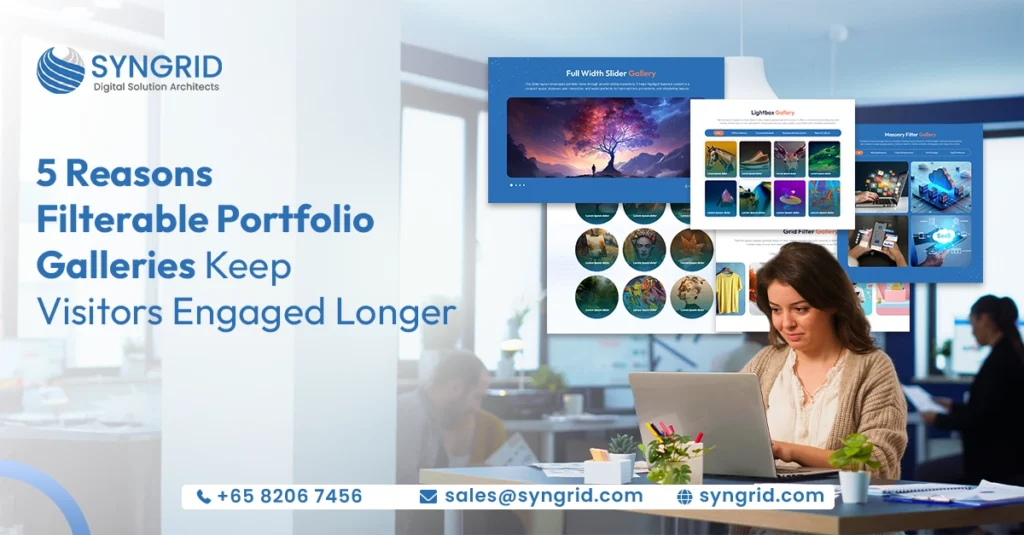
A sophisticated filterable portfolio gallery addresses this by offering multiple layout options that can be matched to content type. A grid layout delivers structured, even spacing ideal for professional services and case studies. A masonry layout creates a dynamic, flowing structure that suits image-rich creative portfolios and photography. A slider layout highlights featured work in a compact, high-impact format perfect for hero sections and promotions. A Lightbox view lets visitors explore individual pieces in full detail without leaving the gallery page.
When the layout matches the content, visitors engage more deeply because the experience feels intentional and polished. The right layout removes friction between the visitor and the work, making it easier to appreciate, evaluate, and remember.
Reason 5—Filterable Galleries Reduce Cognitive Overload and Keep Visitors Focused
One of the most consistent findings in user experience research is that too many choices presented simultaneously overwhelm visitors and reduce engagement. When a website displays everything at once with no filtering mechanism, visitors face a wall of content that is difficult to process, and the instinctive response is to disengage and leave.
A filterable portfolio gallery solves this by allowing visitors to narrow what they see to only what is relevant to them. The result is a focused, manageable browsing experience that reduces cognitive load, increases content relevance, and keeps visitors exploring longer. Each filtered view feels curated and purposeful, presenting exactly the right amount of content at the right time.
This focused experience is particularly valuable for potential clients in the early stages of evaluating your business. Rather than being overwhelmed by the full breadth of your work, they can explore the specific area they care about, building confidence in your expertise in their particular context before broadening their exploration.
SyngHub—The Filterable Portfolio Gallery Built for HubSpot
If your business runs on HubSpot CMS, there is a purpose-built solution that brings all five of these engagement advantages directly to your website without any custom development. SyngHub is Syngrid Technologies’ own HubSpot module, now officiaally available on the HubSpot Marketplace, and it includes a fully featured filterable portfolio gallery designed specifically for the HubSpot environment.
SyngHub’s Filterable Portfolio Gallery gives HubSpot users the ability to present their work across multiple professional layouts—Grid, Masonry, Lightbox, Slider, Full Width Slider, and Bordered Image Gallery—with smooth category filtering that lets visitors instantly sort projects by type, industry, or any custom category relevant to your business.
Built for HubSpot CMS from the ground up, SyngHub requires zero custom coding. Marketers and designers can manage portfolio content, add new projects, update categories, and adjust layouts entirely within the familiar HubSpot interface. Every gallery is fully responsive, mobile-first, and optimized for performance, ensuring the same quality experience across every device and screen size.
For agencies, businesses, and creatives already invested in the HubSpot ecosystem, SyngHub transforms what is typically a complex development project into a straightforward, manageable content experience. Your portfolio works harder for your business without adding complexity to your workflow.
Find SyngHub on the HubSpot Marketplace and start building a filterable portfolio gallery that keeps visitors engaged, builds credibility, and converts browsers into clients.
Conclusion—Engagement Is Not Accidental; It Is Designed
Visitor engagement does not happen by chance. It is the direct result of deliberate design decisions that respect the visitor’s time, simplify their navigation, and present your work in the most compelling way possible. A filterable portfolio gallery does all of these things simultaneously, and the impact on time on site, bounce rate, credibility, and conversion is measurable and consistent.
Whether you are showcasing creative projects, professional services, case studies, or product samples, a filterable portfolio gallery is one of the highest-return investments you can make in your website’s user experience. The businesses that implement it thoughtfully are the ones whose visitors stay, explore, and ultimately decide to get in touch.
Ready to build a filterable portfolio gallery that keeps your visitors engaged? Partner with the Syngrid Technologies website or explore Syngrid on the HubSpot Marketplace today.