
Syngrid

November 2025

Hubspot
Hubspot

HubSpot Migration Services

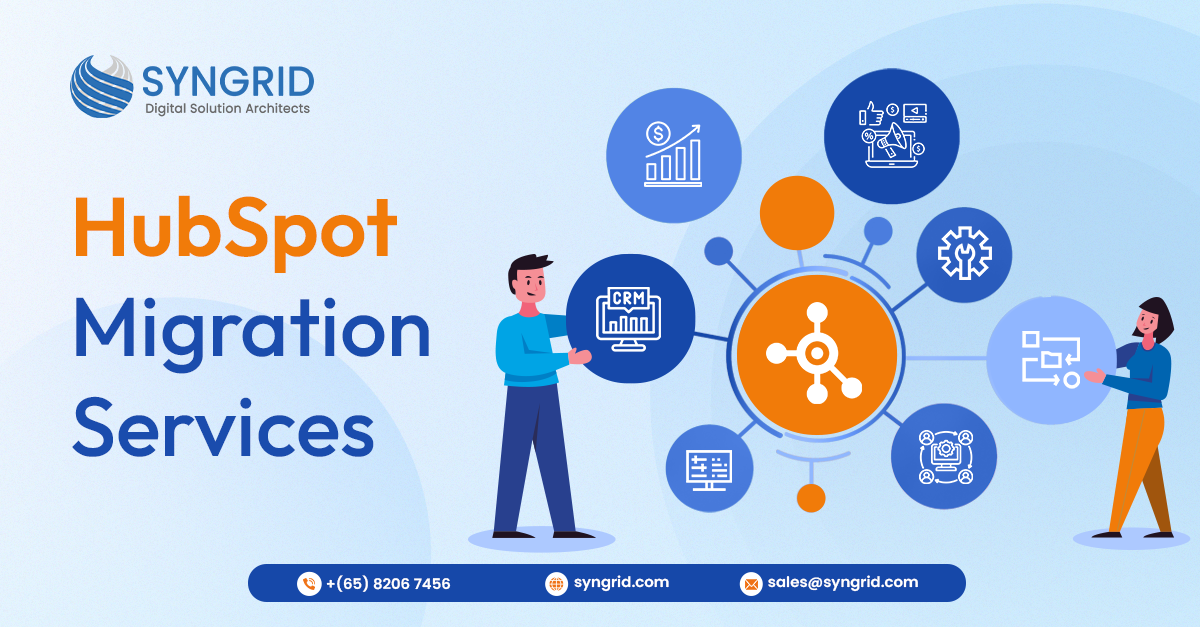
Introduction As businesses scale, managing websites, CRM, marketing automation, and customer data across multiple platforms can become overwhelming. Syngrid Technologies helps organizations seamlessly transition from outdated systems to the HubSpot CMS Hub and HubSpot CRM ecosystem. Our expert HubSpot migration services ensure zero data loss, enhanced performance, and improved ROI. With our proven approach, companies unlock automation, personalized marketing, and unified customer management all in one platform. What Is HubSpot Migration? HubSpot migration refers to the complete transfer of digital assets, website pages, blog content, CRM data, email templates, workflows, and automation into the HubSpot platform.Our process moves businesses from legacy systems like WordPress, Salesforce, Zoho, Wix, Webflow, Mailchimp, or custom CRMs into HubSpot without affecting website performance, SEO rankings, or ongoing operations. Why Migrate to HubSpot? Migrating to HubSpot is more than switching platforms; it’s a growth accelerator. Our clients benefit from Centralized CRM, CMS, marketing automation, and sales tools Personalized customer journeys and automated workflows Advanced analytics and reporting across marketing and sales Built-in SEO and website performance optimization Scalable architecture for growing businesses 24/7 website security, hosting, and CDN (no plugins required) With HubSpot, businesses gain an all-in-one engine for lead generation, automation, and revenue growth. Types of HubSpot Migration Services 1. Website Migration  Our experts migrate website design, layout, pages, blogs, and media to HubSpot CMS while maintaining brand identity, URL structure, responsiveness, and SEO.   2. CRM & Data Migration  Secure transfer of customer data, contacts, deals, pipelines, activities, and custom properties into HubSpot CRM without losing historical records. 3. Marketing Automation Migration Migration of workflows, email automation, campaigns, lead scoring, ad tracking, and customer journeys into HubSpot Marketing Hub. 4. Blog & Content Migration  Moving blog posts, categories, tags, CTAs, internal links, and author profiles while maintaining SEO and readability. 5. Email & Template Migration   Migration of email templates, sequences, newsletters, and branded layouts into HubSpot Email Builder, ensuring mobile-friendly and personalization-ready designs. Challenges Businesses Face During Migration Without professional support, organizations may encounter: Data loss, duplicate records, or property mismatch Broken internal links and SEO drops Layout and theme compatibility issues Downtime affecting traffic and leads Disrupted marketing and sales automation Security vulnerabilities Our structured migration approach addresses these challenges to ensure a smooth transition. Syngrid Technologies’ Step-by-Step HubSpot Migration Process 1. Audit & Planning  Conduct a detailed analysis of the existing system, business goals, workflows, and data architecture to create a precise migration roadmap. 2. Data Mapping  Map CRM fields, automation rules, properties, and modules to ensure 100% data integrity. 3. Secure Migration Execution  Migrate data, website pages, forms, templates, and automations using encryption, validated APIs, and governed practices. 4. Quality Check & Validation Test automation, UI/UX, CRM data, and SEO to ensure everything works as expected before go-live. 5. Go-Live & Optimization Post-launch, optimize website performance, lead tracking, reporting, and marketing ROI. SEO Preservation During HubSpot Migration Migration should never harm search rankings. Our team ensures: URL redirections and canonical tags Metadata retention (titles, descriptions, alt text, schemas) Page speed and Core Web Vitals optimization Internal linking and backlink mapping XML sitemap syncing Analytics and tracking continuity The result is a smooth migration where SEO performance improves rather than drops. Why Choose Syngrid as Your HubSpot Solution Provider? Syngrid is more than a migration vendor; we are a growth partner. Our services include: Expertise in HubSpot CRM, CMS, Marketing, and Sales Hub 100% secure, accurate, and SEO-friendly migration Zero downtime and zero data loss guarantee Tailor-made setups for website scaling and revenue growth Dedicated HubSpot consultancy and post-migration support Whether migrating from WordPress, Salesforce, Zoho, Mailchimp, Shopify, Webflow, or a custom system, our approach ensures a flawless transition into the HubSpot ecosystem. Conclusion Migrating to HubSpot empowers businesses with automation, personalization, scalability, and centralized control. With Syngrid Technologies, your HubSpot migration will be smooth, secure, and ROI-driven.   👉 Contact Syngrid Technologies today for expert HubSpot migration services. Our team specializes in websites, CRM, marketing automation, and content migration with SEO-first execution and uninterrupted business continuity. Let us help you unlock growth and transform your digital presence with HubSpot.

Exploring Blockchain in Mobile App Development
Mobile app development

Exploring Blockchain in Mobile App Development: Use Cases and Benefits

Introduction to Blockchain in Mobile App Development Blockchain is rapidly reshaping mobile app development by offering decentralized architecture, enhanced security, and transparent data management. Unlike centralized systems where user and transaction data is stored in a single vulnerable location, blockchain distributes information across encrypted nodes, making it nearly tamper-proof. As a result, businesses are increasingly adopting blockchain-powered mobile apps to deliver secure, reliable, and scalable digital experiences. Syngrid Technologies is one of the early adopters of blockchain-driven development, helping global businesses build secure and future-ready mobile applications backed by Web3, smart contracts, and decentralized systems. With deep expertise in enterprise-level blockchain solutions, Syngrid integrates security, automation, and scalability to ensure businesses gain real competitive advantage in the digital era. Why Blockchain Technology Is Transforming Mobile Apps? Blockchain solves many common weaknesses of traditional mobile apps: data privacy concerns, fraud, unauthorized access, and lack of transparency. Its decentralized nature ensures that every transaction is validated, encrypted, and permanent, which builds stronger trust between businesses and their users. This alone makes blockchain a breakthrough technology for sectors requiring security, transparency, automation, and traceability. Top Use Cases of Blockchain in Mobile App Development 🔹 Secure & Decentralized Payment Systems   Blockchain eliminates intermediaries such as banking gateways, resulting in faster settlements, reduced transaction fees, and fraud-resistant payments. 🔹 Blockchain-Powered dApps   Decentralized applications (dApps) operate without a central server, offering higher security, transparency, and censorship resistance across categories like finance, gaming, healthcare, and social platforms. 🔹 Supply Chain & Asset Tracking Applications   By recording every transaction on an immutable ledger, blockchain enables real-time tracking of goods, helping companies prevent fraud and ensure product authenticity. 🔹 Digital Identity & Verification Solutions   Blockchain supports secure identity management, allowing tamper-proof document storage, authentication, and e-KYC across finance, healthcare, education, and e-commerce applications. 🔹 Smart Contracts Automation   Blockchain-enabled mobile apps automate transactions using smart contracts, self-executing agreements that eliminate human intervention, reducing processing time, operational cost, and disputes. 🔹 Data Security & User Privacy Applications   Blockchain protects sensitive information through advanced cryptography and decentralized storage, ensuring confidentiality and resistance to hacking attempts. Business Benefits of Integrating Blockchain into Mobile Apps Adopting blockchain in Mobile app development unlocks transformative advantages:   ✔ Enhanced security against cyberattacks✔ Guaranteed transparency and trust among users✔ Reduced operational and transaction costs✔ 100% data integrity through immutable ledgers✔ Higher user control and compliance with privacy regulations✔ Massive scalability with Layer 2 and cross-chain systems Industries Rapidly Adopting Blockchain-Based Mobile Applications Blockchain adoption is growing across:   🔸 Banking & FinTech🔸 Healthcare & Pharmaceuticals🔸 E-Commerce & Retail🔸 Real Estate & Insurance🔸 Logistics & Supply Chain🔸 Gaming & NFT platforms🔸 Government and Public Services   These industries depend on security, transparency, automation, and trust—which blockchain delivers more efficiently than traditional systems. Key Challenges and Considerations Before Implementing Blockchain While powerful, blockchain development requires strategic planning. Key considerations include:   🔹 Selecting the right blockchain network (Ethereum, Hyperledger, Polygon, Solana, etc.)🔹 Compliance requirements and data regulations🔹 Integration with existing IT infrastructure🔹 Skilled blockchain developers needed for execution🔹 Development and maintenance cost planning   With the right development partner, these challenges become opportunities for innovation. Why Blockchain and Mobile App Development Are the Future? As users demand secure digital transactions, decentralized ownership, and transparent business operations, blockchain will play a critical role in the next generation of mobile apps. From Web3 and NFTs to supply chain automation and decentralized finance, the convergence of blockchain and mobile applications represents the future of digital transformation. How Syngrid Technologies Builds Secure & Scalable Blockchain-Based Mobile Apps? Syngrid Technologies specializes in building next-generation mobile apps powered by blockchain, helping businesses unlock security, automation, and transparency. Our blockchain expertise includes:   🔹 Blockchain app development for iOS & Android🔹 dApp & Web3 development🔹 Smart contract development & audits🔹 Crypto payment gateway integration🔹 NFT marketplace & tokenization solutions🔹 Secure identity, supply chain & finance apps   With a proven team of blockchain and mobile app engineers, Syngrid delivers enterprise-grade, scalable, secure, and high-performance blockchain applications tailored to business goals, whether you’re starting a new project or upgrading an existing app. Final Thoughts Blockchain is more than a technological trend; it is becoming the foundation of the future digital ecosystem. Businesses that adopt blockchain-powered mobile apps today gain a significant competitive edge in security, automation, transparency, and user trust. From decentralized finance (DeFi) to supply-chain tracking, smart contracts, identity authentication, and Web3 payments, blockchain is reshaping how modern applications operate.   If you’re planning to build a blockchain-based mobile app or want to explore how blockchain can enhance your existing digital product, Syngrid Technologies is ready to help you transform your vision into a secure, scalable, and high-performing solution powered by next-generation blockchain architecture. Contact Syngrid Technologies today to get expert consultation and a project quote.

How to Integrate Zoho Desk with Your E-commerce Platform
Zoho Products

How to Integrate Zoho Desk with Your E-commerce Platform?

Introduction In modern e-commerce, customer support can make or break a brand. Fast responses, accurate order updates, and seamless issue resolution are now expected, not optional. This is where Zoho Desk integration for e-commerce becomes a game-changer. By connecting your online store with Zoho Desk, you enable automated ticket creation, centralized order visibility, and faster customer support across email, chat, social media, and marketplaces.   At Syngrid Technologies, we specialize in Zoho Desk implementation and e-commerce integration, helping businesses unify customer support, streamline order management, and deliver world-class post-purchase experiences without manual effort. Understanding Zoho Desk Zoho Desk is an AI-powered helpdesk software designed to streamline customer support. It centralizes customer queries, automates ticket routing, enhances agent productivity, and provides instant access to customer and order data, all from a single dashboard. Benefits of Integrating Zoho Desk with an E-commerce Platform ✔ Automatic creation of support tickets from store orders✔ Unified view of shipping status, refunds, returns, and customer conversations✔ Faster resolution by eliminating manual lookups✔ Reduced workload for support teams✔ Personalized support experience with contextual order insights✔ Integration with AI chatbots for 24/7 automated support Prerequisites Before Starting Integration Before integrating Zoho Desk with your online store, ensure: A live e-commerce platform (Shopify, WooCommerce, Magento, BigCommerce, or custom) Active Zoho Desk subscription Order and shipping plugins/databases are accessible. API access (for custom or complex setups Defined customer support workflows   How to Integrate Zoho Desk with Top E-commerce Platforms 1️⃣ Shopify Install the Zoho Desk Shopify Connector from the marketplace. Enable automatic ticket creation for cancellations, refunds, and shipping updates Sync customer & order details to the Zoho Desk dashboard 2️⃣ WooCommerce Use the WooCommerce Zoho Desk Plugin Map order fields (order ID, shipping method, tracking, payment status) Enable workflow automation for returns and complaints 3️⃣ Magento Install the Zoho Desk Magento Extension Configure real-time ticket triggers based on order status Sync product SKUs & inventory updates to support agents 4️⃣ BigCommerce Use Zoho Desk Connector for BigCommerce Enable omnichannel support via email, chat, and social platforms Activate SLA rules for faster response times Custom-Built E-commerce Websites Custom platforms can also integrate with Zoho Desk using: Zoho Desk APIs Webhook triggers REST API Middleware & iPaaS tools (Zapier, Make, Integrately) This enables full customization based on business logic and workflows. Step-by-Step E-commerce Integration with Zoho Desk 1️⃣ Install or configure the connector/plugin.2️⃣ Authenticate your Zoho Desk account.3️⃣ Map customer and order fields4️⃣ Configure automation rules (ticket creation, notifications, CSAT surveys)5️⃣ Enable multichannel support (email, WhatsApp, chat, social media).6️⃣ Test support workflows end-to-end Automating Customer Support & Order Management Zoho Desk allows businesses to automate: Return & refund ticket workflows Shipping delay notifications Product replacement requests Warranty management Escalation rules for priority customers Automation reduces manual effort and accelerates response time. Common Integration Issues & How to Resolve Them IssueSolutionOrders not syncing Validate API permissions and field mapping. Duplicate tickets Enable ticket deduplication rules. Missing customer details Refresh store sync and CRM mapping. Chat not integrated Activate SalesIQ or a third-party chatbot. Email not triggering Verify DNS records and SMTP authentication. Best Practices to Maximize Zoho Desk Efficiency for E-commerce ✔ Use SLAs to guarantee response timelines.✔ Enable Zoho Zia AI for sentiment detection & auto-suggested replies✔ Create canned responses for repetitive issues✔ Use ticket tagging to classify order-related problems.✔ Enable self-service portals for returns and FAQs Must-Have Zoho Desk Extensions for E-commerce Growth 🔹 Zoho SalesIQ (live chat + AI chatbots)🔹 Zoho CRM (complete customer lifecycle view)🔹 Zoho Inventory (real-time stocking & order sync)🔹 Zoho Commerce (end-to-end e-commerce solution)🔹 Telephony & WhatsApp integration How Syngrid Technologies Helps You Implement Zoho Desk with Ease? Syngrid Technologies provides end-to-end integration for Zoho Desk and e-commerce, including:   🔹 Shopify / Magento / BigCommerce / WooCommerce integration🔹 Custom API-based integration for proprietary platforms🔹 Ticket automation & support workflows🔹 Zoho CRM & Zoho Inventory integration🔹 Live chat + WhatsApp + AI chatbot setup🔹 Training & post-deployment support   Whether you’re a growing D2C startup or an enterprise-level e-commerce brand, Syngrid ensures your Zoho Desk setup is scalable, automated, and ROI-driven. Pricing & Integration Time What to Expect Business Size Estimated Integration Time Approx. Cost Small 3–5 days Budget friendly Medium 7–14 days Standard pricing Enterprise 3–6 weeks Custom quotation Conclusion Integrating Zoho Desk with your e-commerce platform is one of the fastest ways to boost customer satisfaction, improve operational efficiency, and scale your business with automated support. With unified tickets, real-time order insights, and AI-powered resolutions, support teams can resolve issues faster and deliver a seamless post-purchase experience.   If you’re ready to integrate Zoho Desk with your e-commerce store, Syngrid Technologies is here to help with expert implementation, automation, and post-deployment support.

Employee Self-Service Portal Boosting Satisfaction and Reducing HR Workload in 2026
Global Payroll

Employee Self-Service (ESS) Portal Boosting Satisfaction and Reducing HR Workload in 2026

Introduction As organizations move deeper into digital transformation, enhancing employee experience and optimizing HR workflows have become top priorities. One of the most effective ways to achieve both is through an Employee Self-Service (ESS) Portal, a centralized digital platform that enables employees to manage their personal and HR-related tasks on their own. More companies are now realizing that empowering employees to access information independently not only improves satisfaction but also reduces the operational burden on HR teams.Syngrid Technologies, a leader in HR tech and custom software development, builds secure, scalable, and automation-driven ESS portals that help businesses modernize workforce management and create a more connected workplace. What Is an Employee Self-Service (ESS) Portal? An employee self-service portal is a web- or mobile-based application that allows employees to handle tasks such as downloading payslips, applying for leave, updating personal details, checking attendance, submitting reimbursement claims, and accessing company policies without needing assistance from HR. It serves as a digital HR hub where employees have full transparency and real-time access to the information they need. How ESS Portals Boost Employee Satisfaction? Employees feel valued and motivated when they have easy access to essential services. With an ESS portal: No more waiting for HR to answer basic queries Quick access to documents, payslips, and leave details Faster approvals and smoother communication Convenience, transparency, and autonomy significantly contribute to higher job satisfaction and employee engagement. Reducing HR Workload with Automated Self-Service Systems HR departments spend an enormous amount of time responding to repetitive requests for attendance corrections, reimbursement updates, appointment letters, policy clarifications, etc.An ESS portal automates and decentralizes these processes, allowing HR teams to focus on talent management, employee growth, and culture building rather than administrative tasks. Key Features Every Modern ESS Portal Should Have in 2026 A future-ready ESS portal should include: Leave & attendance management Payslips, salary structure & tax management Employee onboarding & digital document storage Performance review dashboards Expense & reimbursement workflow automation Internal communication & announcements Shift scheduling and time tracking Training & career development modules Mobile app availability Advanced security & role-based access Top Benefits of Implementing an ESS Portal ✔ Happier and more empowered employees✔ Reduced HR workload and manual effort✔ Centralized and error-free HR data✔ Faster onboarding and employee lifecycle management✔ Improved productivity and transparency✔ Lower operational costs across the HR department Common Challenges in HR Without an ESS Portal Organizations that still depend on manual HR operations typically struggle with: Delayed communication and employee frustration Heavy HR workload due to repeated requests Inefficient document handling and onboarding Data errors caused by manual processing Lack of clarity in policies and procedures Time-consuming payroll and reimbursement queries These challenges impact both employee experience and business performance, making digital HR systems essential. How to Choose the Right ESS Portal? To select the ideal ESS portal, ensure that it offers Seamless integration with existing HRMS, payroll, and attendance systems Smooth and intuitive user experience Automation capabilities for complex workflows Strong data security and compliance Easy customization based on company policies Scalability for future workforce expansion Step-by-Step Guide to Implementing an ESS Portal 1️⃣ Define goals and identify HR challenges.2️⃣ Choose the right ESS software or development partner.3️⃣ Integrate the ESS portal with HR and payroll systems.4️⃣ Configure workflows, automation rules, and permissions.5️⃣ Migrate employee records securely6️⃣ Conduct training for employees and HR teams7️⃣ Measure adoption and optimize based on usage data How Syngrid Technologies Helps Companies Build Advanced ESS Portals?  delivers custom employee self-service portals built around productivity, automation, and employee empowerment. Our solutions are Cloud-based, fast, and mobile-friendly Fully integrated with payroll, attendance, and HR systems Customizable for any industry or workforce size Backed by automation, analytics, and role-based access controls Whether you require a completely custom ESS platform or Zoho People-based HR automation, Syngrid provides end-to-end development, integration, training, and support. Conclusion In 2026, an employee self-service portal is no longer just an HR tool; it is a strategic foundation for employee satisfaction and operational efficiency. Companies that adopt ESS now build a more productive workplace, reduce HR overload, improve transparency, and strengthen retention.   📩 Ready to implement an ESS portal for your organization? Contact Syngrid Technologies today to start your HR digital transformation journey.

AI chatbot integration with CRM and ERP img
AI Chatbot

How to Connect AI chatbots with your CRM and ERP for unified workflows?

Introduction Modern businesses deal with increasing customer interactions, complex processes, and continuous operational demands. AI chatbots are helping organizations manage this smarter, but their true power is unlocked when connected to internal systems such as CRM (Customer Relationship Management) and ERP (Enterprise Resource Planning).   When chatbots work independently, they provide automated responses. When chatbots are integrated with CRM & ERP, they provide data-aware, contextual, and business-driven automation. This leads to: Faster customer query resolution Data-backed responses instead of assumptions Automated tasks across sales, support, and operations Why Should Businesses Integrate Chatbots with CRM & ERP? Businesses integrate chatbots with CRM and ERP to create a single connected ecosystem where communication, customer management, and backend operations function together seamlessly.   🔹 Instant access to customer and transaction data🔹 Consistent responses across departments🔹 Automated workflows without human intervention🔹 Reduced errors and faster decision-making   In simple words: Chatbot + CRM + ERP = Smart communication + Reduced manual work + Improved business productivity CRM Integration Benefits for Sales & Support AI chatbots integrated with CRM systems significantly elevate customer-facing operations, especially in sales and support.   ✔ Personalized responses based on customer history✔ Automated lead qualification and routing✔ Ticket creation and status updates directly from chat✔ Lead reminders and follow-ups without manual entry   Result: More conversions, higher customer satisfaction, and reduced workload for sales & support teams. ERP Integration Benefits for Operations & Efficiency An ERP-connected AI chatbot retrieves and updates operational information in real time, eliminating long wait times and back-and-forth communication.   ✔ Product and stock availability details✔ Order status, invoices, and delivery tracking✔ Automated procurement and inventory alerts✔ Faster internal coordination across departments   Result: Smoother operations, fewer dependencies on humans, and higher organizational efficiency. Top Business Use Cases of AI Chatbot Integration Use Case Chatbot Function E-commerce Order tracking, product search, returns SaaS Onboarding, subscription upgrades, support Banking Loan status, transaction summaries, KYC Healthcare Appointment management, patient queries Manufacturing Inventory visibility, supplier communication Logistics Live shipment alerts, route and delivery updates   AI chatbots become a digital gateway to CRM and ERP data, improving responses, decision-making, and engagement. How to Connect AI Chatbots with CRM & ERP Method Description APIs & Webhooks Real-time data sync between systems iPaaS / Middleware Zapier, Make, Workato, etc. for no-code integration Native Integrations Ready connectors provided by Zoho, HubSpot, SAP, Salesforce Custom Development Tailored integrations for enterprise systems Before implementation, businesses should define:🔹 Data flow rules🔹 Access permissions🔹 Workflow triggers based on events Challenges Businesses Face & How to Fix Them Challenge Solution Data mismatch Standardize field structure across systems Security concerns Enable encryption & role-based access Legacy ERP compatibility Use middleware or custom connectors User adoption Well-structured onboarding & intuitive UX With the right architecture, chatbot-driven automation becomes future-proof and scalable. Syngrid Technologies’ Role in System Integration Syngrid Technologies specializes in developing AI chatbots fully integrated with CRM, ERP, and business applications. The company delivers:   ✔ Custom AI chatbot development for sales, support & operations✔ Seamless CRM/ERP integration with platforms like Zoho, SAP, HubSpot, Salesforce, Microsoft               Dynamics & Oracle✔ Secure and scalable API-driven architecture✔ Workflow automation tailored to business processes✔ Performance analytics and continuous optimization   Syngrid ensures that companies don’t just use chatbots; they leverage chatbot-powered automation for measurable business growth and ROI. Final Verdict Integrating AI chatbots with CRM and ERP systems is a transformational move, not just a technology trend. When done right, it elevates customer engagement, eliminates repetitive manual tasks, speeds up operations, and builds a connected digital infrastructure across every business function. With unified, real-time data flowing between departments, organizations can make faster decisions and deliver seamless customer experiences at scale.   If your organization is ready to automate workflows and unlock unified customer journeys, Syngrid Technologies can help you deploy secure, scalable, and ROI-driven AI chatbot integrations tailored to your business goals. Need help integrating AI chatbots with CRM and ERP? Contact Syngrid Technologies today for expert assistance.

How Web Design Impacts SEO Tips for Better Rankings img
Digital Marketing

How Web Design Impacts SEO: Tips for Better Rankings

Introduction Web design is no longer just about making a website look attractive. The way a site is structured, how fast it loads, and how easily users can navigate it has a direct impact on search engine rankings. In simple words, a well-designed website improves SEO, while a poorly designed one harms visibility, traffic, and conversions. Businesses today need websites built not just for looks, but for performance, discoverability, and growth. At Syngrid Technologies, we specialize in creating SEO-driven web designs that enhance speed, user experience, and search visibility, turning websites into powerful engines for ranking and lead generation. This blog explains how web design influences SEO and what companies should focus on to achieve better rankings. 1️ The Connection Between Web Design & SEO Search engines measure user behavior. If visitors leave quickly, struggle to navigate, or face slow pages, rankings drop. A strong website design keeps visitors engaged, improves session duration, reduces bounce rates, and ultimately boosts search engine performance. 2️ Page Speed & Performance Search engines prioritize fast websites. Even a 2–3 second delay can increase bounce rate and reduce conversions. To improve page speed: Compress and optimize images Remove heavy or unnecessary scripts Enable browser caching and lazy loading Use quality hosting and optimized servers   3️ Mobile-Responsive Design Google uses mobile-first indexing, meaning mobile experience determines rankings.To improve mobile responsiveness: Use a responsive layout for all screen sizes Avoid text that requires zooming. Ensure buttons and navigation are touch-friendly. Remove intrusive pop-ups on mobile   4️ UX & Navigation A search engine ranks websites higher when users can easily find what they need.Strong UX includes: Clean and intuitive navigation Predictable layout patterns Visible CTAs and menu structure Consistent branding and design style Better UX = Better engagement = Higher SEO rankings 5️ Content Structure & Readability How your content is structured influences indexation and readability.Best practices include: Logical heading hierarchy (H1 → H2 → H3) Short paragraphs with clear transitions Bullet points for scannability Readable fonts and good contrast These improvements make content more accessible for users and crawlers. 6️ URL Structure & Internal Links SEO-optimized websites use clean and crawlable URL structures. Tips: Use short and descriptive URLs. Include keywords naturally Avoid random numbers and irrelevant parameters Internal links also distribute authority across pages and help Google understand content relationships. 7️ Image Optimization Images enhance user experience but slow down SEO if poorly optimized.To optimize images: Use descriptive filenames and alt text Compress images without sacrificing quality Use next-gen formats such as WebP Serve assets via a CDN when possible 8️ Website Security & Accessibility Security and accessibility are important ranking signals.Must-haves: HTTPS encryption XML sitemap & structured robots.txt Accessible design for all audiences Search engines prefer websites that are safe, transparent, and easy to crawl. 9️ How Syngrid Technologies Delivers SEO-Driven Web Design? Many businesses still treat SEO and design as separate objectives. Syngrid Technologies integrates both from day one. Syngrid builds websites with: SEO-friendly design architecture High-performance hosting and security Clean UI/UX aligned with search ranking behaviors Mobile-responsive and conversion-focused layouts Technical SEO implementation by default The result? Websites that look great, rank high, and convert sales consistently. Final Thoughts Web design directly influences SEO from loading speed and mobile responsiveness to navigation, content structure, and security. When these elements work together, websites rank higher, attract more traffic, and convert visitors into leads.   At Syngrid Technologies, we focus on this balance by building websites that are not only visually modern but also technically SEO-optimized for performance and growth. If your goal is to improve search rankings and generate more business through your website, a strategic, SEO-driven design approach is the way forward, and Syngrid can help you achieve it.  

All Category

Top Reasons Why Companies Switch to HubSpot CMS?

Introduction A business website can no longer survive by just looking good; it must perform. For B2B companies especially, the website has become the most powerful touchpoint for prospects to learn, compare, engage, and finally decide to connect with sales. The companies that win online today are those with websites built to educate, personalize, nurture, and convert visitors into qualified opportunities. This shift is exactly why more organizations are moving to HubSpot CMS, a platform not just for content management, but for growth, revenue acceleration, and customer experience. Role of Modern B2B Websites in Business Growth A high-performing B2B website must do more than just provide information. It must: Communicate business value clearly Support the buyer journey from awareness to decision Generate qualified leads consistently Deliver a personalized experience to every user Traditional CMS platforms struggle to meet these expectations because they depend heavily on plugins, manual updates, and constant developer support. Businesses now want a platform that not only powers their website but directly drives demand, leads, and revenue. What Makes HubSpot CMS Different from Traditional CMS Platforms? Platforms like WordPress, Joomla, and Drupal rely on multiple third-party plugins for SEO, analytics, performance, personalization, and security. This creates complexity and dependency. HubSpot CMS, on the other hand, is built natively for growth, offering: Full integration with HubSpot CRM Built-in SEO, analytics, and personalization tools Performance, security, hosting, and automation included Instead of being “just a CMS,” HubSpot CMS functions as a true growth platform aligning marketing, sales, and content together. Top Reasons Companies Switch to HubSpot CMS 1. Built-In SEO Tools That Boost Organic Traffic   HubSpot CMS provides complete SEO support without plugins, including: SEO recommendations and page insights Topic clusters and content strategy tools Automatic sitemap creation On-page optimization suggestions This means companies can rank faster, reduce plugin dependency, and get consistent SEO improvements without technical complexity. 2. Seamless CRM Integration for Smarter Lead Intelligence   HubSpot CMS is the only CMS built directly on a CRM, giving businesses powerful insights: Track every website interaction Understand what prospects view and engage with Enable automated lead scoring and segmentation This CRM-CMS connection allows marketing and sales teams to understand buyer behavior in real time, something traditional CMS platforms simply cannot offer. 3. Smart Personalization for Higher Conversions   HubSpot CMS personalizes content automatically based on: Device and location Lead lifecycle stage Past website activity CRM data and contact history With this level of personalization, companies experience higher engagement, improved conversions, and stronger customer relationships. 4. Built-In Lead Generation Tools That Drive Sales   HubSpot CMS transforms websites into revenue engines using: Landing pages and forms Dynamic CTAs AI chatbots and live chat Automated follow-up workflows Instead of adding multiple plugins, everything needed for demand generation and sales enablement is built-in. 5. Security, Speed & Scalability Without Maintenance Headaches   Traditional CMS platforms demand constant attention to updates, backups, plugin management, security patches, and server monitoring. HubSpot CMS removes all of this. It includes: Free SSL Global CDN for faster load speeds 24/7 security monitoring Automatic backups and updates Enterprise-grade hosting Businesses scale without downtime, risk, or additional technical investment. 5. Why Zoho One Is Better Than Using Multiple Stand-Alone Tools? Stand-alone software tools often lead to:  Data silos   Expensive subscriptions Manual reporting & duplicate work  Lack of automation Zoho One removes these challenges by providing: ✔ Enterprise-level features at a single cost✔ Centralized data with 100% visibility✔ Built-in automation across apps✔ Seamless user experience for every department Instead of adapting your business to different tools, Zoho One adapts to your workflow. How HubSpot CMS Empowers Marketing Teams Without Developers? A major reason companies switch to HubSpot CMS is speed. Marketing teams can: Edit pages Publish blogs Update CTAs Launch landing pages all without developer involvement.This reduces campaign execution time dramatically and allows brands to move faster than their competitors. Why Companies Prefer HubSpot CMS for Sales-Driven Growth? HubSpot CMS unifies marketing, sales, CRM, and analytics, empowering companies to: Attract the right audience Convert more leads Share real-time data with sales teams Improve revenue performance predictably Instead of being a cost center, the website becomes a scalable revenue machine Is HubSpot CMS Right for Your Business? HubSpot CMS is ideal for businesses that want: A website built for measurable growth, not just aesthetics Consistent lead generation and automation Tight alignment between marketing and sales Scalability without IT dependencies If your goal is to build a predictable, automated growth engine, HubSpot CMS is one of the strongest platforms available.   How Syngrid Technologies Helps Businesses Migrate & Scale with HubSpot CMS? To unlock the full potential of HubSpot CMS, the right implementation partner matters. Syngrid Technologies supports businesses with: HubSpot CMS migration from any platform Custom website design and theme development CRM + CMS integration setup Personalization & automation workflows Ongoing HubSpot support and optimization With certified HubSpot experts, Syngrid ensures businesses maximize conversions, improve sales outcomes, and achieve faster ROI from their investment in HubSpot CMS. How Syngrid Technologies Helps Businesses Migrate & Scale with HubSpot CMS? To unlock the full potential of HubSpot CMS, the right implementation partner matters. Syngrid Technologies supports businesses with: HubSpot CMS migration from any platform Custom website design and theme development CRM + CMS integration setup Personalization & automation workflows Ongoing HubSpot support and optimization With certified HubSpot experts, Syngrid Technologies ensures businesses maximize conversions, improve sales outcomes, and achieve faster ROI from their investment in HubSpot CMS.

Zoho Products

How You Can Grow Your Business with Zoho One?

1. Understanding Zoho One: A Unified Business Operating System Zoho One is more than a standard SaaS suite; it is a unified business operating system designed to run every department from a single connected platform. With 40+ integrated applications for sales, marketing, HR, finance, support, operations, and analytics, Zoho One eliminates the complexity of juggling multiple standalone tools.Businesses gain a centralized ecosystem where teams collaborate seamlessly, data flows without friction, and decision-making becomes faster and smarter. 2. Why Zoho One Is the Growth Engine for Modern Businesses? Today’s businesses demand agility, automation, and real-time customer insights. Zoho One acts as a true growth engine by connecting operations end-to-end: Sales and marketing alignment Automated customer journeys Unified financial tracking Streamlined communication and workflows This integration allows businesses to scale without increasing operational chaos and supports long-term digital transformation. 3. Identifying Your Core Applications for Scalable and Sustainable Growth Every business relies on a few primary apps to run its daily operations. With Zoho One, these core functions might include: Zoho CRM for sales pipeline management Zoho Books for accounting and billing Zoho People for HR and payroll Zoho Projects for collaboration and project delivery Choosing core apps sets a strong foundation for scalable growth, ensuring that the most critical processes are always optimized. 4. Integrating Auxiliary Applications for a Complete Software Ecosystem Auxiliary applications complement your core tools to create a fully connected digital ecosystem. Examples include: Zoho Inventory to sync with Zoho Books for stock management Zoho Campaigns to support Zoho CRM with automated email journeys Zoho Desk to enable customer support connected to CRM records This layered approach ensures that every department works together—not in silos. 5. Why Zoho One Is Better Than Using Multiple Stand-Alone Tools? Stand-alone software tools often lead to:  Data silos   Expensive subscriptions Manual reporting & duplicate work  Lack of automation Zoho One removes these challenges by providing: ✔ Enterprise-level features at a single cost✔ Centralized data with 100% visibility✔ Built-in automation across apps✔ Seamless user experience for every department Instead of adapting your business to different tools, Zoho One adapts to your workflow. 6. Automating Workflows to Improve Productivity & Reduce Manual Effort Automation is where Zoho One delivers remarkable results. Businesses can: Automate lead assignment, invoicing, notifications & reporting Trigger marketing sequences based on customer actions Sync CRM, accounting, sales & support workflows automatically This reduces manual work, saves time, minimizes errors, and allows teams to focus on high-value tasks instead of repetitive actions. 7. Benefits of Transforming Business Operations with Zoho One By adopting Zoho One, companies experience: 🔹 Higher team productivity🔹 Faster customer response times🔹 Increased revenue through automation🔹 Better data-driven decision-making🔹 Reduced software expenses🔹 Transparent visibility across departments Zoho One becomes not just a tool but a strategic driver of business efficiency and growth. 8. How Syngrid Technologies Helps Businesses with Zoho One? To get the full benefits of Zoho One, expert implementation makes a major difference.Syngrid Technologies helps businesses: Identify the right Zoho applications for their unique needs Configure and integrate apps without disrupting operations Automate complex workflows across departments Customize CRM, dashboards, analytics & reports Provide technical support and user training With Syngrid’s certified Zoho experts, companies maximize ROI and leverage Zoho One to its fullest capability, making digital transformation faster and smoother. 9. Final Thoughts Zoho One empowers organizations to scale confidently, automate intelligently, and grow sustainably Whether you’re a startup, SME, or enterprise, Zoho One provides everything needed to modernize business operations from the ground up. If your business is ready to move away from scattered tools and operate from a single connected platform, Zoho One is the most cost-efficient and future-ready solution, and Syngrid Technologies can help you get there.

AI Chatbot

How to Build an AI Chatbot for Your Website: Step-by-Step Guide

Introduction In today’s digital-first world, businesses need to engage with customers instantly, provide 24/7 support, and capture actionable insights. AI-powered chatbots make this possible by delivering automated, intelligent, and human-like conversations. A well-implemented chatbot can improve customer satisfaction, reduce support costs, and drive business growth. Companies like Syngrid Technologies specialize in designing AI chatbots that are scalable, efficient, and tailored to business objectives. By leveraging advanced AI technologies, Syngrid helps organizations create smarter, more interactive user experiences from the start. This guide walks you through why chatbots are important, the types of AI chatbots, strategy planning, development steps, no-code tools, costs, practical tips, and future trends. Why Your Business Needs an AI Chatbot AI chatbots are essential for businesses that want to stay competitive. Key benefits include: 24/7 Customer Support—Chatbots provide instant answers around the clock. Lead Generation & Qualification – Automatically collect and filter potential customers. Cost Efficiency – Reduce manual support while handling high volumes of queries. Enhanced Engagement – Personalized interactions keep users returning.   Types of AI Chatbots AI chatbots can vary in complexity and application: Rule-Based Chatbots – Follow predefined scripts, ideal for FAQs and simple queries. AI-Powered Chatbots – Use machine learning and NLP to understand intent and provide smart responses. Hybrid Chatbots – Combine rules and AI for both structured guidance and intelligent interactions. Voice-Enabled Chatbots – Enable hands-free interaction using voice recognition technology. Choosing the right type depends on your audience, industry, and business objectives. Planning an AI Chatbot Strategy A successful chatbot starts with a solid strategy: Define Objectives—Determine if the chatbot will handle customer support, sales, or lead generation. Know Your Audience—Understand users’ needs, pain points, and preferred communication channels. Feature Selection—Decide on live agent handover, analytics, multi-language support, or CRM integration. Set KPIs—Measure chatbot success through engagement, conversion rates, and user satisfaction. A clear strategy ensures the chatbot meets both business and user needs effectively. Step-by-Step Guide to Building an AI Chatbot Follow these steps for successful chatbot implementation: Requirement Analysis – Identify your goals, target audience, and the queries your chatbot will handle. Conversation Design – Map user journeys and create engaging dialogue flows. Technology Selection – Choose AI platforms, NLP engines, and integration tools. Development & Training – Build the chatbot and train it using relevant datasets. Testing & Optimization – Conduct beta testing and refine responses based on feedback. Deployment—Add the chatbot to your website, mobile app, or social media. Monitoring & Maintenance – Continuously optimize with analytics and user insights.   No-Code AI Chatbot Tools No-code platforms allow faster chatbot deployment without extensive coding: Dialogflow—Google’s platform for creating conversational interfaces. Microsoft Power Virtual Agents – Build chatbots using a drag-and-drop interface. Tidio, LandBot, ManyChat—Popular solutions for web and social media chatbot implementation. These tools are ideal for startups and small businesses aiming to launch quickly without deep technical resources. AI Chatbot Development Costs The cost of developing an AI chatbot depends on factors such as complexity, features, integrations, and the level of customization your business requires. Simple chatbots with basic functionality may require less investment, while advanced chatbots with NLP capabilities, CRM integration, analytics, and multi-channel support require a more strategic approach.   For an accurate estimate tailored to your business needs, it’s best to connect with the Syngrid Technologies sales team. They can help determine a solution that fits your goals, ensures scalability, and delivers a strong ROI. Practical Tips for Successful Chatbot Implementation Keep Conversations Simple – Avoid overly complicated scripts. Prioritize Mobile Experience – Ensure chatbots work flawlessly on smartphones and tablets. Continuous Testing—Regularly collect feedback and optimize performance. Integrate Analytics—Monitor interactions to improve user experience. Ensure Security & Privacy – Protect user data and comply with regulations. Even small improvements in these areas can significantly enhance user engagement and satisfaction. Future of Web-Based AI Chatbots The future of AI chatbots is bright and continuously evolving. Key trends include: Voice & Multimodal Interfaces—Handle text, voice, and images for richer interactions. Predictive Personalization – AI anticipates user needs and delivers tailored suggestions. Omnichannel Experiences—Unified interactions across websites, apps, and social platforms. AI-Driven Analytics – Real-time insights for smarter business decisions. AI chatbots are no longer just a tech trend; they are essential tools for business growth. Companies that leverage AI chatbots gain a competitive advantage through better customer support, higher conversions, and measurable efficiency. With strategic planning and expert implementation, your AI chatbot can transform the way your business interacts with users, providing scalable, intelligent, and impactful results. By partnering with Syngrid Technologies, businesses can implement future-ready AI chatbots that drive engagement, enhance customer experience, and improve operational efficiency.

AI Development

The Future of AI Development: Key Trends to Watch in 2026

Why AI Development Matters More Than Ever in 2026? Artificial intelligence has moved from being an emerging innovation to a core driver of digital transformation. In 2026, businesses are no longer asking whether they need AI; the real question is how fast they can adopt it.Organizations now depend on AI to improve decision-making, streamline operations, reduce labor costs, enhance customer experience, and create new revenue opportunities. From automation and predictive analytics to real-time personalization and autonomous systems, AI has become the backbone of modern business growth. As industries embrace AI at scale, companies that invest early gain a significant competitive advantage, faster operations, lower costs, and smarter digital products How is AI transforming web and mobile application development? AI is reshaping the entire cycle of web and mobile app development, making digital products quicker to build, more intuitive, and highly personalized. Here’s how AI is driving this transformation: 🔹 Smarter User Experiences   Apps can now understand user behavior, preferences, and intent, enabling more personalized experiences. 🔹 Predictive Interfaces   AI predicts what users need next, improving usability and increasing conversions. 🔹 Automated Testing   AI-powered tools test hundreds of app flows in seconds, ensuring bug-free releases. 🔹 Faster Development Cycles   With AI-assisted coding and low-code platforms, developers build apps 2–3x faster. 🔹 Enhanced Security   AI monitors unusual behavior, preventing attacks before they happen. From chatbots and recommendation engines to voice interfaces and AI-driven UI, artificial intelligence is now powering the next generation of digital applications. Trend 1: Autonomous AI Systems Becoming Mainstream 2026 marks the rise of self-learning, self-improving AI systems that can operate with minimal human input.These systems can: Make decisions independently Adapt to new data Recognize patterns in real time Optimize operations without manual adjustments Industries like logistics, finance, manufacturing, and automotive are already adopting autonomous AI to streamline processes and reduce operational delays. Trend 2: AI-Driven Business Automation Across All Industries AI automation is becoming essential for scaling businesses, especially in repetitive, time-consuming processes. AI automates:   Customer support via AI chatbots Payroll and HR workflows Document processing Inventory and supply chain operations Marketing segmentation and targeting By 2026, businesses that do not automate will fall behind in cost efficiency and productivity. Trend 3: Generative AI Advancing for Enterprise-Level Use Generative AI will evolve beyond content creation and enter enterprise-level applications. New enterprise use cases include:   Automated product design Smart customer onboarding Real-time market research Complex data modeling Automated coding and debugging Organizations will use generative AI to speed up internal operations while improving output quality. Trend 4: Hyper-Personalization Through Intelligent Data Models Personalization will become the standard expectation in 2026 , AI systems will deliver: Tailored product recommendations Dynamic website content Personalized pricing Behavior-based marketing Predictive service suggestions This improves user engagement, reduces churn, and boosts conversions significantly. Trend 5: AI + IoT Integration Creating Smarter Connected Ecosystems AI and IoT together will create an interconnected digital environment where devices communicate and adapt intelligently. Examples include: Smart homes and buildings Predictive healthcare systems Automated manufacturing using AI-driven sensors Intelligent logistics with real-time tracking AI and IoT will redefine automation across multiple industries globally. Trend 6: AI-Powered Cybersecurity for Real-Time Threat Detection With rising cyber threats, businesses are shifting to AI-driven security solutions. AI systems can: Detect anomalies instantly Stop attacks in real time Analyze patterns of suspicious behavior Automate security responses By 2026, AI will be considered the primary defense layer in cybersecurity. Trend 7: Low-Code & No-Code AI Accelerating Product Development Low-code AI platforms allow businesses to build applications without deep technical knowledge. Benefits include:   Faster product development Cost savings Easy integration with existing systems Democratization of AI inside organizations This trend will empower more teams to build and deploy digital products without relying heavily on engineering resources. Trend 8: Ethical AI, Data Privacy & Global Regulatory Trends With AI evolving quickly, governments and organizations are enforcing global standards for: Data privacy AI transparency Ethical decision-making Bias-free algorithms Businesses must follow these guidelines to maintain trust and remain compliant as regulations grow stronger in 2026. Trend 9: AI in Cloud & Edge Computing for Distributed Intelligence AI is moving closer to the user through edge computing., This enables:   Faster processing Reduced latency Real-time analytics Better performance for apps and IoT devices Cloud + Edge AI will enable smarter, real-time systems across industries requiring instant data decisions. How Businesses Should Prepare for the AI Shift in 2026 To stay competitive, organizations must: Invest in AI-ready infrastructure Implement data-driven processes Automate repetitive workflows Train teams in AI tools and technologies Adopt secure and ethical AI practices Partner with experienced AI development companies Businesses that prepare early will lead their industries in the coming decade. Why Choose Syngrid Technologies for AI Development? Syngrid Technologies helps organizations unlock the power of AI with solutions built for scalability, automation, and business growth With Syngrid, you get:   End-to-end AI development AI-powered automation systems Generative AI solutions Enterprise-level AI integration Data analytics & predictive modeling AI chatbots and virtual assistants Machine learning & deep learning solutions Custom AI solutions for mobile applications and website Development  Syngrid designs future-ready AI solutions that enhance productivity, reduce costs, and accelerate digital transformation Conclusion AI is reshaping industries faster than ever, and 2026 will be a defining year for businesses adopting advanced AI technologies. Companies that integrate AI into operations, customer experience, product development, and security will outperform competitors significantly. By partnering with Syngrid Technologies, businesses gain access to intelligent, scalable, and secure AI solutions designed to meet evolving digital demands. The future of AI development is here, and the organizations that act today will lead tomorrow.

Scroll to Top