
Syngrid

Global Payroll

Global Payroll

Midsize business expansion checklist: Is your payroll department ready for world-wide growth?

As midsize businesses expand into international markets, payroll operations quickly become one of the most complex business functions. Managing regional tax regulations, statutory benefits, multiple currencies, and workforce structures across countries requires systems that are designed for scale and compliance. A globally expanding organization must ensure its payroll framework can support operational growth without increasing financial or regulatory risk. This checklist outlines the essential payroll readiness factors midsize businesses must evaluate before entering new global markets. 1. Centralized Payroll Governance Across Regions Operating payroll through disconnected regional vendors or manual processes leads to data inconsistencies, delayed salary cycles, and limited oversight. For global expansion, businesses require a centralized payroll governance model that standardizes processes while accommodating country-specific requirements. Payroll teams should have real-time visibility into payroll status, approvals, and exceptions across all operating regions. Readiness check: Can payroll operations be monitored centrally across countries? Are payroll processes standardized without compromising local compliance? 2. Country-Specific Compliance and Statutory Accuracy Each country enforces unique payroll regulations related to taxation, social security, labor laws, and reporting schedules. Failure to meet statutory obligations can result in penalties, audits, and reputational damage. A globally ready payroll function must automatically apply local statutory rules, adapt to regulatory changes, and maintain audit-ready payroll records. Readiness check: Are statutory calculations automated per country? Can compliance updates be applied without manual intervention? 3. Multi-Currency Payroll Processing and Financial Consistency Global payroll requires precise handling of salaries across multiple currencies while maintaining financial consistency for reporting and budgeting. Payroll systems must support local currency calculations, standardized exchange rate application, and consolidated reporting for finance teams. Manual currency handling increases reconciliation effort and financial risk. Readiness check: Can payroll be processed in multiple currencies accurately? Are payroll costs consolidated for financial reporting? 4. Workforce Classification and Scalable Onboarding As organizations expand globally, workforce structures become more diverse. Payroll must support full-time employees, contract workers, and region-specific employment models. Scalable onboarding workflows and consistent payroll treatment across workforce types are critical for maintaining accuracy and compliance during rapid expansion. Readiness check: Can payroll handle different employment types across regions? Is onboarding standardized and scalable? 5. Payroll Data Security and Role-Based Access Payroll data contains sensitive personal and financial information, making security a non-negotiable requirement. A globally ready payroll system must include role-based access controls, data encryption, and audit logs to ensure data protection, regulatory compliance, and accountability across teams and geographies. Readiness check: Is payroll access restricted by role and region? Are audit trails available for internal and external reviews? 6. Integration With Finance, HR, and ERP Systems Payroll data contains sensitive personal and financial information, making security a non-negotiable requirement. A globally ready payroll system must include role-based access controls, data encryption, and audit logs to ensure data protection, regulatory compliance, and accountability across teams and geographies. Readiness check: Is payroll access restricted by role and region? Are audit trails available for internal and external reviews? 7. Real-Time Reporting and Executive Visibility Leadership teams require timely insights into payroll costs, headcount distribution, and compliance status across regions to support informed decision-making. Payroll reporting should provide real-time visibility, trend analysis, and exception monitoring without relying on manual data consolidation. Readiness check: Can leadership access consolidated global payroll insights? Are reports available without manual intervention? Why Syngroo Is Built for Midsize Global Expansion? Midsize businesses require enterprise-grade payroll capabilities without the operational complexity of traditional enterprise systems. Syngroo by Syngrid Technologies is purpose-built to support: Centralized global payroll operations with unified control Country-specific statutory compliance and tax accuracy Multi-currency salary processing with consolidated reporting Secure, scalable payroll architecture with role-based access Seamless integration with HRMS, ERP, and accounting platforms By eliminating fragmented payroll vendors and manual processes, Syngroo enables organizations to scale internationally with confidence, compliance, and financial visibility. Is Your Payroll Ready for Global Growth? Global expansion should accelerate growth, not introduce operational risk. Syngrid Technologies helps midsize businesses modernize payroll operations with Syngroo, delivering accuracy, compliance, and scalability across international markets. 👉 Contact Syngrid Technologies to assess your global payroll readiness and experience Syngroo with a 15-day free trial with no feature restrictions, designed to support your global expansion strategy with confidence.

Global Payroll

Global Payroll vs Local Payroll: Key Differences & Impact

Introduction As companies grow beyond national boundaries, payroll management becomes far more complex than simply processing salaries. Each country has its own tax laws, statutory deductions, currencies, and compliance requirements that must be followed accurately. Choosing the right payroll approach local payroll or global payroll can directly affect operational efficiency, compliance accuracy, and employee satisfaction. In this article, we break down the key differences between local and global payroll, explain their impact on businesses, and show how Syngroo, an advanced Global Payroll HRMS by Syngrid Technologies, helps organizations manage multi-country payroll with ease. What Is Local Payroll? Local payroll refers to managing employee salaries within a single country using payroll systems designed specifically for that region. It focuses on complying with local labor laws, tax regulations, and statutory obligations such as provident fund, social security, and income tax. While local payroll works well for businesses operating in one country, it becomes challenging as organizations expand internationally. Managing separate payroll vendors, systems, and compliance rules across multiple regions often leads to inefficiencies, higher costs, and an increased risk of errors or delays. What Is Global Payroll? Global payroll is a centralized system that allows businesses to manage payroll for employees across multiple countries from a single platform. It handles country-specific regulations, multi-currency payments, tax compliance, and benefits administration within one unified workflow. Syngroo Global Payroll HRMS automates salary calculations, deductions, allowances, and benefits while ensuring compliance across regions. With seamless integration into HRMS, accounting, and attendance systems, Syngroo makes global payroll scalable, accurate, and easy to manage for growing organizations. Global Payroll vs. Local Payroll: Key Differences Explained The main difference between local and global payroll lies in scale, automation, and control. Local payroll systems function independently for each country, often requiring manual coordination. Global payroll, on the other hand, centralizes payroll operations, enabling consistent processes across regions. Global payroll supports multi-currency payments, country-wise compensation structures, and consolidated reporting, while local payroll systems typically lack flexibility, scalability, and integration capabilities. Compliance & Regulatory Impact Across Countries Payroll compliance varies widely from one country to another, covering areas such as taxation, social security, labor laws, and statutory reporting. Managing these regulations manually or through multiple disconnected systems significantly increases the risk of compliance failures and penalties. Syngroo ensures country-specific statutory compliance by automatically applying local payroll rules and regulations. This reduces compliance risks and helps businesses maintain accurate and legally compliant payroll operations worldwide. Role of HRMS in Modern Payroll Systems Today’s payroll systems are no longer standalone solutions. Integrating payroll with an HRMS allows organizations to manage employee data, attendance, leave, benefits, and payroll from a single platform. Syngroo operates as an all-in-one HRMS & global payroll solution, enabling real-time data synchronization between HR and payroll. This integration improves accuracy, reduces duplication, and streamlines day-to-day HR operations. Automation & Efficiency: Global Payroll Advantage One of the biggest advantages of global payroll is automation. Syngroo automates salary calculations, overtime, deductions, reimbursements, and leave adjustments, significantly reducing manual effort and payroll errors. With automated workflows, approvals, notifications, and reporting become seamless, allowing HR and finance teams to focus on strategic tasks rather than repetitive payroll processing. Data Security, Access Control & Global Payments Payroll data is highly sensitive and requires strong security measures. Syngroo follows enterprise-grade data security standards, using encrypted cloud infrastructure to protect employee information. Role-Based Access Control (RBAC) ensures that only authorized users can access sensitive payroll data. In addition, Syngroo supports global payments and multi-currency payroll, ensuring employees are paid accurately and on time, regardless of their location. Business Impact: Cost, Accuracy & Scalability Global payroll systems help reduce operational costs by eliminating the need for multiple payroll vendors and manual processes. Automation improves accuracy through real-time validation, while centralized management allows businesses to scale easily as they enter new markets. Syngroo is designed to support startups, mid-sized businesses, and large enterprises with flexible configurations and a scalable payroll architecture. Why Syngroo Is the Right Choice for Global Payroll? Syngroo is built to solve real-world global payroll challenges. It offers country-wise compliance management, automated payroll processing, HRMS integration, advanced analytics, and customizable workflows. Features such as employee self-service dashboards, dynamic payroll forms, and integrated accounting make Syngroo a future-ready solution for managing global payroll efficiently. Why Choose Syngrid Technologies for Global Payroll Solutions? Syngrid Technologies is a trusted global payroll software development company in Singapore with over 9 years of experience. We specialize in building secure, scalable, and customized HRMS & payroll solutions tailored to different industries and workforce structures. Our expertise ensures accurate payroll processing, regulatory compliance, and ongoing supporthelping businesses grow confidently across borders. Conclusion Choosing between local and global payroll depends on your organization’s size and growth plans. While local payroll may be suitable for single-country operations, global payroll is essential for businesses managing international teams. With Syngroo Global Payroll HRMS and the expertise of Syngrid Technologies, organizations can automate payroll, ensure compliance, improve accuracy, and scale seamlessly turning global payroll from a challenge into a strategic advantage.

global payroll challenges
Global Payroll

Top Global Payroll Challenges Solved by SYNGroo

Introduction As businesses expand across borders, managing global payroll has become increasingly complex. Organizations must deal with different tax laws, statutory regulations, currencies, compliance requirements, and employee benefit structures across countries. Traditional payroll methods and disconnected systems often lead to errors, compliance risks, delayed salary payments, and employee dissatisfaction. This is where SYNGroo by Syngrid Technologies makes a difference. Built as next-generation global payroll management software, SYNGroo helps businesses automate payroll processes, ensure multi-country compliance, and streamline HR and finance operations through a single, unified platform. Challenge 1: Managing Multi-Country Payroll Compliance and Regulations Each country follows unique payroll laws, statutory deductions, tax rules, and reporting standards. Constant regulatory updates make compliance one of the biggest challenges for global organizations. How SYNGroo solves it: SYNGroo supports country-specific payroll compliance by automatically applying statutory rules such as CPF, PF, ESI, TDS, and other regional deductions. The platform stays aligned with local labor laws, helping businesses remain compliant without manual tracking or legal risks. Challenge 2: Handling Multiple Currencies and Global Salary Payments Managing salaries across different currencies and fluctuating exchange rates often results in payroll inaccuracies and delayed payments. How SYNGroo solves it: SYNGroo enables multi-currency payroll processing, allowing businesses to fund payroll in a base currency while ensuring employees receive accurate payments in their local currencies. This ensures timely salary disbursement and builds employee trust across regions. Challenge 3: Payroll Errors, Manual Processing, and Data Inconsistency Disconnected payroll, HR, and accounting systems create data silos, complicating reporting, reconciliation, and audits. How SYNGroo solves it: SYNGroo seamlessly integrates with HRMS, accounting software, attendance systems, biometric devices, and mobile apps. Attendance, leave, reimbursements, and employee data sync automatically with payroll, ensuring accurate and consistent salary processing. Challenge 4: Integrating Payroll with HRMS, Accounting, and Attendance Systems Disconnected payroll, HR, and accounting systems create data silos, complicating reporting, reconciliation, and audits. How SYNGroo solves it: SYNGroo seamlessly integrates with HRMS, accounting software, attendance systems, biometric devices, and mobile apps. Attendance, leave, reimbursements, and employee data sync automatically with payroll, ensuring accurate and consistent salary processing. Challenge 5: Managing Employee Earnings, Deductions, and Benefits Across Regions Global organizations must manage different earning structures, statutory benefits, allowances, and reimbursements based on regional policies. How SYNGroo solves it: SYNGroo supports country-wise compensation and benefits management, accurately calculating earnings, statutory deductions, non-statutory deductions, and reimbursements. Employees can easily access payslips, benefits, and claims through a centralized self-service dashboard. Challenge 6: Ensuring Data Security and Privacy in Global Payroll Systems Payroll systems handle highly sensitive employee data, making security and privacy non-negotiable. How SYNGroo solves it: SYNGroo follows enterprise-grade data security standards, including end-to-end encryption, role-based access control, and secure cloud infrastructure. This ensures payroll data privacy, regulatory compliance, and protection against cyber threats. Challenge 7: Lack of Real-Time Payroll Insights and Reporting Without real-time visibility, businesses struggle to track payroll costs, compliance status, and workforce trends. How SYNGroo solves it: SYNGroo delivers real-time payroll analytics and reporting, offering insights into payroll expenses, deductions, compliance status, and employee trends. These insights enable better financial planning and informed workforce decisions. How SYNGroo Streamlines Global Payroll Operations for Modern Businesses? SYNGroo simplifies end-to-end global payroll operations by combining automation, compliance, integration, and analytics into one powerful platform. Businesses gain centralized control, reduced manual effort, and improved payroll accuracy across all regions. Final Words Global payroll doesn’t have to be complicated. With the right technology, organizations can eliminate manual errors, reduce compliance risks, and improve employee satisfaction. SYNGroo by Syngrid Technologies empowers businesses to manage global payroll confidently with automation, security, and compliance at its core. If you’re looking to simplify multi-country payroll operations and future-proof your HR and finance processes, SYNGroo is the smart choice.

cloud payroll software-singapore
Global Payroll

How to Choose the Right Cloud Payroll Software in Singapore

Introduction Managing payroll in Singapore is more complex than it appears. From CPF contributions and MOM regulations to tax compliance and accurate salary calculations, even a small mistake can lead to penalties and employee dissatisfaction. As businesses grow and workforces become more dynamic, manual payroll processes and legacy systems struggle to keep up.   This is why many organizations are moving toward cloud payroll software in Singapore. A modern cloud payroll solution simplifies payroll processing, ensures compliance, and supports business scalability. In this guide, we’ll explore what cloud payroll software is, the challenges it solves, and how to choose the right solution while also showing why Syngrid’s global payroll platform, Syngroo, is a strong fit for Singapore and beyond. What Is Cloud Payroll Software? Cloud payroll software is an online payroll management system that allows businesses to process salaries, manage statutory deductions, and generate payroll reports through a secure cloud platform. Unlike traditional on-premise payroll systems, cloud payroll software does not require local installation or manual updates.   With cloud payroll software for Singapore, employers can calculate salaries, CPF contributions, overtime, and allowances automatically while accessing payroll data anytime, anywhere. These platforms are designed to stay updated with local regulations and reduce dependency on manual calculations. Key Payroll Challenges Faced by Businesses in Singapore Payroll in Singapore comes with its own set of challenges. Frequent regulatory updates, strict compliance requirements, and diverse workforce structures make payroll management demanding. Businesses often struggle with: Keeping up with changing CPF contribution rates and wage ceilings Accurate overtime and allowance calculations MOM reporting and statutory compliance Payroll errors caused by manual processes Managing payroll across multiple entities or regions Without the right payroll system, these challenges can increase operational risk and administrative workload. Benefits of Using Cloud Payroll Software Adopting cloud payroll software in Singapore offers clear operational and business advantages. One major benefit is accuracy. Automated payroll calculations reduce errors in salary processing, CPF deductions, and tax computations. Another key advantage is time efficiency, as repetitive payroll tasks are handled automatically.   Cloud payroll systems also improve compliance, ensuring statutory rules are applied correctly and updated regularly. Additionally, businesses gain real-time visibility into payroll data, enabling better financial planning and decision-making. Essential Features to Look for in Cloud Payroll Software Not all payroll systems are created equal. When evaluating cloud payroll software for Singapore, certain features are essential.   The platform should support automated gross-to-net salary calculations, CPF computation by age group, and flexible allowance and overtime handling. A strong payroll system should also offer employee self-service, allowing staff to access payslips and tax documents easily.   Advanced reporting, audit-ready payroll records, and seamless integration with HRMS, ERP, and attendance systems are also critical features to consider. Compliance Requirements: CPF, MOM, Tax & Statutory Reporting Compliance is non-negotiable in Singapore payroll. Cloud payroll software must be capable of handling CPF contributions, income tax calculations, and MOM reporting accurately.   An effective payroll solution ensures that employee and employer CPF contributions are calculated based on current regulations. It should also generate statutory reports and maintain proper documentation for audits and inspections.   Using compliant payroll software significantly reduces legal risks and gives businesses peace of mind. Scalability, Security & Integration Capabilities to Consider As businesses grow, payroll systems must scale without disruption. Cloud payroll software should handle workforce expansion, multi-entity operations, and even cross-border payroll needs.   Security is equally important. Payroll data contains sensitive employee information, so features like data encryption, access control, and secure cloud infrastructure are essential. Integration capabilities also play a key role. Payroll software should integrate smoothly with HR, finance, and attendance systems to ensure consistent and accurate data flow across platforms. Cost, Pricing Models & ROI of Cloud Payroll Solutions Cost is a major factor when choosing payroll software, but it should be evaluated alongside value and ROI. Some cloud payroll solutions in Singapore follow per-employee pricing, while others offer modular or subscription-based models.   Beyond upfront costs, businesses should consider long-term savings from reduced manual effort, fewer errors, and improved compliance. A well-implemented cloud payroll system delivers strong ROI by improving efficiency and minimizing payroll-related risks. Why Is Syngroo the Right Choice? Syngroo, the global payroll platform by Syngrid Technologies, is built to simplify payroll for businesses while supporting worldwide operations.   Syngroo automates gross-to-net salary calculations, CPF contributions, overtime, and allowances with precision. It is designed to stay compliant with Singapore regulations while also offering built-in support for multi-country payroll rules, making it ideal for growing and global businesses. The platform ensures smooth data flow and accurate payroll processing. With Syngroo, businesses can manage payroll across regions from a single, secure platform without increasing operational complexity. Conclusion Choosing the right cloud payroll software in Singapore is a strategic decision that impacts compliance, efficiency, and employee trust. With increasing regulatory demands and workforce complexity, businesses need a payroll solution that is accurate, scalable, and future-ready.   Syngrid Technologies, through its Syngroo global payroll platform, helps businesses simplify payroll operations, maintain compliance, and scale confidently both in Singapore and worldwide. If you’re ready to move away from manual payroll challenges and adopt a smarter payroll system, Syngroo is built to support your growth every step of the way.

Gross Salary in Singapore Explained
Global Payroll

Gross Salary in Singapore Explained: Quick Guide

Understanding Gross Salary in Singapore Understanding how salaries are calculated in Singapore is crucial for both businesses and employees. Terms like “basic salary,” “gross salary,” “overtime pay,” “CPF,” and “take-home salary” often create confusion. To simplify payroll and ensure clarity, let’s break down everything you need to know about gross salary in Singapore: what it includes, how it’s calculated, and why it matters. What Does Gross Salary Mean? Gross salary refers to the total earnings an employee receives before any deductions or taxes. It includes the basic monthly salary plus all additional payments such as Bonuses Overtime wages Allowances Commissions Incentives In simple terms, gross pay = basic salary + all additional income earned by an employee. Are Allowances Included in Gross Salary? Yes. Allowances are part of the gross salary. Common allowance types include Housing Allowance Transport Allowance Meal Allowance Allowances reflect the complete value of an employee’s compensation package. Including them in gross salary helps companies offer competitive pay and improve recruitment and retention. Does Overtime Compensation Count Toward Gross Pay? Yes. Overtime pay is included in gross salary. In Singapore, overtime compensation is typically calculated as Overtime Pay = Basic Hourly Rate × 1.5 × Overtime Hours Worked Including overtime helps employees understand the full value of additional hours worked and enables transparent compensation. Are CPF Contributions Part of Gross Salary? Employee CPF contributions are calculated based on an employee’s gross wages, and the contribution rate varies by age. Age Group CPF Contribution by Employee (%) 55 & below 20% Above 55 – 60 15% Above 60 – 65 9.5% Above 65 – 70 7% Above 70 5% Since regulations change over time, employers must stay updated on CPF rates and wage ceilings to remain compliant. Gross Salary vs. Basic Salary vs. Take-Home Salary Salary Type Meaning Basic Salary Fixed monthly pay without allowances/bonuses Gross Salary Basic salary + allowances + bonuses + overtime Take-Home Salary (Net Salary) Final amount received after CPF + taxes + deductions What Should an Employee’s Monthly Gross Salary Consist Of? Monthly gross salary generally includes: Basic pay Fixed monthly allowances Fixed monthly supplements Bonuses and overtime allowances are typically used when calculating annual gross salary rather than monthly. Are Raises Based on Basic Salary or Gross Salary? Salary increments may depend on company policy. Some businesses apply increments on: Basic Salary—for predictable payroll planning Gross Salary—for more comprehensive income growth Both employers and employees should have clarity on the increment basis to avoid confusion during performance reviews. Benefits of Accurate Gross Salary Calculation for Employers & Employees For Employers   Transparent compensation planning Easy salary bench-marking during hiring Improved employee retention Clear linkage between bonuses, performance & pay For Employees   Clear understanding of total compensation value Better monthly budgeting & financial planning Awareness of allowances and additional income value Accurate gross salary calculation supports trust, transparency, and compliance in the workplace. How Syngrid Technologies Simplifies Payroll & Salary Calculations in Singapore? Manual payroll processing often leads to inconsistencies in CPF calculations, overtime payments, and allowance management. Syngroo, the global payroll platform developed by Syngrid Technologies, addresses these challenges through structured automation and compliance-driven workflows. Syngroo supports accurate and efficient payroll operations by providing: Precise gross-to-net salary calculations aligned with Singapore payroll regulations Automated CPF computation based on employee age, category, and wage structure Configurable handling of allowances, bonuses, overtime, and statutory components Seamless integration with HRMS and attendance systems Timely and consistent salary processing with minimal manual interventio Built-in support for multi-country and region-specific payroll rules, enabling businesses to manage Singapore and global payroll operations worldwide from a single, unified platform Conclusion Gross salary isn’t just a number on a payslip; it represents the complete earning value for employees and plays a key role in budgeting, hiring, increments, and financial planning. Understanding gross salary builds transparency between companies and employees. If your business wants to automate payroll, ensure compliance, and improve accuracy, Syngrid Technologies is ready to support you with a powerful and scalable Global  payroll solution designed for Singapore and global operations.

payroll software company
Global Payroll

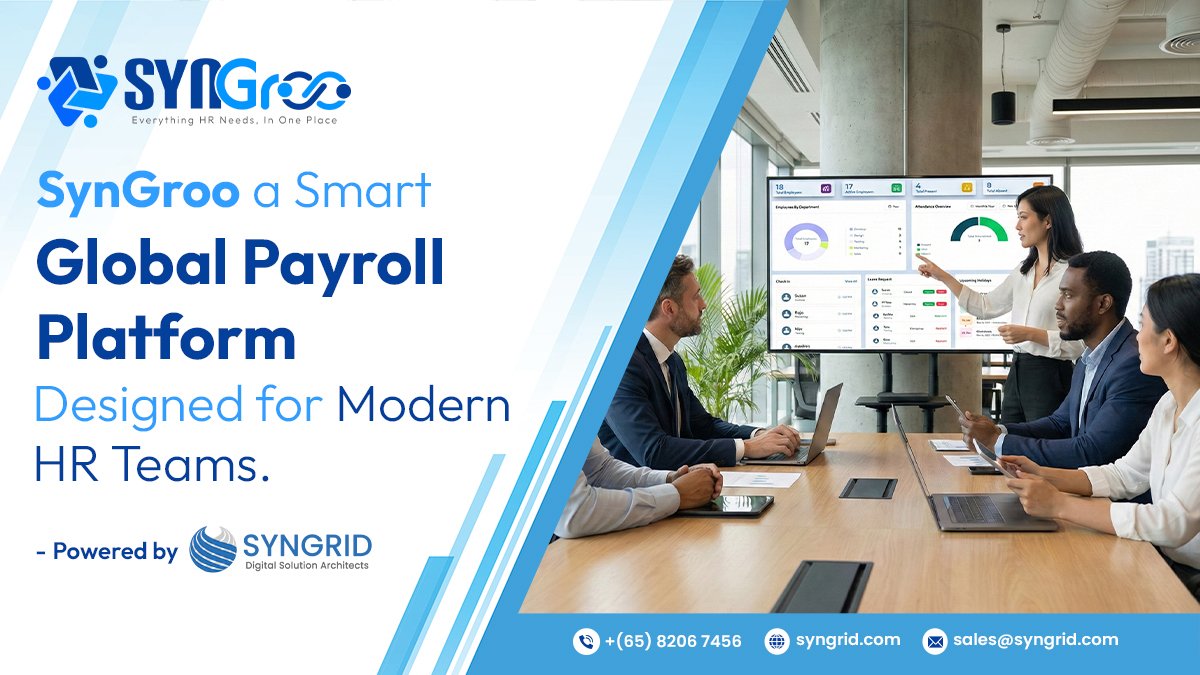
SynGroo—A Smart Global Payroll Platform for Modern HR Teams

1.Introduction Managing global payroll across multiple regions, currencies, time zones, and compliance laws is one of the biggest challenges for modern HR teams. Traditional payroll systems and disconnected HRMS tools often fail to support multi-country payroll management, remote work models, and rapidly evolving regulatory frameworks.   SynGroo, developed by Syngrid Technologies, is next-generation global payroll software with built-in HRMS capabilities, designed to automate payroll, attendance, leave, reimbursements, and HR workflows in one unified platform. Built for scalability, this cloud-based payroll with HRMS solution empowers startups, SMEs, and enterprises to run international payroll processing with confidence, accuracy, and speed anywhere in the world. 2.What Is SynGroo? SynGroo is Syngrid’s cloud-based global payroll platform built to handle multi-country payroll operations effortlessly. It centralizes payroll processing, attendance tracking, leave management, HR document management, and compliance monitoring into one secure global payroll ecosystem.   Designed for HR teams, payroll managers, finance teams, and distributed organizations, SynGroo delivers automated payroll management, integrated HRMS functionality, real-time payroll insights, and full global payroll compliance—without manual effort. 2.1 Next-Gen Global Payroll Software Solutions for Workflow Automation With 9+ years of experience, Syngrid Technologies specializes in building custom global payroll software tailored to workforce structures and country-specific payroll regulations. SynGroo automates salary distribution, leave tracking, attendance, reimbursements, and compliance across regions while offering drag-and-drop payroll customization and flexible subscription plans. 3. Key Features of SynGroo  3.1 Employee Dashboard SynGroo’s employee self-service payroll dashboard provides instant access to essential HR and payroll information without HR dependency. Payslips, attendance, and leave balances in one place Profile updates and real-time notifications Web and mobile access via the Syngroo app 3.2 Dynamic Employee & Payroll Forms Create and manage custom HRMS forms with an intuitive drag-and-drop builder. Custom payroll fields by department or role Role-based access for department heads Seamless employee data collection across teams 3.3 Employee Earnings & Deductions Management Automated and accurate global payroll calculations across countries. Salaries, bonuses, overtime, and incentives Statutory deductions (PF, ESI, income tax, age-wise rules) Loans, advances, and non-statutory deductions Error-free net pay every payroll cycle 3.4 Smart Payslip Generation SynGroo’s automated payslip generation system calculates gross-to-net salary with precision using real-time payroll by HRMS data. Bulk payslip email distribution Statutory and non-statutory deductions included Fully synced with attendance and leave 3.5 Leave Management System A fully automated HRMS-based leave management system tightly integrated with payroll. Digital leave requests and approvals Real-time leave balance tracking Auto-sync leave data with payroll processing 3.6 Holiday Management & Announcements   Manage holidays and internal communications across regions. Region-wise and company-wide holiday calendars Automated sync with payroll and attendance Scheduled announcements and alerts 3.7 Attendance & HR Settings   Flexible attendance tracking software with real-time accuracy. Biometric, web, and mobile check-in/check-out Grace time, permission hours, and weekend rules Attendance automatically synced with payroll 3.8 Cloud Document Management   Secure cloud-based payroll document management. Role-based access control Encrypted payroll data storage Anytime, anywhere global access 3.9 Payslip Download System   Employees can view and download payslips effortlessly. Historical payslip access Year-wise filtering Clear summary and navigation views 3.10 Check-in/Check-out System   Accurate global attendance management across devices. Real-time check-in and check-out logs Shift-based attendance tracking Mobile app and biometric device support 3.11 Project Management   Integrated HR project management software for productivity tracking. Task assignments and deadlines Agile dashboards Team collaboration and performance insights 4. SynGroo vs Other Global Payroll Software Why SynGroo global payroll software stands out: All-in-one Payroll + HR + Attendance + Reimbursements + Project Management Biometric, mobile, and web attendance support Drag-and-drop payroll customization Employee-first self-service payroll experience Cost-effective global payroll solution for SMEs & enterprises Built and supported by Syngrid Technologies 5. Why Businesses Choose SynGroo? Faster and fully automated payroll cycles Multi-country payroll compliance and currency support Reduced HR and finance workload Real-time global payroll visibility Scalable payroll system for growing businesses Secure, cloud-based payroll access 6. The Future of Payroll with SynGroo SynGroo continues to evolve as a future-ready global payroll platform with: AI-driven payroll automation Predictive payroll error detection Integrated accounting and HRIS systems Time-zone and region-wise payroll scheduling Advanced payroll analytics and reporting Our vision is to make global payroll management accurate, compliant, automated, and effortless. Upfront & Transparent Pricing Custom global payroll subscription plans Automated renewal reminders Unified payroll, HR, and expense management platform Dedicated global payroll specialists Full compliance with global payroll and tax laws Conclusion SynGroo is not just payroll software—it is a complete global payroll with HRMS workforce management platform designed for modern HR teams. With automation, compliance, security, and scalability at its core, SynGroo enables businesses to manage international payroll and HR operations with confidence. SynGroo, powered by Syngrid Technologies, helps organizations simplify global payroll, streamline HRMS processes, reduce errors, and empower employees worldwide.    Ready to transform your payroll operations? Contact us today to schedule a live demo or speak with our experts and discover how SynGroo can streamline payroll and HR management for your business globally.

Global Payroll

Top 10 Best Global Payroll Companies in 2026

Introduction Managing payroll across multiple countries is one of the most complex challenges for global businesses. From varying tax regulations and labor laws to multi-currency payments and local compliance requirements, companies need reliable payroll partners to ensure timely, accurate, and compliant employee payments.   In 2026, businesses are increasingly turning to global payroll providers to simplify payroll processes, reduce errors, and improve operational efficiency. Among these providers, Syngrid Technologies stands out for its comprehensive, automated, and compliance-focused global payroll solutions. What to Look for in a Global Payroll Company Choosing the right global payroll provider is critical to ensure smooth operations. Here are the key factors businesses should consider: Compliance Expertise: Ability to handle local tax laws, labor regulations, and statutory requirements in all operating countries. Automation Capabilities: Payroll automation to reduce manual errors and processing time. Multi-Country Support: Efficient management of employees across multiple countries, currencies, and pay schedules. Integration Options: Seamless integration with HRMS, ERP, and attendance systems. Data Security: Strong encryption, role-based access, and compliance with data privacy regulations (e.g., GDPR, PDPA). Scalability: Ability to grow alongside your business as operations expand globally. Our team at Syngrid Technologies ensures that every client receives a solution tailored to meet these criteria, giving businesses confidence in managing their global workforce. Top 10 Best Global Payroll Companies in 2026 1. Deel   Deel provides global payroll, contractor management, and compliance services. Its platform is known for simplifying cross-border payments and offers automated tax calculations for international hires. 2. Syngrid Technologies   Syngrid Technologies offers a dedicated payroll product, Syngroo, designed to provide centralized global payroll management with complete end-to-end automation. Syngroo supports multi-country compliance, integrates seamlessly with HRMS, ERP, and attendance systems, and delivers real-time reporting and insights. Businesses can rely on Syngroo to manage payroll with accuracy while significantly improving overall operational efficiency. 3. ADP   ADP is a well-established global payroll provider with a wide range of HR and payroll services. It offers scalable solutions suitable for enterprises of all sizes. 4. Papaya Global   Papaya Global specializes in payroll automation and workforce management for international teams. It provides real-time reporting and multi-country compliance. 5. Rippling   Rippling combines payroll with HR, IT, and benefits management in a single platform, enabling businesses to automate global employee administration efficiently. 6. Globalization Partners (G-P)   G-P offers Employer of Record services, allowing companies to hire internationally without establishing a local entity. Its global payroll system ensures compliance and simplifies workforce management. 7. Velocity Global   Velocity Global helps companies expand globally with compliant payroll, contractor management, and HR solutions tailored to international markets. 8. Paychex   Paychex provides payroll, HR, and benefits administration solutions. It’s known for reliability and strong customer support, primarily catering to U.S. and select international markets. 9. Oyster HR   Oyster HR offers global payroll, benefits, and compliance services for remote teams. It focuses on simplifying payroll processes for fast-growing international companies. 10. Safeguard Global   Safeguard Global delivers workforce management, payroll outsourcing, and compliance services for companies with employees in multiple countries. Comparison of Top Global Payroll Providers—Features & Pricing When comparing providers, businesses must consider: Number of supported countries Payroll automation and reporting features Integration capabilities with existing systems Customer support and service reliability Cost-effectiveness and pricing models Our team at Syngrid Technologies helps companies evaluate payroll providers against these metrics and even offers customized solutions to meet unique business requirements. Which Global Payroll Provider Is Right for Your Business? To select the best payroll provider, businesses should follow this framework: Assess Payroll Complexity: Number of employees, countries, and currencies involved. Evaluate Compliance Needs: Understand local labor laws, tax obligations, and reporting requirements. Integration Requirements: Ensure payroll systems can connect with HRMS, ERP, and time-tracking tools. Automation & Scalability: Look for solutions that reduce manual work and grow with your business. Security & Data Privacy: Check encryption, access control, and compliance with GDPR, PDPA, and other regulations. We at Syngrid Technologies guide businesses through this framework to ensure a seamless selection process and long-term payroll success. How Syngrid Helps Businesses Manage Global Payroll Efficiently? Centralized Global Payroll Processing   Our platform consolidates payroll data from multiple countries into a single system, giving HR and finance teams complete visibility and control. Multi-Country Compliance Support   We ensure adherence to local tax laws, labor regulations, and statutory filings in every country your business operates in. Integration With HRMS, ERP & Attendance Systems   Syngrid Technologies integrates payroll seamlessly with existing HR and accounting platforms to reduce manual reconciliation and errors. Payroll Automation & Reporting   Automated workflows handle calculations, approvals, and disbursements. Real-time reporting and analytics help businesses make data-driven decisions quickly. Our services ensure timely payments, accurate tax management, full compliance, and a transparent payroll experience for employees. Conclusion Managing global payroll is challenging, but with the right technology and expertise, businesses can simplify operations, reduce errors, and ensure compliance across all regions.   If your organization is expanding internationally or managing a distributed workforce, contact Syngrid Technologies. We provide centralized, automated, and secure global payroll solutions tailored to your business needs, allowing you to focus on growth while we handle the complexities of payroll management.

What is Global Payroll?
Global Payroll

What is global payroll?

Introduction As companies expand across borders, managing employee payments across multiple countries becomes increasingly complex. Different tax regulations, salaries in multiple currencies, data security laws, holiday entitlements, and cultural expectations make payroll management a demanding task. This is where a global payroll system becomes crucial for businesses aiming to pay international teams accurately, on time, and in full compliance. Syngrid Technologies supports companies in streamlining international payroll operations with high-accuracy processes and global payroll expertise. What is global payroll? Global payroll refers to the centralized management of payroll for employees and contractors across multiple countries. It covers salary calculation, tax filing, benefits administration, compliance, attendance tracking, holiday management, data protection, and payment distribution—all while following each country’s laws and policies. A global payroll system ensures: Employees are paid correctly and on time in their local currency. Taxes and statutory contributions are handled according to regional laws. Payroll data is collected, processed, and stored securely in one platform. Public holidays, leave quotas, and attendance records are captured in real time for accurate payments. Key Differences Between Global Payroll vs Local Payroll Local Payroll Global Payroll Manages payroll in one country Manages payroll across multiple countries Only one set of tax & labor laws Multiple tax & employment laws Local currency only Multiple currencies Lower compliance complexity High legal & regulatory complexity Simple internal workflows Centralized or hybrid workflows Global payroll is an advanced solution designed for multinational teams, remote companies, and businesses hiring beyond borders. How Global Payroll Works Global payroll processes salaries across countries by managing: Local tax calculations and statutory benefits Currency exchange and payment formatting Data privacy and regional data protection laws Attendance management, shift tracking & overtime calculations Holiday mapping according to each country’s calendar Regulatory reporting and filing deadlines Employee and contractor payout schedules A well-structured global payroll system ensures accuracy, compliance, and smooth salary distribution globally. Common Challenges in Managing Global Payroll 🔹 Regulatory Compliance Across Borders   Every country has unique tax codes, benefits rules, overtime policies, and holidays. Even a small compliance error can result in penalties and legal risks. 🔹 Data Integration Across Systems   If HR, attendance, and finance tools don’t integrate, payroll teams end up wasting time reconciling mismatched data. 🔹 Data Security   Protecting employee information (banking details, IDs, salary records) is essential to comply with GDPR, PDPA, CCPA, and other global data laws. 🔹 Language & Cultural Barriers   Payroll guidelines, leave rules, and reporting formats vary by geography and sometimes by language slowing payroll processing. Why Implement a Global Payroll Management System? A global payroll system enables companies to: Reduce manual work and payroll errors Improve compliance across markets Deliver accurate and timely payments worldwide Maintain transparency with centralized reporting Enhance employee satisfaction through accurate leave and attendance reflection Strengthen data security with secure payroll access How to Implement Global Payroll Processes That Work A strategic global payroll setup includes: Defining payroll & leave policies per region Consolidating payroll and attendance data in one system Configuring compliance rules and automatic tax updates Establishing approval workflows Ongoing payroll audits and reporting analytics 3 Types of Global Payroll Processing Modelsps? Businesses expanding across borders can choose different payroll operating models depending on their workforce size, hiring regions, and compliance requirements. Below is a clear breakdown of the three primary models: 1. In-House Global Payroll This model involves managing payroll internally with a dedicated team and payroll technology. Benefits Maximum control over payroll operations Custom workflows tailored to internal policies Direct access to payroll data Challenges Requires payroll and compliance specialists in every hiring country High operational costs and ongoing training requirements Limited scalability when entering new markets 2. Outsourced In-Country Payroll Providers Here, payroll for each country is outsourced to local agencies specializing in regional payroll compliance. Benefits Strong knowledge of local tax laws and labor regulations Faster setup when hiring in individual countries Reduced compliance risk at the country level Challenges Limited visibility and centralized reporting across global locations Increased complexity when managing multiple vendor relationships Lack of standardization in processes and formats 3. Global Payroll Provider  A global payroll provider manages payroll across all hiring countries through a unified system. Benefits Centralized payroll operations for all global employees and contractors Standardized workflows and consolidated reporting Automated compliance updates for multi-country regulations Challenges Higher initial onboarding and implementation investment Requires internal change management during the transition Best Practices for Global Payroll To maintain efficiency and compliance globally: Track legislative changes for every hiring region Maintain clear payroll, attendance & leave policies per country Conduct periodic payroll audits Train HR and payroll teams regularly Integrate payroll with HR, finance & attendance systems Use automation to reduce manual work Implement secure access controls Offer employee self-service portals for payslips, tax forms & leave requests. How Syngrid Technologies Helps Businesses Simplify Global Payroll Syngrid Technologies provides end-to-end global payroll services with: Centralized payroll processing for international teams Attendance and overtime tracking for accurate salary calculations Holiday & leave management powered by local calendars Automated compliance with regional tax and employment laws Integration with HRMS, ERP & accounting systems Secure payroll infrastructure with encryption and role-based access Real-time reporting for cost analysis and executive visibility Our global payroll services ensure: Timely payments in local currencies Accurate tax and benefits processing Full compliance with cross-border regulations Smooth onboarding & exit workflows Transparent employee payroll experience  We provide our payroll services based on the selected service items—when a business chooses attendance tracking, holiday management, compliance handling, or workforce analytics, Syngrid activates those precise modules for the client. Final Thoughts Managing payroll across multiple countries is challenging—but with the right technology and expertise, it becomes a scalable system that supports global workforce growth.Organizations that adopt a centralized global payroll model gain improved visibility, compliance, accuracy, employee trust, and operational efficiency.   If your business is expanding internationally or managing remote teams, Syngrid Technologies is ready to streamline your global payroll with automation-driven, compliance-focused solutions. Contact Syngrid Technologies today for seamless multi-country payroll and workforce management.

Employee Self-Service Portal Boosting Satisfaction and Reducing HR Workload in 2026
Global Payroll

Employee Self-Service (ESS) Portal Boosting Satisfaction and Reducing HR Workload in 2026

Introduction As organizations move deeper into digital transformation, enhancing employee experience and optimizing HR workflows have become top priorities. One of the most effective ways to achieve both is through an Employee Self-Service (ESS) Portal, a centralized digital platform that enables employees to manage their personal and HR-related tasks on their own. More companies are now realizing that empowering employees to access information independently not only improves satisfaction but also reduces the operational burden on HR teams.Syngrid Technologies, a leader in HR tech and custom software development, builds secure, scalable, and automation-driven ESS portals that help businesses modernize workforce management and create a more connected workplace. What Is an Employee Self-Service (ESS) Portal? An employee self-service portal is a web- or mobile-based application that allows employees to handle tasks such as downloading payslips, applying for leave, updating personal details, checking attendance, submitting reimbursement claims, and accessing company policies without needing assistance from HR. It serves as a digital HR hub where employees have full transparency and real-time access to the information they need. How ESS Portals Boost Employee Satisfaction? Employees feel valued and motivated when they have easy access to essential services. With an ESS portal: No more waiting for HR to answer basic queries Quick access to documents, payslips, and leave details Faster approvals and smoother communication Convenience, transparency, and autonomy significantly contribute to higher job satisfaction and employee engagement. Reducing HR Workload with Automated Self-Service Systems HR departments spend an enormous amount of time responding to repetitive requests for attendance corrections, reimbursement updates, appointment letters, policy clarifications, etc.An ESS portal automates and decentralizes these processes, allowing HR teams to focus on talent management, employee growth, and culture building rather than administrative tasks. Key Features Every Modern ESS Portal Should Have in 2026 A future-ready ESS portal should include: Leave & attendance management Payslips, salary structure & tax management Employee onboarding & digital document storage Performance review dashboards Expense & reimbursement workflow automation Internal communication & announcements Shift scheduling and time tracking Training & career development modules Mobile app availability Advanced security & role-based access Top Benefits of Implementing an ESS Portal ✔ Happier and more empowered employees✔ Reduced HR workload and manual effort✔ Centralized and error-free HR data✔ Faster onboarding and employee lifecycle management✔ Improved productivity and transparency✔ Lower operational costs across the HR department Common Challenges in HR Without an ESS Portal Organizations that still depend on manual HR operations typically struggle with: Delayed communication and employee frustration Heavy HR workload due to repeated requests Inefficient document handling and onboarding Data errors caused by manual processing Lack of clarity in policies and procedures Time-consuming payroll and reimbursement queries These challenges impact both employee experience and business performance, making digital HR systems essential. How to Choose the Right ESS Portal? To select the ideal ESS portal, ensure that it offers Seamless integration with existing HRMS, payroll, and attendance systems Smooth and intuitive user experience Automation capabilities for complex workflows Strong data security and compliance Easy customization based on company policies Scalability for future workforce expansion Step-by-Step Guide to Implementing an ESS Portal 1️⃣ Define goals and identify HR challenges.2️⃣ Choose the right ESS software or development partner.3️⃣ Integrate the ESS portal with HR and payroll systems.4️⃣ Configure workflows, automation rules, and permissions.5️⃣ Migrate employee records securely6️⃣ Conduct training for employees and HR teams7️⃣ Measure adoption and optimize based on usage data How Syngrid Technologies Helps Companies Build Advanced ESS Portals?  delivers custom employee self-service portals built around productivity, automation, and employee empowerment. Our solutions are Cloud-based, fast, and mobile-friendly Fully integrated with payroll, attendance, and HR systems Customizable for any industry or workforce size Backed by automation, analytics, and role-based access controls Whether you require a completely custom ESS platform or Zoho People-based HR automation, Syngrid provides end-to-end development, integration, training, and support. Conclusion In 2026, an employee self-service portal is no longer just an HR tool; it is a strategic foundation for employee satisfaction and operational efficiency. Companies that adopt ESS now build a more productive workplace, reduce HR overload, improve transparency, and strengthen retention.   📩 Ready to implement an ESS portal for your organization? Contact Syngrid Technologies today to start your HR digital transformation journey.

Global Payroll

Online Leave Management Software  

Managing employee leave efficiently is essential for productivity, payroll accuracy, and workforce satisfaction. Manual methods such as spreadsheets often lead to miscommunication, data errors, and approval delays. At Syngrid Technologies, we provide a cloud-based leave management software that automates leave tracking, approvals, and reporting. The platform gives HR teams complete control while improving accuracy and compliance.Whether you manage a small team or operate across multiple branches, Syngrid’s Leave Management System helps you simplify HR tasks, reduce paperwork, and keep employees informed in real time. What Is Online Leave Management Software? Online Leave Management Software is a digital platform that automates the process of managing employee leave. It eliminates paperwork and provides real-time visibility for both employees and HR departments. The system manages requests, approvals, leave tracking, and payroll integration from a single dashboard. With Syngrid Technologies, businesses can maintain clear leave policies, avoid payroll mismatches, and ensure compliance with labor laws.Our solution supports on-site, remote, and hybrid teams — providing a flexible, accessible platform that works from anywhere. Common Challenges in Manual Leave Management Many organizations still handle leave requests through emails or spreadsheets, which can result in delays and inaccuracies. Manual processes often lead to: These challenges reduce overall productivity and can affect employee satisfaction. Syngrid Technologies eliminates these issues through automation and centralized tracking, giving HR teams better control and faster results.  Features of Syngrid’s Online Leave Management Software   Aside from simplifying leave requests, Syngrid Technologies’ Online Leave Management System helps HR teams, managers, and employees save time through a smooth, automated approval process. With our cloud-based platform, employees can easily apply for leave via web or mobile — while managers approve requests in real-time with full visibility and control.  Employees   Approving Officers   HR Managers   Benefits of Using Online Leave Management Software   Implementing Online Leave Management Software brings measurable improvements in efficiency, accuracy, and employee experience. Instead of juggling spreadsheets and emails, HR teams can focus on strategic initiatives while the system handles repetitive administrative tasks. Improved Accuracy and Transparency   Eliminate manual errors and give employees full visibility into their leave balances and history. Time and Cost Savings   Automated workflows reduce HR workload, minimize delays, and speed up approvals — saving valuable time and resources. Enhanced Compliance   Stay aligned with company policies and regional labor laws through automatic rule enforcement and audit-ready records. Better Decision-Making   Data-driven reports help HR and management identify trends, track absenteeism, and plan resources more effectively. Seamless Integration   Our system connects easily with payroll, attendance, and HR tools — ensuring consistency and smooth data flow across platforms.At Syngrid Technologies, we help businesses of all sizes create a more connected, efficient, and compliant HR ecosystem through intelligent automation. Explore the Leave Management Software Functions   Syngrid Technologies’ Online Leave Management Software is designed to simplify complex HR operations with powerful, user-friendly functions that enhance accuracy and collaboration. Apply and Approve Leave Instantly   Employees can submit leave requests through an online dashboard, while managers review and approve them in real-time — ensuring quick communication and zero paperwork. Track Leave Balances Effortlessly   Monitor available leave, pending requests, and history all in one place. The system automatically updates balances after every approval or cancellation. Configure Custom Leave Policies   Set up rules for leave types, accruals, and carry-forward options based on company policy or regional labor laws. Centralized Calendar View   Get a complete overview of who’s on leave, plan team schedules effectively, and prevent overlapping absences. Real-Time Reporting and Insights   Generate reports on employee attendance, leave patterns, and departmental trends — helping HR make data-backed decisions.With Syngrid Technologies, every function is designed to make HR operations simpler, faster, and more transparent — empowering both management and employees. Leave Management Software for Small Business   For small businesses, managing employee leave manually can quickly become time-consuming and error-prone. Spreadsheets and email approvals often lead to confusion, especially as the team grows. That’s why Syngrid Technologies offers a simple yet powerful Leave Management Software tailored for small businesses. It automates leave tracking, approvals, and reporting — giving HR and business owners more time to focus on growth instead of administration. Key Advantages for Small Businesses   With Syngrid’s Leave Management Software, small businesses gain the tools they need to operate efficiently, boost employee satisfaction, and scale confidently. Who Can Use This Software (SMB to Enterprise)?   Syngrid Technologies’ Online Leave Management Software is designed for every business size — from startups to large enterprises. Its flexible, cloud-based structure makes it easy to adapt to different organizational needs, policies, and hierarchies. Small and Medium Businesses (SMBs)   Ideal for growing teams that need a simple, affordable, and efficient way to manage leave. SMBs can automate manual tasks, reduce HR workload, and ensure accuracy without heavy setup costs. Large Enterprises   For enterprises managing hundreds or thousands of employees, Syngrid’s system provides advanced configurations — multi-branch management, approval hierarchies, integration with ERP and payroll, and detailed analytics for strategic HR insights. Remote and Hybrid Teams   Our cloud-based platform enables global teams to request, approve, and track leave anytime, from anywhere. Perfect for distributed workforces that require centralized visibility and control.With Syngrid Technologies, every organization — no matter the size or structure — can streamline leave processes, maintain compliance, and enhance operational efficiency. Why Businesses Choose Syngrid Technologies for Online Leave Management Software  ? Businesses across industries trust Syngrid Technologies for our reliable, scalable, and user-friendly Online Leave Management Software. We go beyond automation — delivering solutions that fit seamlessly into your existing HR ecosystem. Custom-Built for Every OrganizationOur solution adapts to your company’s policies, hierarchy, and operational needs. Integration-ReadyConnect with ERP, CRM, HR, and payroll tools to unify employee data. Scalable and Secure Cloud PlatformDesigned to grow with your organization while maintaining data protection and compliance.End-to-End Implementation and SupportFrom setup to onboarding and updates, Syngrid Technologies ensures smooth operation and long-term value. Conclusion   Efficient leave management isn’t just an HR necessity — it’s a key part of creating a productive and motivated workplace. By adopting a smart, automated system, businesses can eliminate manual errors, save time, and ensure complete transparency.

Scroll to Top