

Syngrid

December 2025

Top 5 Digital Solutions Companies
IT Services and IT Solutions

Top 5 Digital Solutions to Scale Your Business in 2026

Introduction The future of business growth is undeniably digital. As global competition increases and customer expectations evolve, companies must adopt smart and scalable technologies to stay ahead. In 2026, the organizations achieving the highest revenue growth are the ones embracing automation, cloud solutions, advanced data analytics, cybersecurity, and digital commerce. Modern businesses need systems that are fast, secure, customer-centric, and capable of supporting expansion across industries and borders.   Digital transformation is no longer optional; it is the foundation for sustainable growth. The following five digital solutions represent the most powerful technologies that will help businesses scale rapidly in 2026. Why Digital Transformation Matters for Business Growth in 2026? Digital transformation enhances efficiency, reduces operational costs, and drives innovation. Companies adopting advanced business systems experience: Better decision-making powered by real-time insights Seamless collaboration across teams and locations Improved customer experience and higher retention Automated workflows that replace manual tasks Stronger security and regulatory compliance Businesses that delay digital adoption risk slower productivity, loss of customers, higher costs, and decreasing competitiveness. Digital Solution #1: AI-Powered Automation & Business Intelligence Artificial Intelligence (AI) and BI tools are transforming how businesses operate. AI-powered automation streamlines routine workflows, while business intelligence offers deep insights for strategic decision-making. Benefits of AI Automation Reduced manual work and human errors Faster turnaround time across departments Predictive analytics for smarter forecasting Enhanced customer service with chatbots and smart support Use Cases Across Industries Inventory forecasting in retail Fraud detection in banking Predictive maintenance in manufacturing Personalized marketing in e-commerce AI will continue to play a major role in accelerating business operations and revenue growth in 2026. Digital Solution #2: Cloud-Based ERP & Workforce Management Cloud-powered ERP solutions unify business operations under one secure platform, ensuring end-to-end visibility across finance, HR, procurement, sales, projects, and supply chain. Centralized Data & Real-Time Visibility Businesses can manage all key operations with real-time dashboards, enabling accurate planning and faster decision-making. Scalability for Fast-Growing Companies Cloud-based ERP grows with the organization, allowing teams to add new departments, locations, and employees without infrastructure limitations. Digital Solution #3: CRM Platforms for Customer Experience & Revenue Growth Customer Relationship Management (CRM) platforms have become essential for business scalability. A CRM helps consolidate customer data, track engagement, and optimize sales and marketing performance. Sales & Marketing Automation Lead scoring and pipeline automation Automated follow-ups across email, SMS, and social media Streamlined deal management and sales forecasting Data-Driven Decision Making CRM analytics uncover customer behavior patterns and help businesses tailor personalized outreach that maximizes conversions and retention. Digital Solution #4 Cybersecurity & Zero-Trust Infrastructure With rising cyber threats and an increasingly remote workforce, modern businesses require robust cybersecurity strategies. Securing Remote & Hybrid Workforces Zero-trust security frameworks ensure that every user, device, and system is verified before access is granted. Threat Detection & Compliance Requirements Advanced cybersecurity solutions provide: Continuous monitoring and automated threat detection Data encryption and multi-factor authentication Compliance with regional and international security standards Cybersecurity plays a crucial role in defending intellectual property, customer information, and financial data. Digital Solution #5: E-Commerce & Digital Commerce Ecosystems To maximize ROI from digital transformation, organizations should evaluate: Current pain points in operations and customer experience Budget and scalability requirements Integration compatibility with existing systems Level of automation needed across departments Industry-specific workflows and compliance challenges A strategic approach ensures technology aligns with measurable business goals. Digital Adoption Challenges and How to Overcome Them? Challenge Solution Employee resistance to change Continuous training & change-management support Integration & compatibility issues Use scalable platforms with API-ready infrastructure High upfront investment Start with modular deployment & expand gradually Cybersecurity concerns Implement strong access controls & compliance frameworks How Syngrid Technologies Helps Businesses Scale with Digital Solutions Syngrid Technologies supports organizations in adopting and implementing high-impact digital solutions tailored to their industry and growth stage. Services include: AI automation and machine learning integrations Cloud-based ERP & workforce management setup CRM development and sales-marketing automation End-to-end cybersecurity solutions E-commerce and digital commerce ecosystem development Data migration, support, and long-term consultancy Our digital transformation strategy enables businesses to reduce manual workloads, enhance operational visibility, strengthen customer experience, and accelerate revenue powered by future-ready technologies. Conclusion Digital solutions are now the backbone of business scalability. AI automation, cloud ERP, CRM platforms, cybersecurity, and digital commerce ecosystems are not just trends; they are essential pillars for success in 2026 and beyond. Businesses that embrace digital transformation gain faster growth, operational efficiency, customer loyalty, and competitive advantages in the global market.   If your organization is ready to scale with modern technology, digital strategy, and automation-focused execution, Syngrid Technologies is here to help.

What is Global Payroll?
Global Payroll

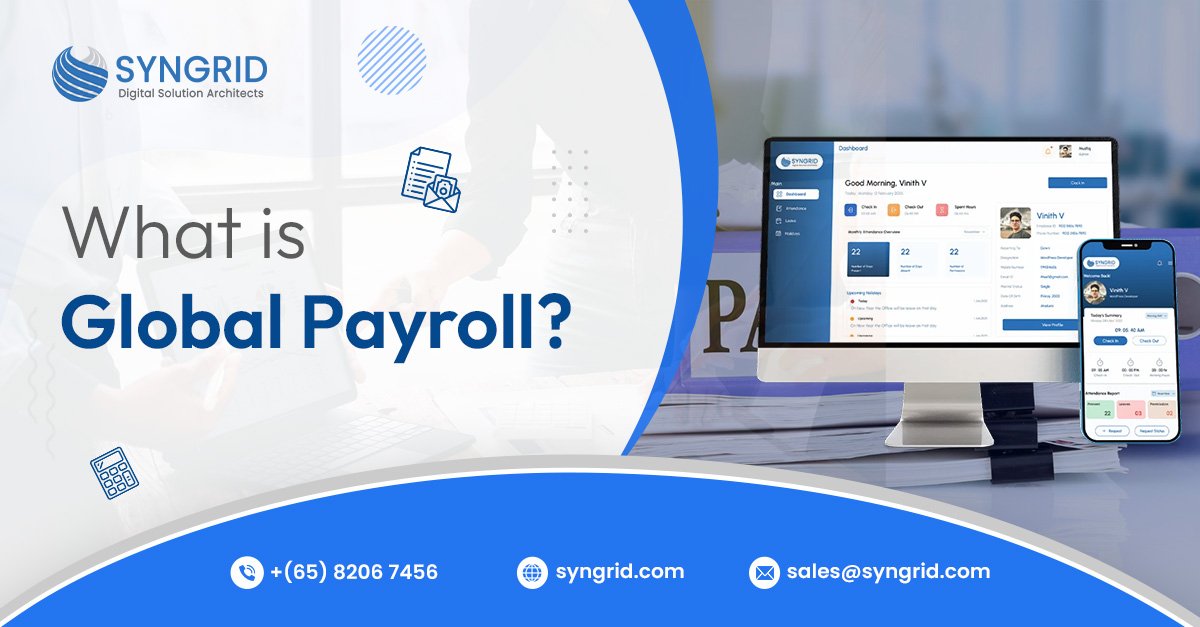
What is global payroll?

Introduction As companies expand across borders, managing employee payments across multiple countries becomes increasingly complex. Different tax regulations, salaries in multiple currencies, data security laws, holiday entitlements, and cultural expectations make payroll management a demanding task. This is where a global payroll system becomes crucial for businesses aiming to pay international teams accurately, on time, and in full compliance. Syngrid Technologies supports companies in streamlining international payroll operations with high-accuracy processes and global payroll expertise. What is global payroll? Global payroll refers to the centralized management of payroll for employees and contractors across multiple countries. It covers salary calculation, tax filing, benefits administration, compliance, attendance tracking, holiday management, data protection, and payment distribution—all while following each country’s laws and policies. A global payroll system ensures: Employees are paid correctly and on time in their local currency. Taxes and statutory contributions are handled according to regional laws. Payroll data is collected, processed, and stored securely in one platform. Public holidays, leave quotas, and attendance records are captured in real time for accurate payments. Key Differences Between Global Payroll vs Local Payroll Local Payroll Global Payroll Manages payroll in one country Manages payroll across multiple countries Only one set of tax & labor laws Multiple tax & employment laws Local currency only Multiple currencies Lower compliance complexity High legal & regulatory complexity Simple internal workflows Centralized or hybrid workflows Global payroll is an advanced solution designed for multinational teams, remote companies, and businesses hiring beyond borders. How Global Payroll Works Global payroll processes salaries across countries by managing: Local tax calculations and statutory benefits Currency exchange and payment formatting Data privacy and regional data protection laws Attendance management, shift tracking & overtime calculations Holiday mapping according to each country’s calendar Regulatory reporting and filing deadlines Employee and contractor payout schedules A well-structured global payroll system ensures accuracy, compliance, and smooth salary distribution globally. Common Challenges in Managing Global Payroll 🔹 Regulatory Compliance Across Borders   Every country has unique tax codes, benefits rules, overtime policies, and holidays. Even a small compliance error can result in penalties and legal risks. 🔹 Data Integration Across Systems   If HR, attendance, and finance tools don’t integrate, payroll teams end up wasting time reconciling mismatched data. 🔹 Data Security   Protecting employee information (banking details, IDs, salary records) is essential to comply with GDPR, PDPA, CCPA, and other global data laws. 🔹 Language & Cultural Barriers   Payroll guidelines, leave rules, and reporting formats vary by geography and sometimes by language slowing payroll processing. Why Implement a Global Payroll Management System? A global payroll system enables companies to: Reduce manual work and payroll errors Improve compliance across markets Deliver accurate and timely payments worldwide Maintain transparency with centralized reporting Enhance employee satisfaction through accurate leave and attendance reflection Strengthen data security with secure payroll access How to Implement Global Payroll Processes That Work A strategic global payroll setup includes: Defining payroll & leave policies per region Consolidating payroll and attendance data in one system Configuring compliance rules and automatic tax updates Establishing approval workflows Ongoing payroll audits and reporting analytics 3 Types of Global Payroll Processing Modelsps? Businesses expanding across borders can choose different payroll operating models depending on their workforce size, hiring regions, and compliance requirements. Below is a clear breakdown of the three primary models: 1. In-House Global Payroll This model involves managing payroll internally with a dedicated team and payroll technology. Benefits Maximum control over payroll operations Custom workflows tailored to internal policies Direct access to payroll data Challenges Requires payroll and compliance specialists in every hiring country High operational costs and ongoing training requirements Limited scalability when entering new markets 2. Outsourced In-Country Payroll Providers Here, payroll for each country is outsourced to local agencies specializing in regional payroll compliance. Benefits Strong knowledge of local tax laws and labor regulations Faster setup when hiring in individual countries Reduced compliance risk at the country level Challenges Limited visibility and centralized reporting across global locations Increased complexity when managing multiple vendor relationships Lack of standardization in processes and formats 3. Global Payroll Provider  A global payroll provider manages payroll across all hiring countries through a unified system. Benefits Centralized payroll operations for all global employees and contractors Standardized workflows and consolidated reporting Automated compliance updates for multi-country regulations Challenges Higher initial onboarding and implementation investment Requires internal change management during the transition Best Practices for Global Payroll To maintain efficiency and compliance globally: Track legislative changes for every hiring region Maintain clear payroll, attendance & leave policies per country Conduct periodic payroll audits Train HR and payroll teams regularly Integrate payroll with HR, finance & attendance systems Use automation to reduce manual work Implement secure access controls Offer employee self-service portals for payslips, tax forms & leave requests. How Syngrid Technologies Helps Businesses Simplify Global Payroll Syngrid Technologies provides end-to-end global payroll services with: Centralized payroll processing for international teams Attendance and overtime tracking for accurate salary calculations Holiday & leave management powered by local calendars Automated compliance with regional tax and employment laws Integration with HRMS, ERP & accounting systems Secure payroll infrastructure with encryption and role-based access Real-time reporting for cost analysis and executive visibility Our global payroll services ensure: Timely payments in local currencies Accurate tax and benefits processing Full compliance with cross-border regulations Smooth onboarding & exit workflows Transparent employee payroll experience  We provide our payroll services based on the selected service items—when a business chooses attendance tracking, holiday management, compliance handling, or workforce analytics, Syngrid activates those precise modules for the client. Final Thoughts Managing payroll across multiple countries is challenging—but with the right technology and expertise, it becomes a scalable system that supports global workforce growth.Organizations that adopt a centralized global payroll model gain improved visibility, compliance, accuracy, employee trust, and operational efficiency.   If your business is expanding internationally or managing remote teams, Syngrid Technologies is ready to streamline your global payroll with automation-driven, compliance-focused solutions. Contact Syngrid Technologies today for seamless multi-country payroll and workforce management.

Scroll to Top